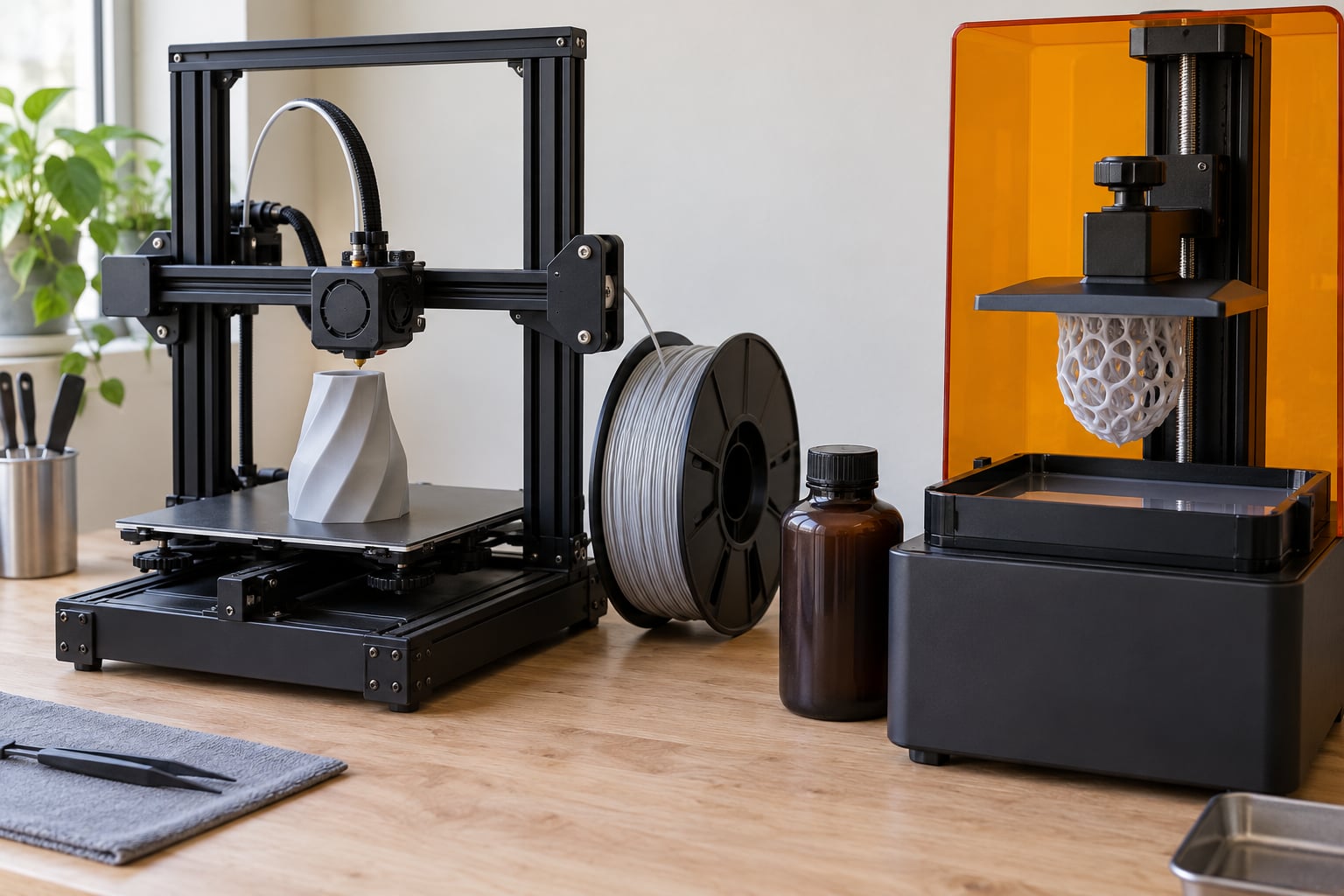
FDM and SLA 3D printing both build a part one layer at a time from a digital model, but they get there in completely different ways. FDM melts thermoplastic filament and pushes it through a heated nozzle. SLA flashes UV light into a vat of liquid resin to harden it, one thin layer at a time. That single difference cascades into surface finish, layer height, strength direction, safety, workflow and cost per part.
The short version: FDM is the safer, cheaper workhorse for larger parts, functional prototypes and everyday thermoplastics. SLA wins on fine detail, smooth surfaces, tight fits and small precision parts. Everything below unpacks where that line actually sits.
Table of Contents
- FDM vs SLA 3D Printing Differences at a Glance
- How FDM 3D Printing Works
- Why FDM parts show visible layer lines
- How SLA 3D Printing Works
- Most printers sold as SLA today are not laser SLA
- Which Technology Produces Better Surface Finish?
- Accuracy and Dimensional Precision
- What accuracy difference actually matters in FDM vs SLA 3D printing?
- Materials and What You Can Print
- Print Speed, Scale, and Productivity
- Cost, Maintenance, and Post-Processing
- Which Should You Choose?
- Frequently Asked Questions
- Is SLA always more accurate than FDM?
- Can FDM produce smooth, watertight parts?
- Are SLA parts stronger than FDM parts?
- Is SLA resin safe to use at home?
- Which FDM vs SLA 3D printing differences matter most for miniatures?
FDM vs SLA 3D Printing Differences at a Glance
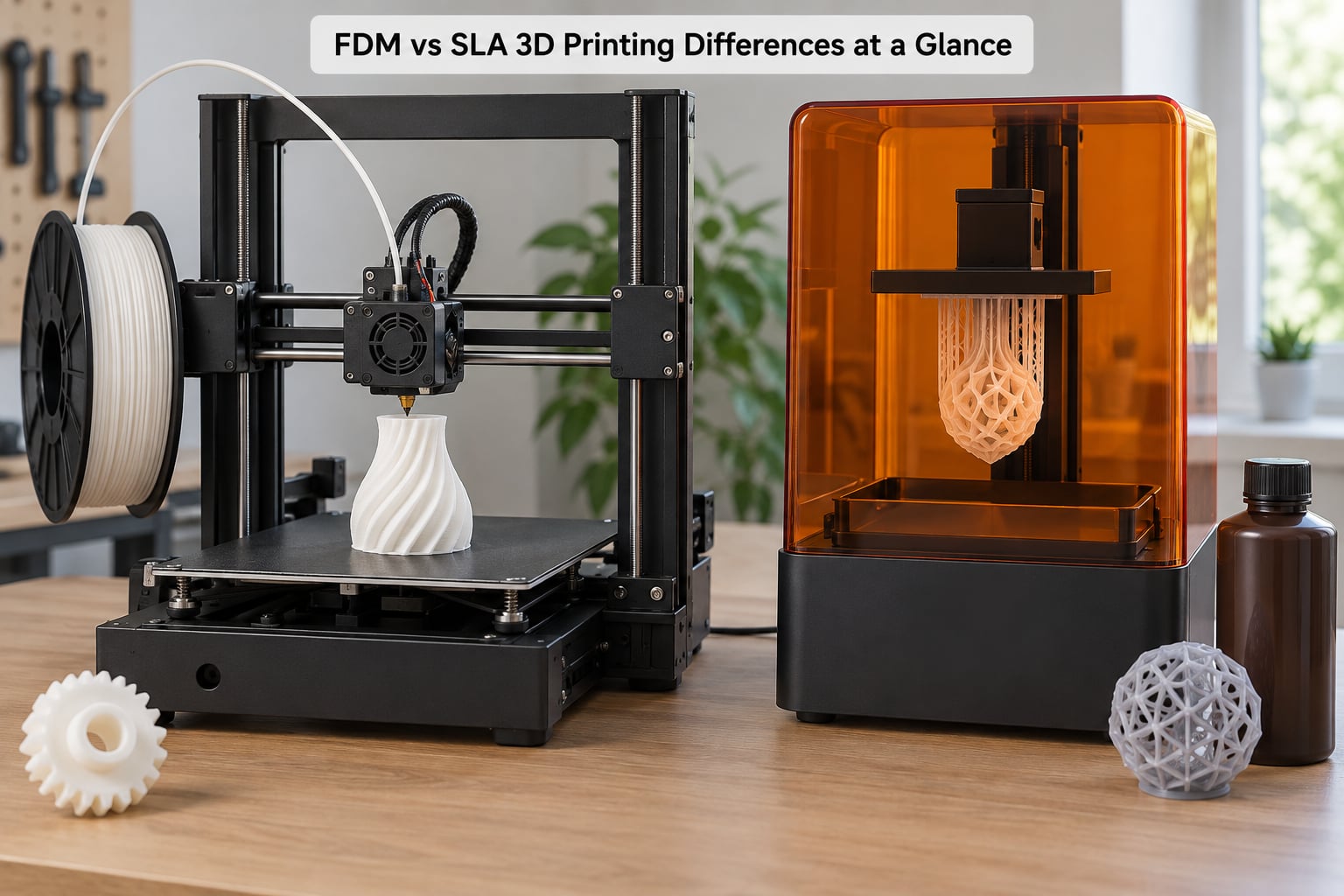
The FDM vs SLA 3D printing differences come down to one thing: whether each layer is physically deposited as molten plastic, or chemically hardened by light inside a vat. Everything else — finish, strength, safety, workflow — follows from that choice.
| Attribute | FDM | SLA |
|---|---|---|
| Printing process | Molten filament is extruded through a heated nozzle | UV light cures liquid photopolymer resin in a vat |
| Material form | Solid thermoplastic filament, usually 1.75 mm or 2.85 mm | Low-viscosity liquid resin |
| Typical layer height | 0.1 mm on a well-tuned machine, up to 0.28 mm for speed | 25 to 50 microns |
| XY resolution | Set by nozzle diameter, commonly 0.4 mm | Set by screen pixel pitch, commonly 35 to 50 microns |
| Surface finish | Visible layer lines, sometimes a seam line | Very smooth, glassy on vertical faces |
| Detail and small features | Good, but limited by nozzle width and movement | Excellent, including thin faces and small text |
| Strength behaviour | Anisotropic: weaker along the layer lines, especially in Z | Isotropic: layers cross-link during curing |
| Supports | Printed in the same material, or soluble PVA or HIPS | Separate support structures, usually same resin, raft on the plate |
| Post-processing | Remove supports, optionally sand and paint | Mask, detach, wash in isopropyl alcohol, UV post-cure, finish |
| Working volume | Commonly larger, with bigger machines readily available | Limited by vat size, usually smaller per machine |
| Consumables and hidden gear | Filament, occasional nozzle and worn PTFE liner | Resin, alcohol, nitrile gloves, filters, silicone mat, wash and cure station, ventilation |
| Working indoors | Almost no special precautions | Ventilation and gloves are not optional |
| Best for | Larger parts, functional parts, jigs, enclosures, high-volume runs | Miniatures, dental models, jewellery patterns, fine detail, presentation prototypes |
How FDM 3D Printing Works
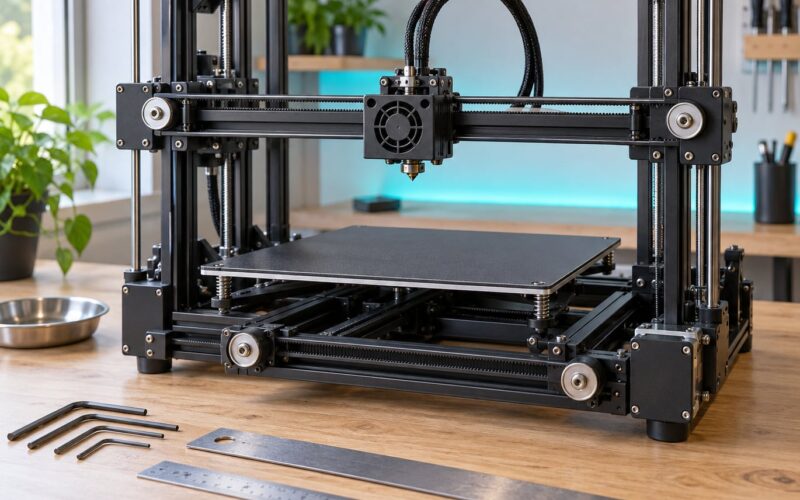
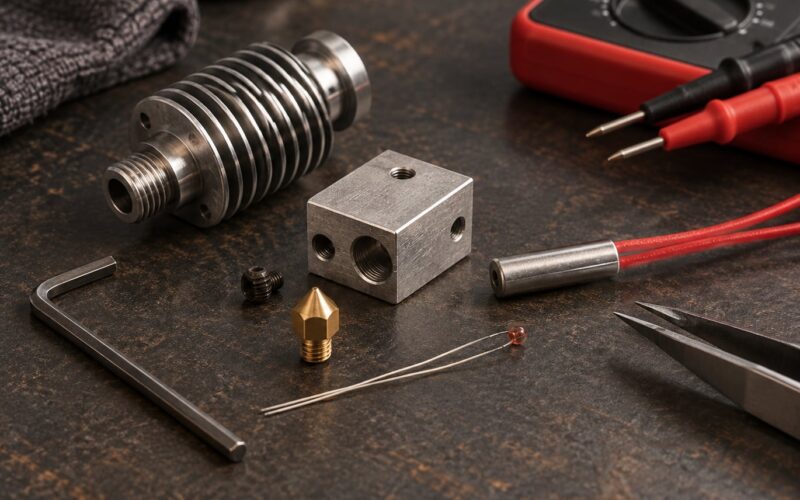
A spool of filament feeds through an extruder into a hot end, where a heated nozzle melts it and deposits a bead of plastic. The printer moves that nozzle in a path for one layer, drops the Z axis by the height of the next layer, and repeats until the part is finished.
Because the bead has real width, the nozzle has to move slightly wider or narrower to cover a wall at that width. Overhangs steeper than roughly 45 to 50 degrees need support structures, which are usually printed in the same filament unless you use a soluble PVA or HIPS support. Bed adhesion is handled with a brim, raft, or adhesive on the build plate.
Temperature control is the whole ballgame. Too cool and the bead doesn’t bond to the layer below; too hot and the plastic droops or strings. Most first-time FDM failures are really temperature or retraction problems, which is why a cheap filament dryer fixes more prints than a new printer does.
Why FDM parts show visible layer lines
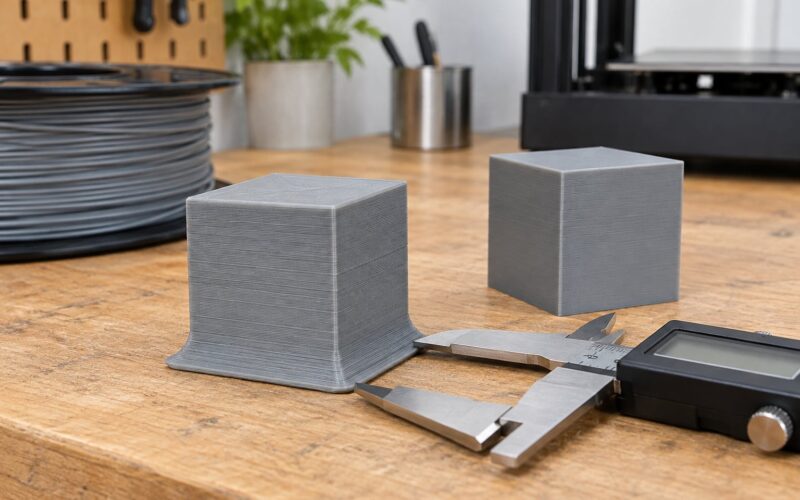
Each layer is a discrete bead laid on top of the last one. The bead edges don’t merge completely with their neighbours, so light catches those ridges and you can see them on curved and sloped surfaces. A fine layer height narrows the steps but also means the nozzle travels further for the same part, so quality and print time trade directly against each other.
How SLA 3D Printing Works
In most SLA machines, the build plate hangs upside down just under the surface of a vat of resin. A light source cures a single thin layer, the plate lifts away, the layer is peeled off, the plate drops back down, and the cycle repeats. A fan or heater keeps the resin at an even temperature, because viscosity changes make a real difference to layer formation.
It’s worth being precise about the last step, because people often assume the finished part is simply dipped in resin. It isn’t. A printed part is still partly uncured, covered in resin residue, and mechanically weak until it has been washed and post-cured. Skip the wash and cure cycle and you get a part that stays tacky, smudges when handled, and embeds uncured acrylate monomer.
Most printers sold as SLA today are not laser SLA
True laser SLA scans each layer point by point. MSLA, DLP and LCD mask printing expose an entire layer at once through a pixelated screen, and that’s what nearly all desktop resin printers use now. It’s faster per layer at typical layer counts, cheaper to build, and produces the same fine XY resolution — with a caveat around Z-axis repeatability, where cheap machines drift more than laser-based ones do.
DLP uses a single projector, while LCD mask uses an LCD or DMD backlit display behind the vat. If a listing just says “SLA”, assume mask printing unless it says laser.
Which Technology Produces Better Surface Finish?
SLA, without much argument. Vertical walls come out smooth and glossy, and there’s no seam line to hide because the resin cures as one continuous surface. FDM always shows some layer texture, and worse along curves, sharp overhangs and support interfaces.
That said, the gap narrows as parts get bigger. On r/PrintedMinis, the recurring observation is that resin’s detail advantage is dramatic on a 32 mm miniature and much less obvious on a 200 mm bust — at that scale the eye picks up overall form rather than surface texture, and FDM’s volume and material options start to matter more.
Finish only matters when it’s part of the job. A display model, a figurine someone will hold, or a jewellery master pattern that gets polished and plated — those are SLA jobs. A bracket for a machine shop does not care about surface texture, and FDM prints that bracket in a fraction of the time with a tougher material.
Accuracy and Dimensional Precision
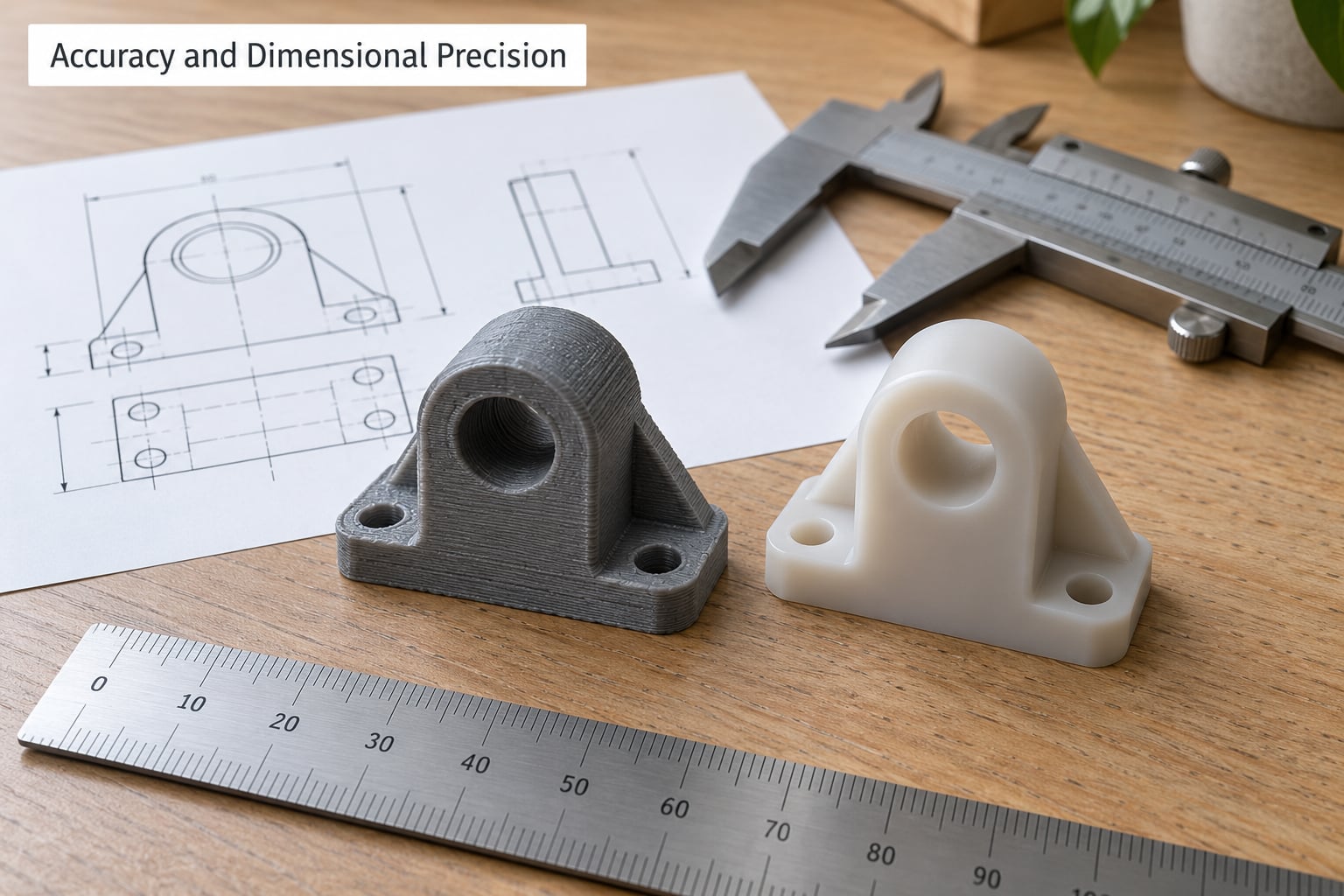
SLA parts hold tighter dimensions, and the gap is large. A well-tuned FDM machine lands in the range of roughly ±0.2 mm, dominated by the 0.4 mm nozzle width. A resin machine can hold ±0.05 mm or better, which is what makes dimensionally accurate threads, press fits and snap-together assemblies realistic on SLA and mostly a fantasy on FDM.
The mechanism matters more than the number. FDM accuracy is bounded by how wide the nozzle is and how precisely it reverses at corners; X and Y move mechanically and vibrate slightly. SLA X and Y accuracy is set by the pixel pitch of the screen, so it’s optical rather than mechanical, and Z is set by how consistently the platform steps down.
What accuracy difference actually matters in FDM vs SLA 3D printing?
It depends on tolerance and orientation, not on the printer label. FDM parts shrink slightly as the hot plastic cools, and they warp when the bed loses adhesion, so accuracy is tied to ambient temperature, enclosure quality and bed prep. Resin cures at nearly constant volume, so shrinkage is small, but a part still deforms if the supports are wrong or the vat is not agitated.
The practical takeaway: for anything with a fit, a thread or a hole that has to line up with another part, choose SLA. For a bracket that bolts to a drilled plate, FDM’s real-world accuracy is fine, and better sheet metal practice would be a bigger win.
Materials and What You Can Print
FDM covers thermoplastic filament, which means you can melt and re-melt a part. PLA is easy and rigid but heat-sensitive. PETG is tougher, slightly stringy and moisture-hungry. ABS and ASA survive heat and UV but need an enclosure because they warp badly in a draught. TPU is a flexible elastomer, and Nylon, PEI and PEEK take heat and load far beyond what resin offers — PA-CF and PET-CF add chopped carbon fibre for stiffness at low layer adhesion.
SLA covers liquid thermoset photopolymers, which cannot be re-melted. Standard grey resin is stiff and brittle. Tough and ABS-like resins add real impact resistance. Flexible resin bends and stretches, high-temperature resin resists heat deflection better than standard, and castable resin burns out cleanly for jewellery and low-volume manufacturing. Nylon-like resins fill the gap for functional parts, though they need careful washing to reach full properties.
The honest summary: FDM wins on material range and on parts that need to flex, absorb impact or survive heat. SLA wins on surface, detail and dimensional precision. And the reason r/3Dprinting users push back on the claim that resin is stronger is here — a grey standard resin part will snap under a load that a PA-CF filament part bends through.
Print Speed, Scale, and Productivity
Headline speed numbers don’t compare between these technologies. FDM is quoted in mm/s of nozzle travel, and SLA in layers per hour, so neither tells you how long a part takes. The better comparison is total time from clicking print to holding a finished part.
On that measure FDM usually wins for large parts. A single machine can run for ten hours unattended and the part comes out done, with support removal as the only cleanup. An SLA print of the same volume may be faster in raw machine time, but you add masking, washing, curing and a lot of fiddly support work before it’s finished.
Scale works the same way. FDM’s usable volume per machine is generally larger, and large-format machines are widely available, so anything bigger than a few hundred millimetres across is mostly an FDM job. Resin wins on throughput per unit of build volume because a whole layer cures at once, and it holds up well for batches of small identical parts. The wash and cure step scales too, so a hundred miniatures means a hundred miniatures to strip, wash and cure by hand unless you invest in bigger washers.
Cost, Maintenance, and Post-Processing
Sticker price is the least useful number. FDM needs a printer, filament and very little else. Resin needs a printer, resin, isopropyl alcohol, nitrile gloves, a wash and cure station, replacement silicone mats and filters, and a ventilation solution, and resin is typically consumed faster per part than filament because supports, raft and failed prints go in the bin.
For maintenance, FDM asks for bed levelling, an occasional new nozzle and a dried spool. Resin asks for a clean vat, a stirrer, consistent temperature, film replacements and a discipline about not touching uncured parts. Most resin breakdowns are process errors rather than hardware failures.
The full resin workflow, and honestly the part people underestimate most:
- Mask the build plate and set the exposure or burn-in test.
- Print, then detach the part and peel off the supports while the part is still soft.
- Wash in isopropyl alcohol, agitating it, then cure any remaining supports off and wash again.
- Run a full UV post-cure so the part hardens all the way through and comes off the plate cleanly.
- Finish it — sand, prime, paint, or leave it raw if the material suits the job.
FDM is three steps: slice, print, remove supports. That difference is where the time and the headache go.
On safety, uncured liquid resin is an irritant and a potential skin sensitiser, and many formulations give off odour. Wear nitrile gloves whenever you handle liquid resin, pour a fresh vat outdoors, and run the printer in a separate ventilated room if you can. In a shared space, an activated-carbon exhaust filter or an enclosure venting outdoors makes the difference between an annoying room and a workable one — several people on hobbyist resin forums describe the smell as the single thing that stopped them printing indoors. Always read the safety data sheet for the specific resin, since formulations differ. Fully cured resin is largely inert, but incomplete curing leaves uncured monomer behind, and sanding a cured part throws dust, so vent that too. Dispose of vat resin and alcohol according to local rules rather than down the sink.
Which Should You Choose?
Map the project to the process and the answer stops being vague:
| Project | Better choice | Why |
|---|---|---|
| Miniatures and figurines under about 75 mm | SLA | Fine facial and armour detail, clean bases, thin weapons |
| Large busts and big display models | Either, leaning SLA for finish | Detail gap narrows with size; volume favours FDM |
| Tabletop terrain in kilograms | FDM | Size, build volume and speed dominate |
| Jigs, fixtures and shop brackets | FDM | Tough materials, no wash step, cheap to iterate |
| Loaded functional parts | FDM with PA-CF, PET-CF or tough filament | Impact resistance and toughness beat standard resin |
| Jewellery master and casting patterns | SLA | Fine detail, smooth finish, minimal post-processing |
| Dental and orthodontic models | SLA | Dimensional accuracy and surface quality |
| Snap-fit assemblies, threads, press fits | SLA | Tighter tolerances than any extrusion process |
| Cosplay props and masks | FDM | Size, low cost, easy to sand and fill |
| Watertight vessels or fluid paths | SLA | Cross-linked layers seal; FDM layers can leak |
If you already own an FDM machine, a resin printer is the most common upgrade, because it opens the category you genuinely can’t reach otherwise. If you’re starting from zero and your projects are functional, buy FDM. A lot of people end up owning both, splitting the work the way a professional fleet does: FDM for large rugged jobs, resin for detail work. As for the widely advertised “highest quality” resin printer, quality is decided by pixel pitch, Z-axis repeatability, motion accuracy, build volume and resin agitation rather than by the badge on the box.
Frequently Asked Questions
Is SLA always more accurate than FDM?
No, but it is usually close enough that you stop arguing about it. A well-tuned FDM machine holds roughly plus or minus 0.2 mm, limited mostly by the 0.4 mm nozzle. Resin machines commonly manage plus or minus 0.05 mm because XY detail is set by screen pixel pitch rather than mechanical movement. For press fits, threads and mating parts, resin is the right answer. For a bracket that bolts to a drilled plate, FDM is accurate enough.
Can FDM produce smooth, watertight parts?
Smooth, yes. Watertight, sometimes, but it is not the default. Layer lines can be sanded and filled down to a decent finish, and printing at a finer layer height plus higher temperature helps. For genuinely sealed parts such as fluid fittings or vessels, resin is more reliable because cured layers cross-link into one body, while FDM relies on diffusion between thermoplastic layers. Vase mode in FDM avoids the problem entirely by printing as a single continuous spiral.
Are SLA parts stronger than FDM parts?
Depends on which direction you load them. Resin is isotropic, so a part is equally strong on every axis, which is why it holds up well in tension. FDM is anisotropic: the bead-to-bead bond between layers is much weaker than the material itself, and a part can lose most of its strength when pulled apart along Z. That said, a standard grey resin part is brittle and will shatter where a tough FDM filament bends without breaking.
Is SLA resin safe to use at home?
Yes, with controls. Wear nitrile gloves whenever you handle liquid resin, pour a fresh vat outdoors, and run the printer in a ventilated room or with an activated-carbon exhaust filter if you share the space. Wash parts in isopropyl alcohol with ventilation, and complete the full post-cure cycle before handling a part bare. Uncured resin is an irritant and potential skin sensitiser; fully cured resin is largely inert. Read the safety data sheet for your specific formulation.
Which FDM vs SLA 3D printing differences matter most for miniatures?
Surface finish and small-feature detail decide it. Resin reproduces thin facial features, hair, chainmail and small text cleanly, and thin overhanging islands are far easier to support on a resin build plate than on FDM, where they often need awkward sacrificial geometry. The resin advantage shrinks noticeably as the model gets larger, so for a big bust FDM with a fine layer height and good cooling is a perfectly reasonable choice.
The bottom line: choose FDM if the part is large, functional, heat-exposed or you plan to make several. Choose SLA if it is small, detailed, dimensionally fussy, or going to be looked at closely. The technology is not the decision — the part is, and once you name the part the answer is usually obvious.