To dispose of leftover 3D printing resin, cure it until it is completely solid, then scrape the solid into your household trash. Never pour liquid resin, resin-contaminated isopropyl alcohol, or resin rinse water down a drain. Most people end up with a few millilitres of old resin, a jar of dirty IPA, and a pile of resin-soaked wipes, and each of those needs a different route.
The whole method takes an afternoon, plus whatever time the curing needs. Most of it is waiting, and the waiting is the part that makes it safe. People who rush this end up with sticky solids, a hot bucket of resin, or a blocked trap, and all three are avoidable.
I have made every mistake on this list in a small home studio, including curing a sealed jar that got uncomfortably warm, so treat the warnings below as earned rather than theoretical. What matters is that only cured solid resin goes in the bin, and everything else follows the label and your local council’s rules.
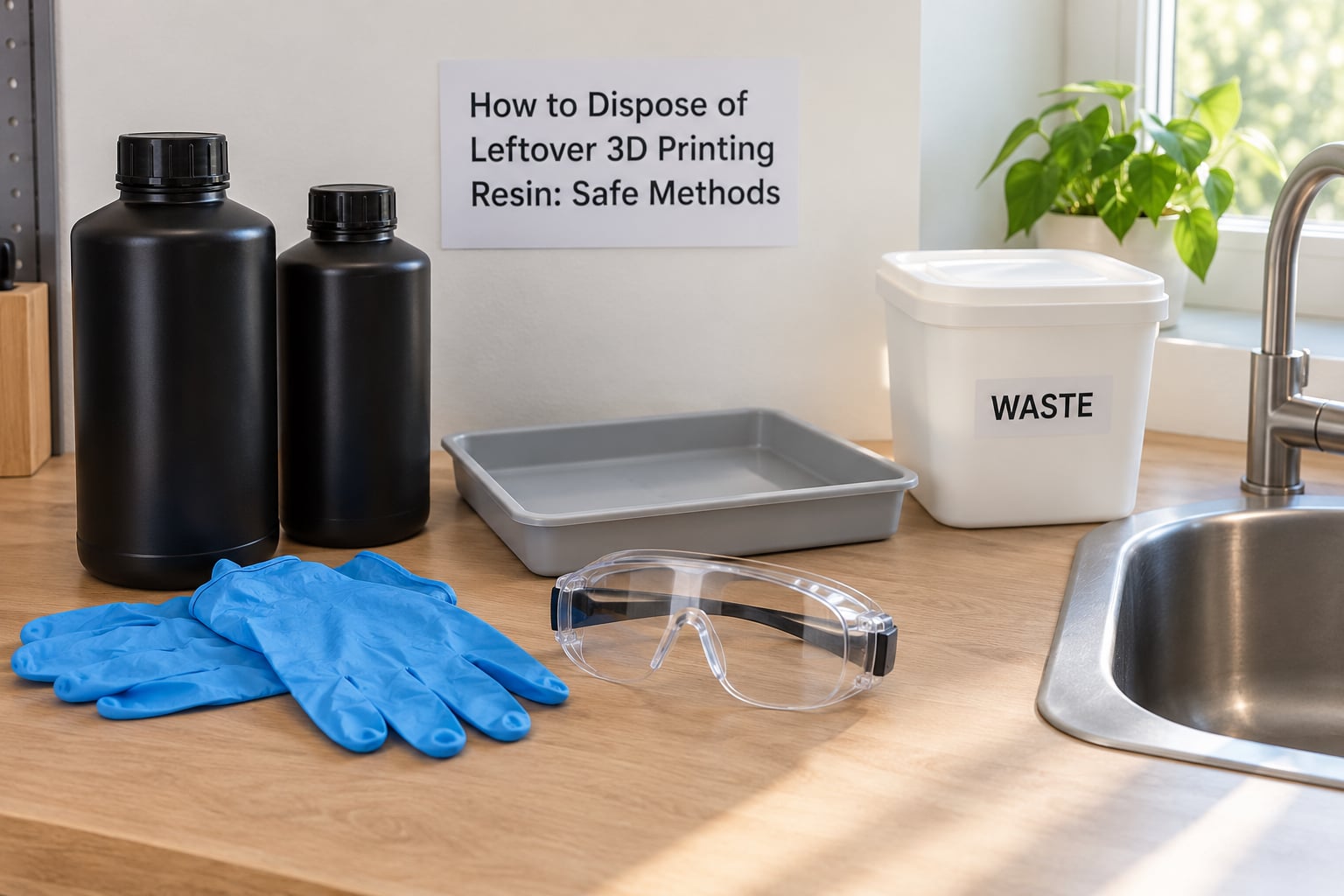
Table of Contents
- What You Need
- Step-by-Step: How to Dispose of Leftover 3D Printing Resin
- Identify What Kind of Resin You Have
- Check the Resin and Local Waste Rules
- Protect Yourself and the Work Area
- Cure Leftover 3D Printing Resin Before Solid Disposal
- Recycle Resin Only When the Manufacturer Allows It
- Dispose of Containers, Supports, and Contaminated Materials
- Common Mistakes
- Frequently Asked Questions
- Can resin go down the drain?
- Is resin still toxic after curing?
- How long do you cure resin under UV light?
- When is it safe to dispose of resin rinse water?
- Can I mix old resin with new resin to use it up?
- Are empty resin bottles and failed prints recyclable?
- Conclusion
What You Need
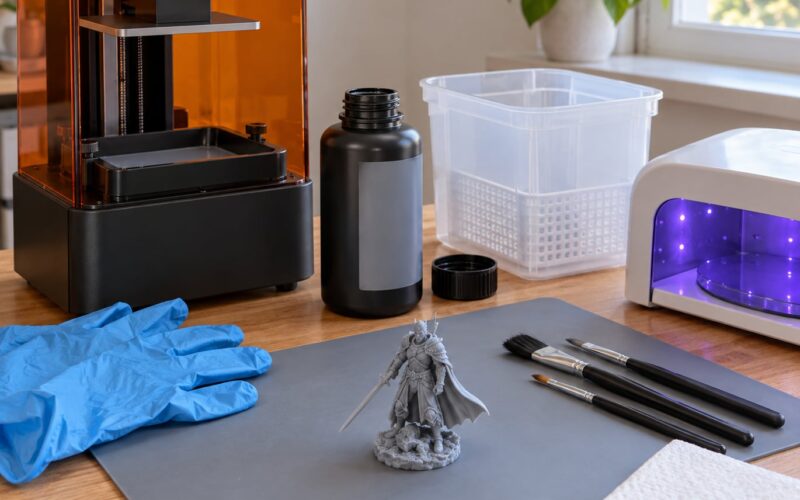
Gather your protection first, then your containment. Handling uncured resin is a twenty-minute job if everything is within reach and a half-hour scramble if it is not.
- Nitrile gloves for every pour and wipe-down. Latex is not good enough for acrylate monomers.
- Safety goggles and a lab coat or old long-sleeved shirt.
- Good ventilation, ideally a fume cupboard or a fan drawing air away from your face. Do not work in a closed room with an open jar.
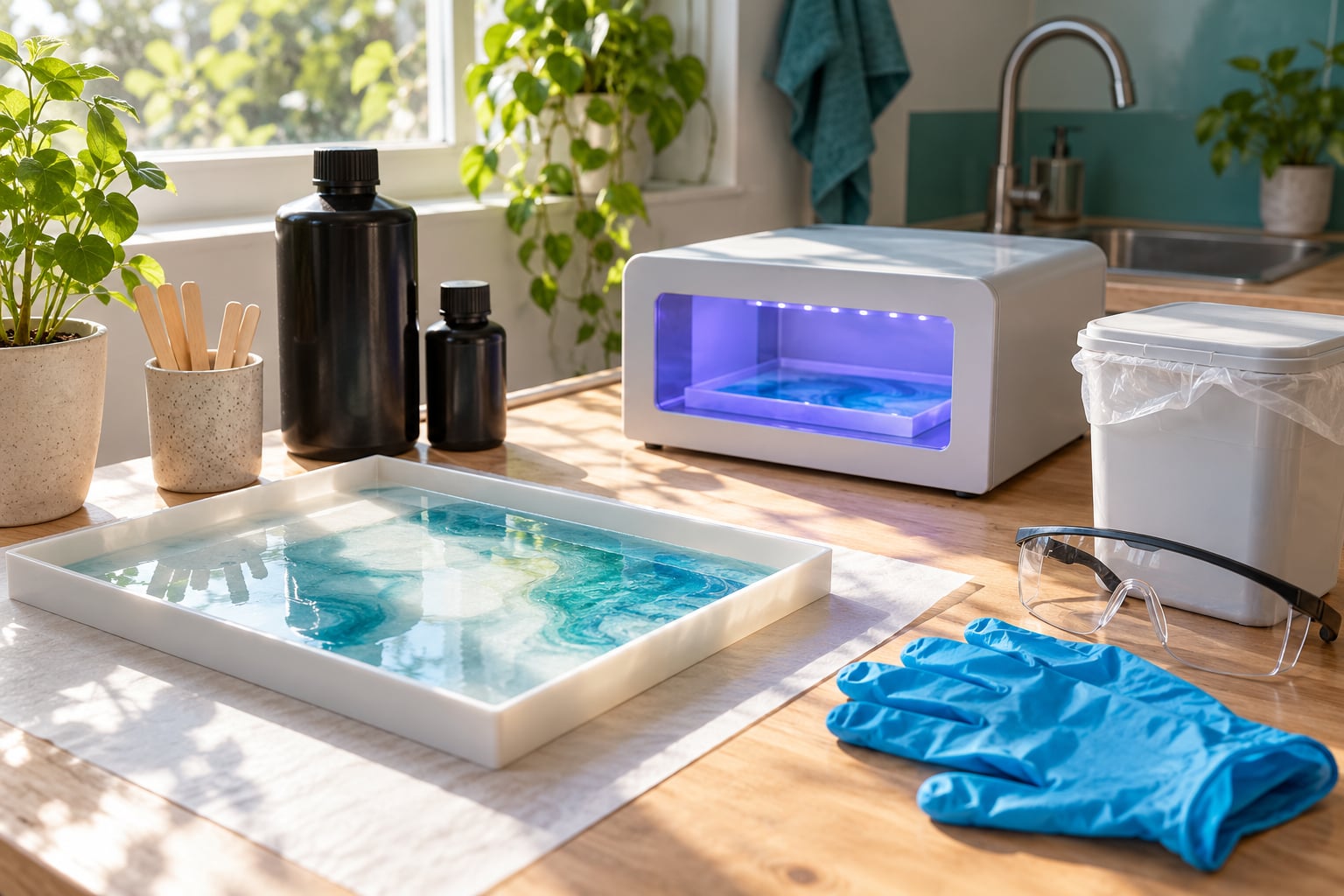
- A shallow, clear, open container such as a silicone curing tray, a wide glass jar, or a takeout tub. Wide and shallow beats deep, because you need light to reach the whole surface.
- A UV light box, UV flashlight, or a sunny windowsill to cure with.
- A funnel and a spare sealed container for transferring resin without spilling.
- Absorbent material such as paper towels, cat litter, or uncoated paper for containment of small spills.
- A dedicated, labeled waste container with a lid for anything you cannot cure to a solid.
- The safety data sheet (SDS) for your specific resin, on your phone or printed out.
Label the waste container with the resin name and the date. If anyone else touches that container, they will know exactly what is inside and how old it is.
Step-by-Step: How to Dispose of Leftover 3D Printing Resin
The route depends on one thing above all else: whether the resin is cured or uncured. Everything else, from whether you can recycle the container to whether a drop-off centre will take it, follows from that single distinction.
Identify What Kind of Resin You Have
Sort what you have into separate containers before you touch any of it. Mixed resin is still uncured resin, and cured parts mixed into liquid resin still need the liquid dealt with first.
Then route each waste stream the way it should go.
| Waste stream | Acceptable route | Never do |
|---|---|---|
| Unused liquid resin, never mixed | Cure in a shallow open container until hard, then household trash; or return to manufacturer take-back if offered | Pour it down a sink, toilet, or storm drain |
| Partially mixed or pigment-settled resin | Cure completely as above; check the SDS because some filled resins need a different route | Put it in household trash while liquid |
| Resin mixed with printed parts, supports, or rafters | Separate the solids, cure or set them aside, cure the remaining liquid, then cure and trash the solids | Bin the pieces while they are still tacky |
| Fully cured solid resin | Household trash, once no longer liquid or tacky | Recycle it in your curbside plastics bin |
| Isopropyl alcohol containing dissolved resin | Filter out cured solids and keep reusing the alcohol; take the remainder to household hazardous waste | Pour it down a drain or into the trash |
| Rinse water from washing prints | Cure the settled resin solids first, then dispose of the water as directed on the resin label | Assume clear water is safe just because it looks clear |
| Nitrile gloves, paper towels, silicone mats, filters | Cure in sunlight or under UV until the resin is solid, then household trash | Bag them while still wet |
| Empty resin bottles and cartridges | Wash, then check the resin recycling program offered by your supplier or the manufacturer | Reuse a bottle for another liquid, or bin it if it still holds residue |
| Failed prints and support structures | Cure fully if they are still soft, then household trash | Reuse them while they smell of acrylate or bend like rubber |
Cured solids are handled as ordinary solid waste. Uncured liquid resin is not, and neither is solvent with resin dissolved in it. That is the whole rule.
Check the Resin and Local Waste Rules
Open the safety data sheet for your resin and read the disposal section before you do anything else. Resin formulations differ, so the manufacturer’s guidance beats any general guide, including this one.
Then check local rules. Waste handling varies by council, municipality, and state, and what a household hazardous waste day accepts in one place may not be accepted in the next. A phone call to your local waste collection center answers the question in a minute and saves you from a rejected bin.
Two things worth knowing. Under the US Resource Conservation and Recovery Act (RCRA), generators of hazardous waste can carry obligations that hobby printers often do not realise, and clinics or labs usually route waste through a licensed treatment, storage and disposal facility (TSDF). And do not assume a paint or varnish waste code covers resin; those codes assume different chemistry.
Protect Yourself and the Work Area
Put on nitrile gloves and goggles before you open anything, and work somewhere the resin cannot reach a drain. Cover the bench with a disposable sheet or silicone mat you are willing to lose.
Pour slowly into a shallow container, letting it run down the side rather than dropping straight in. A funnel and a steady hand beat a fast pour every time.
One warning worth taking seriously: curing resin releases heat, and this is exothermic. A sealed jar of thick resin left in direct sun can get hot enough to deform or burst. Leave every container open and shallow, and never cure more than a few centimetres of depth at a time.
Cure Leftover 3D Printing Resin Before Solid Disposal
Curing works because photopolymer resin hardens when it receives light in the right wavelength range. Spread the liquid no deeper than a few millimetres, leave it open, and give it light until the whole surface is firm.
| Method | Indicative time | Good for | Watch out for |
|---|---|---|---|
| UV light box | 5 to 15 minutes for a thin layer | Fast, controlled, works indoors | Use UV-rated eye protection if the box is open-topped; check wattage and wavelength against your resin |
| UV flashlight | A few minutes per pass, several passes | Small quantities when no box is available | Coverage is uneven, so move it slowly over the whole surface |
| Direct sunlight | 1 to 3 hours in strong sun for a thin layer; several hours or overnight for thicker resin or cloudy conditions | Free, effective, the community default | Glass blocks some UV, so use an open window rather than a closed one |
| Warm or hot water | 30 to 60 minutes for water-washable resin | Water-washable and water-cured resins only | Only follow this if the resin manufacturer allows it; the water itself still needs handling |
These are ballpark figures for a thin layer, not a substitute for your resin’s instructions. Deep volumes, cold weather, and overcast days all push the times up.
How do you know it is cured? Press a fingertip firmly into an edge. If it dents, it is not done. When the surface is completely hard, non-tacky, and no longer smells of sharp acrylate, it is finished. Scrape or shred the solid and put it in the trash.
For gloves, towels, and silicone mats, spread them out in the sun so light reaches both sides, or stack them loosely rather than folding them into a wet ball. Solid cured resin peels off silicone cleanly, which is the main reason people buy those mats in the first place.
Recycle Resin Only When the Manufacturer Allows It
Recycling resin is possible, but only through routes the manufacturer actually sets up. Some suppliers run a take-back or recovery program for unused resin, and a few specialist recyclers accept cured and uncured photopolymer waste.
Household curbside plastic recycling is not one of those routes. Photopolymer resin does not melt and flow like PET or HDPE, so it contaminates the bale it ends up in, and a bottle with cured residue stuck in it is not clean enough for the stream.
If a program exists for your resin, follow their instructions. If you cannot find one, cure and trash, and stop there rather than experimenting.
Dispose of Containers, Supports, and Contaminated Materials
Containers first. Rinse bottles and cartridges, let them dry fully, and check whether your supplier or the resin manufacturer runs a recycling program; some accept emptied cartridges by post. If no program exists, put the empty container in household recycling or trash according to your local rules, once it is dry and residue-free.
Supports, rafters, and failed prints get cured first. If they are still soft or bendy, lay them flat in sunlight until they are hard. Fully cured parts go in household trash and are not reusable as material.
Contaminated isopropyl alcohol is the hardest stream to get rid of. Filter it through a fine mesh or coffee filter to catch cured solids, keep the clean alcohol for the next wash, and expect to repeat the filtering every few cycles. When the alcohol is too dark or too contaminated to reuse, it goes to household hazardous waste, not the sink. Users on printing forums do report diluting small amounts of genuinely clean, never-used IPA down a drain with plenty of running water, but resin-contaminated alcohol is a different material and should not be treated that way.
Water wash water is its own stream again. Let the resin particles settle, cure and remove the solids, then follow your resin’s instructions for the water itself. Clear-looking water is not proof of safety, because dissolved resin is exactly what you cannot see.
Finally, masks, nitrile gloves, filters, and spent nitrile gloves go through the same cure-then-trash route as everything else. Throw them into the sunlight, wait until hard, then bin them.
Common Mistakes
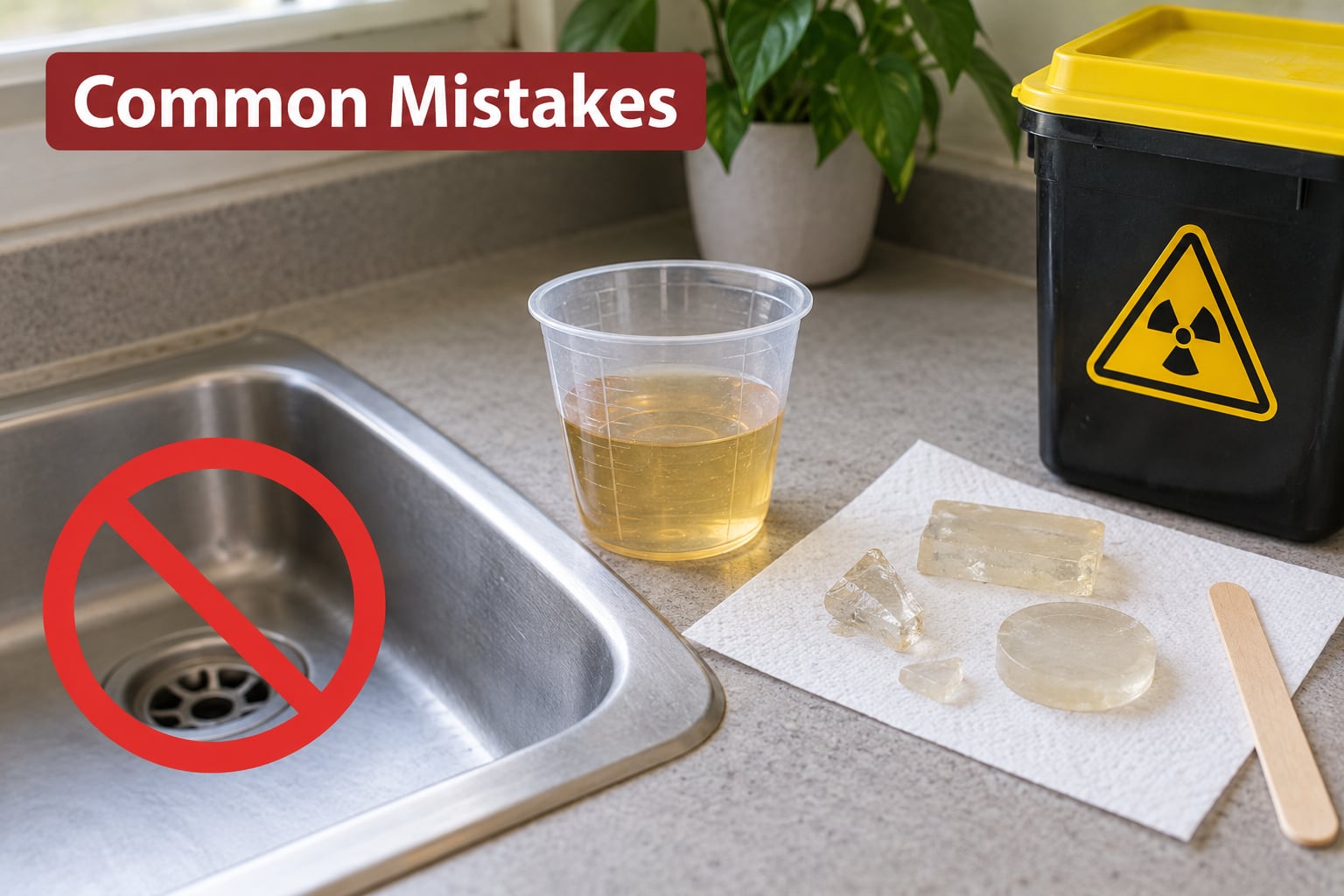
Almost every resin disposal problem traces back to one of these. None of them are hard to avoid once you know them.
- Pouring resin down the sink or toilet. It solidifies inside the trap and the pipework, and it carries hazardous waste into the sewer and the water supply. This is the single most common mistake.
- Putting liquid resin in household trash. It leaks, it sticks to everything, and it will cure in the bin and coat whatever is next to it.
- Binning resin before it is fully cured. If it dents under a fingernail or leaves a mark on paper, it is still liquid. Give it more light and more time.
- Sealing warm resin in a closed container. The cure is exothermic. Open, shallow containers only.
- Flushing contaminated IPA or wash water. Unused resin in the water is still uncured resin, however clear the water looks.
- Ignoring the safety data sheet or your local council. Household hazardous waste rules differ by area, and a rejected bin is a problem you inherit later, possibly in someone else’s house.
And if you already poured resin down the drain, do not keep pouring water after it and hope. Stop using that drain, note how much went in and roughly when, and call your local wastewater authority or a plumber. Small amounts in a household sink are usually manageable once the trap is removed and cleaned, but only a professional can tell you whether the line to the street is clear. Contain what you can, and tell the truth if anyone asks.
One last piece of advice I would give anyone starting out: reuse before you dispose. Top up old resin with fresh resin if your printer allows it and your resin manual permits blending, and keep filtering IPA until it genuinely stops doing its job. Every litre you never have to throw away is one less container of liquid waste to manage.
Frequently Asked Questions
Can resin go down the drain?
No. Never pour uncured liquid resin, resin-contaminated isopropyl alcohol, or resin rinse water down a sink, toilet, or storm drain. Resin can solidify inside the trap and pipework and block it, and it introduces hazardous waste into the sewer and waterways. Cure liquid resin to a solid first, then place it in household trash. Contaminated IPA and wash water go to household hazardous waste unless your local authority says otherwise.
Is resin still toxic after curing?
Cured resin is far less hazardous than liquid resin because the acrylate monomers have reacted and are locked into a solid polymer. It is still a chemical solid, not harmless food-grade material, so keep it away from children and pets, and do not use it for anything intended to touch food or skin. The hazard that matters most, skin irritation and sensitization, comes from uncured liquid resin and from solvent-contaminated waste.
How long do you cure resin under UV light?
For a thin layer of leftover liquid resin, a UV light box typically takes five to fifteen minutes. Deeper pours, thicker resin, or an open-topped box with uneven coverage take longer. Move a UV flashlight slowly across the surface for a few minutes per pass rather than holding it still. The real test is not the clock but the result: the resin must be hard all the way through and leave no mark when pressed firmly with a fingertip.
When is it safe to dispose of resin rinse water?
Only after the resin in it has been cured and removed. Let the rinse water stand so particles settle, expose those particles to sunlight or UV until they are fully solid, then collect and trash them. After that, follow your resin manufacturer’s instructions for the remaining water, because rules differ between standard and water-washable resins. Water that looks clear can still contain uncured resin, so treat it as liquid waste until you have removed the solids.
Can I mix old resin with new resin to use it up?
Sometimes, with care. Some printers allow topping up old resin with fresh resin, but only if your machine accepts partial cartridge or vat refills and your resin manual permits blending. Different chemistries, colours, and ages do not always mix well, and old resin that has thickened or picked up dust will print badly. Never mix resins from different brands or types for a load-bearing or safety-critical part. If in doubt, cure and trash it instead.
Are empty resin bottles and failed prints recyclable?
Empty resin bottles and cartridges are recyclable only through a program run by the resin manufacturer or your supplier, because the cured residue makes them unacceptable for curbside plastic recycling. Rinse them and let them dry fully first. Failed prints and supports are cured resin and are not recyclable through household streams; once fully hardened, they go in household trash. Many people also reuse good supports as future rafters or scrap tools once they have cured completely.
Conclusion
Start by identifying what you have, then read that resin’s safety data sheet before anything else. Cure liquid resin in a shallow, open container until it is completely hard and non-tacky, and only then scrape it into household trash.
Contaminated isopropyl alcohol and rinse water follow their own routes, and both need the solids removed first. Whatever you cannot cure to a solid goes to your local household hazardous waste facility. Never let liquid resin reach a drain, and check with your council, since the rules differ and this guidance is current for 2026, not permanent.