For any part that lives in sun, rain, or a hot car, choose ASA. ABS is the cheaper, easier option and it holds up fine indoors, but UV light breaks down its rubber phase, so an untreated ABS part yellows, chalks, and turns brittle within months of direct sun. This guide covers ABS vs ASA for outdoor 3D printed parts so you can pick the right filament and print it so it actually lasts.
Last updated October 2026.
Table of Contents
- ABS vs ASA for Outdoor 3D Printed Parts at a Glance
- Which Material Lasts Longer Outdoors?
- What ABS degradation actually looks like over time
- What still matters besides the material
- Heat and Temperature Resistance Compared
- Where heat actually causes failures
- Strength, Toughness, and Layer Adhesion
- Is ASA more brittle than ABS?
- What changes impact strength in practice
- Layer adhesion in vibration
- ABS vs ASA for Outdoor 3D Printed Parts: Printing Differences
- Warping is the real reason people quit on ABS and ASA
- Do you need an enclosure?
- Fumes and ventilation
- Drying and storage
- Surface Finish, Finishing, and Long-Term Protection
- Sanding and smoothing
- How to properly paint ABS for outdoor duty
- Joining ABS and ASA
- Which Should You Choose?
- A short decision checklist
- Frequently Asked Questions
- Is ASA better than ABS for outdoor 3D printing?
- Can ABS be used outside if it is painted or coated?
- Does ASA need an enclosed printer?
- Which filament has the higher heat resistance, ABS or ASA?
- Is ASA weatherproof and waterproof?
- How do I stop ASA and ABS outdoor prints from warping?
- Conclusion
ABS vs ASA for Outdoor 3D Printed Parts at a Glance
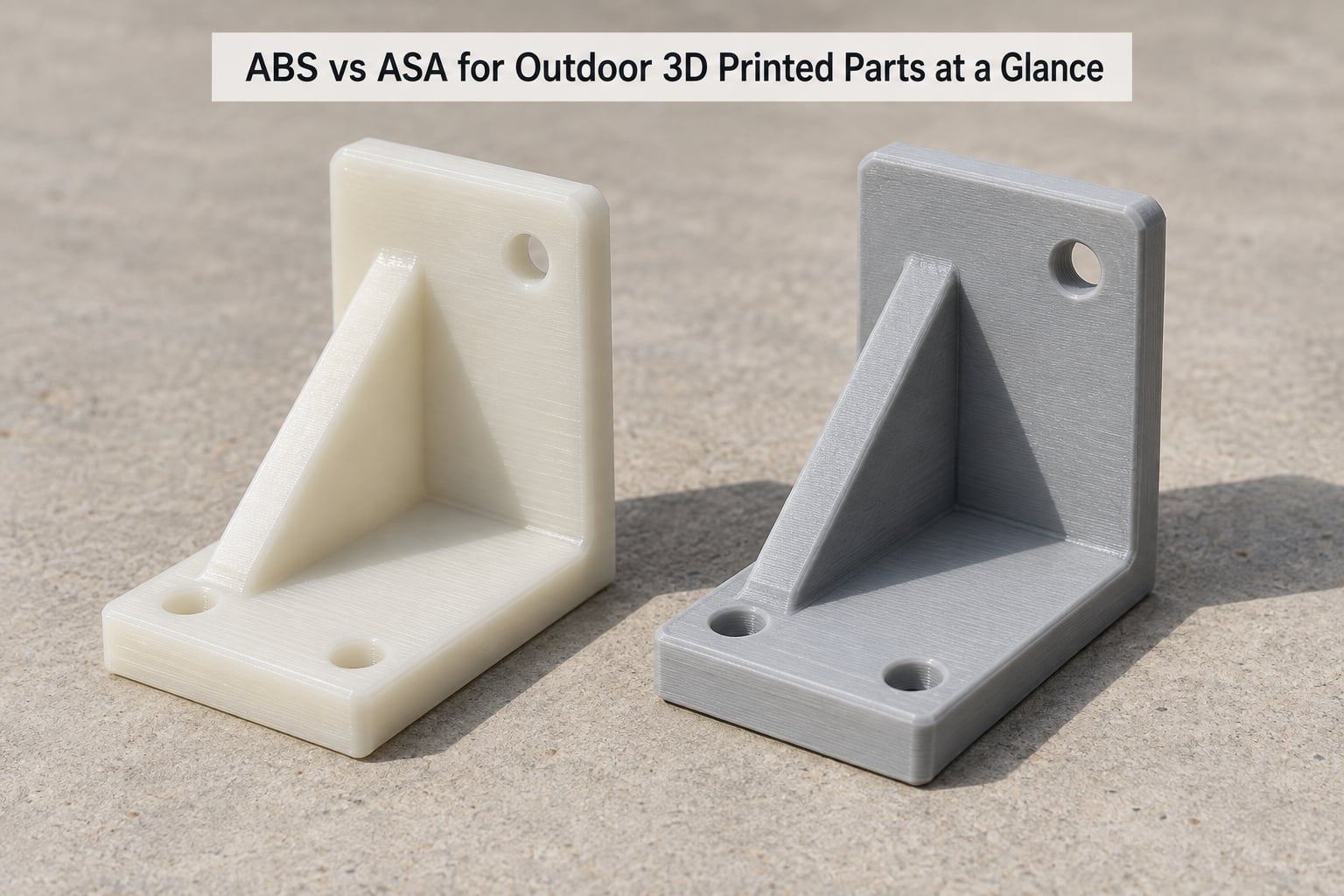
Both materials are styrenic thermoplastics and they print at similar temperatures. The differences show up in long-term exposure and in how much fuss the printer needs.
| Property | ABS | ASA |
|---|---|---|
| UV and weather resistance | Poor. Yellows and chalks in direct sun | Good. Built for outdoor exposure |
| Glass transition temperature | About 105 C | About 100-105 C |
| Impact toughness | Slightly tougher, more forgiving | Very good, slightly crisper |
| Stiffness | Slightly stiffer on paper | Very similar in practice |
| Layer adhesion | Very good | Very good |
| Warpping tendency | Moderate to high | Moderate, usually a touch calmer |
| Print difficulty | Moderate | Moderate, slightly narrower window |
| Enclosure needed | Strongly recommended | Strongly recommended |
| Odor and fumes | Pronounced styrene odor | Lighter styrene odor |
| Moisture sensitivity | Low. Sealed spool stores fine | Low to moderate |
| Paint and filler adhesion | Very good | Very good |
| Cost per kg | Lower | Noticeably higher |
| Best outdoor uses | Sheltered, shaded, coated parts | Exposed brackets, housings, garden and vehicle parts |
Temperatures above are typical published ranges for unfilled filament. Always check the technical data sheet for the specific spool you bought, because brands shift these numbers.
Which Material Lasts Longer Outdoors?
ASA lasts longer outdoors. That is not a marketing claim, it comes straight from the chemistry: ABS gets its toughness from butadiene rubber, and the carbon-carbon double bonds in that rubber are exactly what ultraviolet light attacks. The chains break, and you see it as yellowing first, then a chalky surface film, then a drop in impact strength.
ASA swaps that butadiene rubber for an acrylate rubber that has no such vulnerable double bonds. The result is a material that holds its color and its mechanical properties through the same exposure that wrecks ABS.
What ABS degradation actually looks like over time
In full, unobstructed sun, an unpainted ABS part usually shows visible yellowing somewhere between one and six months. The surface goes matte and chalky after roughly the same window, and cracks tend to start at layer lines or sharp corners rather than across flat faces.
Real degradation is faster than most people expect. Community reports on printing forums describe ABS parts that went yellow and brittle inside a single summer on a south-facing wall, and in my own experience a black ABS bracket on a fence post lost noticeable impact strength well before it lost its color.
Shade changes everything. ABS under a covered porch or inside an enclosure can look untouched for years, because the degradation mechanism needs photons to start. The same part on a south-facing wall in summer sun is a completely different story.
What still matters besides the material
Material choice sets the ceiling, but geometry decides how you get there. Wall thickness, infill percentage, print orientation, and any coating all change real service life as much as the filament brand does.
- Wall thickness. Thin parts lose impact strength first. If a part will be handled or knocked, print at least three perimeters.
- Orientation. Load-bearing layers should run along the load, not perpendicular to it.
- Infill. For functional brackets, 20 to 40 percent gyroid or cubic is plenty. Going denser adds print time and warping risk for little gain.
- Coatings. Any UV-resistant paint or epoxy topcoat buys service life on either material.
There is a contrarian view floating around forums, that nearly any printed part can survive UV and you never need ASA. That holds for a part in permanent shade or indoors. It fails for anything in direct sun, and the field reports from makers who left ABS out over a summer are hard to argue with.
Salt is the other exposure that gets overlooked. Neither styrenic is a marine-grade material, and neither should hold a load underwater continuously. For boat hardware above the waterline, unfilled ASA is the reasonable pick, with ASA-CF worth considering when the part needs to stay rigid without flexing.
One thing that changes the economics: ASA filament usually runs roughly 20 to 30 percent more per kilo than ABS, but a coated ABS part that needs replacing every season costs more in material, print time and your own evenings than a single ASA part that sits there for years. Judge cost over service life, not per spool.
Heat and Temperature Resistance Compared
The heat story is closer than most comparisons suggest. Both polymers soften at roughly the same glass transition temperature, around 100 to 105 C for unfilled filament, which means neither one is a good choice for a hot engine bay or an exhaust-adjacent mount.
ASA usually sits a little lower on the glass transition scale than premium ABS, so a part in sustained heat near those temperatures can creep in either material. In real outdoor use this rarely decides the choice, because a sun-heated part in summer rarely reaches anything close to 100 C.
Where heat actually causes failures
The more common heat failure is thermal cycling rather than peak temperature. A bracket on a south-facing wall expands every afternoon, contracts every night, and a brittle part cracks at the hole where the stress concentrates.
Dimensional stability also drops sharply above the glass transition point. A part that fits a snap-fit or a press-fit tolerance tight on the bench can be loose after a hot afternoon, and the same tolerance issue shows up on ABS parts that creep under a constant clamp load.
If your part genuinely needs to live above roughly 100 C, neither of these is the right material and you should look at polycarbonate, PC blends, or nylon instead.
Strength, Toughness, and Layer Adhesion
Stiffness and toughness are different things, and most confusion in this comparison comes from mixing them up. ABS and ASA are both fairly stiff styrenics with good layer bonding, and the gap between them is small enough that most functional parts will never reveal it.
Is ASA more brittle than ABS?
ASA is not meaningfully more brittle than ABS. The rumor that ASA snaps more easily comes from print settings rather than the material, because ASA is often printed at the low end of its range with a closed chamber and low fan, which produces a crisper, less rubbery surface layer.
Turn the fan up a little, drop the nozzle temperature within the filament’s own range, and you get a surface with a bit more give. Print both at the same temperatures, same fan, same walls, and the impact behaviour of the two is close.
What changes impact strength in practice
- Fan percentage. More cooling on ASA and ABS means better layer bonding and a less brittle result. Too much cooling on a small layer height causes splitting.
- Nozzle temperature. Printing near the middle of the recommended range gives the strongest layer adhesion in both materials.
- Perimeters. Shell thickness is the single biggest lever for a part that gets dropped or knocked.
- Grade. Filled variants such as ASA-CF and ABS-CF are stiffer and often less forgiving of impact, because the fibers do not absorb energy the way unfilled rubber does.
Layer adhesion in vibration
For anything that lives on a vehicle, a bike, or a drone frame, layer splitting is the failure to watch for. Both materials bond well, and neither will surprise you here as long as the nozzle is hot enough and the part is not being printed at extreme speed with heavy cooling.
The practical takeaway: if a part will see hard knocks, print more walls before you reach for a different polymer. Three or four perimeters and moderate infill will outperform a thin-walled part in a tougher material every time.
ABS vs ASA for Outdoor 3D Printed Parts: Printing Differences
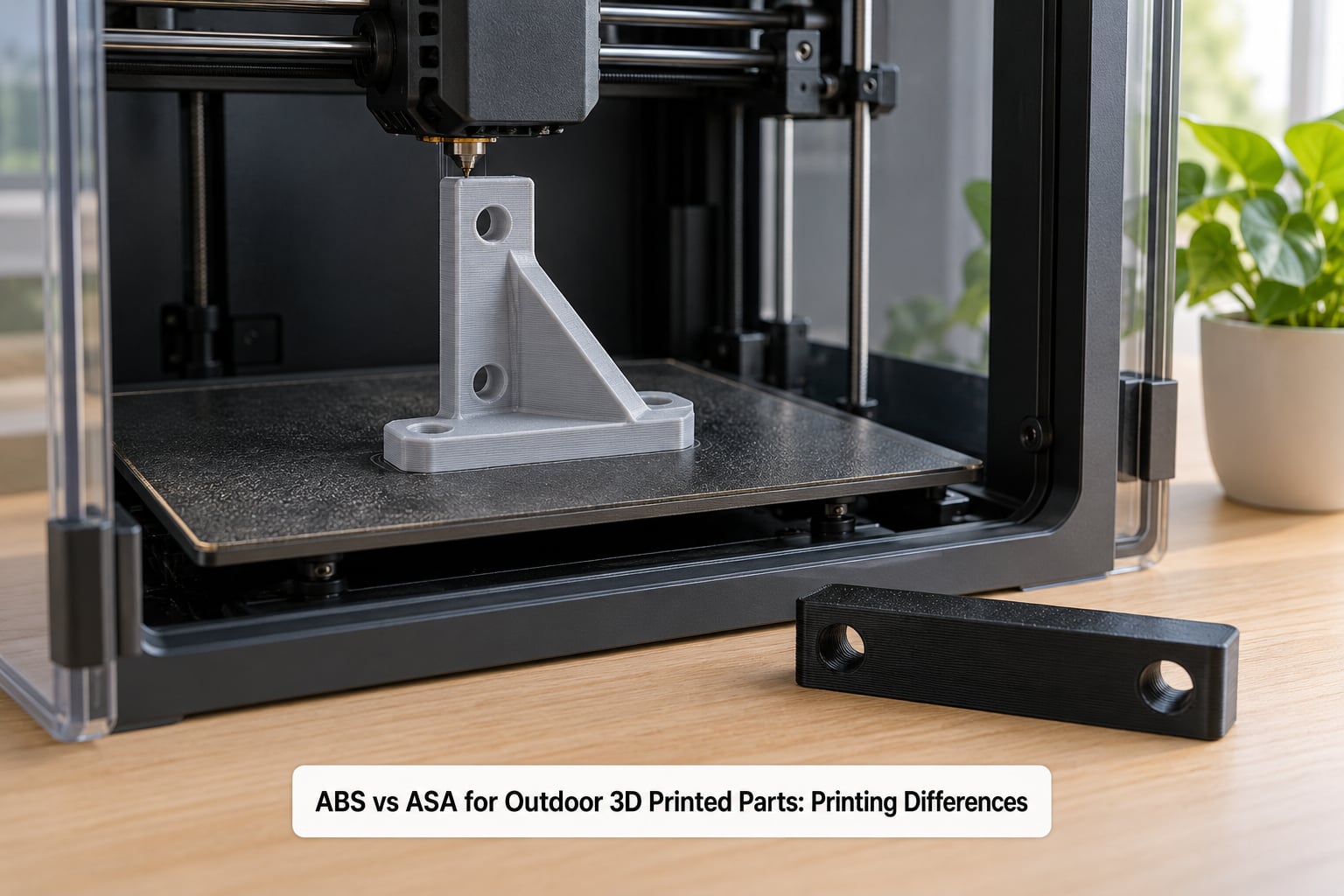
Printing these two materials is close enough that a slicer profile for one will start the other. The differences are small enough that you should verify actual temperatures against the filament you bought rather than trusting a generic profile.
| Setting | ABS | ASA |
|---|---|---|
| Nozzle temperature | 240-260 C typical | 240-270 C typical |
| Bed temperature | 90-110 C | 90-110 C |
| Chamber temperature | 40-60 C helps a lot | 40-60 C helps a lot |
| Part cooling fan | 30-50 percent | 20-40 percent |
| Enclosure | Recommended for large parts | Recommended for large parts |
| Bed surface | Textured PEI sheet or similar | Textured PEI sheet or similar |
| Dry before printing | Not usually required | Optional, check the spool |
All ranges are typical for unfilled filament. Brand-specific data sheets override these numbers whenever they disagree.
Warping is the real reason people quit on ABS and ASA
Both materials shrink as they cool, and a part that cools unevenly curls. Enclosure builders on printing forums commonly run ASA for external skins and keep ABS for internal frames, which tells you something about how each behaves in a closed machine.
Here is the anti-warping checklist I use:
- Close the chamber. A steady 40 to 60 C chamber removes the draft and layer-by-layer temperature swings that cause curl.
- Add a brim or raft. A 5 to 10 mm brim gives the base something to grip while the lower layers cool.
- Raise the bed temperature. 100 C or so keeps the first layers soft and stuck.
- Avoid drafts. Do not print near an open window, an air conditioning unit, or a door that opens often.
- Orient the part flat. Tall thin prints warp more than flat plates for the same material.
- Reduce fan on the first layers. Let the base set before cooling kicks in.
- Keep the nozzle inside the bed. A part that overhangs the edge loses chamber heat and warps.
Do you need an enclosure?
For small parts under about 100 mm, an open-frame printer can produce both materials with a brim and a draft shield. Beyond that, an enclosure makes the difference between a print that succeeds on the first try and one that needs a reprint, and open-frame users are the group most likely to abandon ASA after a bad first experience.
A simple cardboard or acrylic cover over an open frame costs very little and removes most of the problem. That is often the cheapest upgrade a hobby printer can get for styrenics.
Fumes and ventilation
Both materials emit styrene while melting. ABS smells noticeably more, but neither belongs in a closed room, a bedroom, or a small apartment with no extraction.
Print near an open window with a fan blowing outward, or use an enclosure with a HEPA filter for particles and a carbon filter for the organic vapor. Filters help, but the most reliable control is simply not breathing the exhaust.
Drying and storage
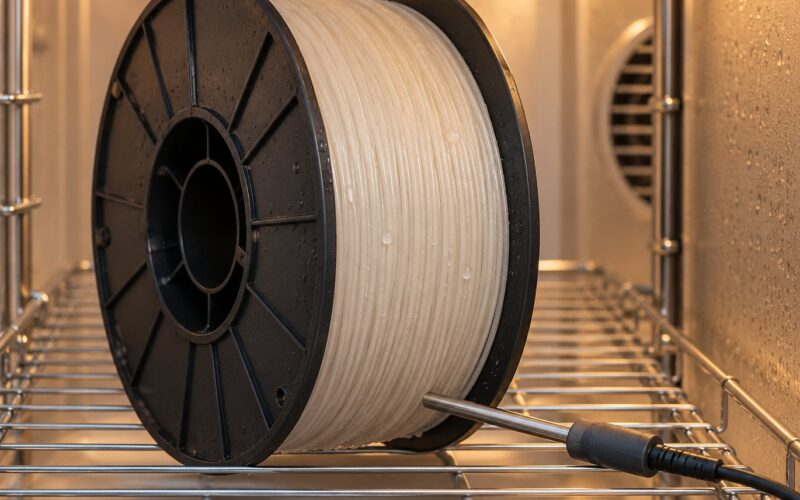
ABS is not fussy about moisture, which is one of its practical advantages. ASA picks up a little more, so if you hear popping or see rough, blistered surfaces, dry the spool at 60 to 70 C for four to six hours.
Seal the spool in a dry box with desiccant once opened. Filament printed during winter for parts needed next summer is a common workflow, and a sealed box is what makes that work across months.
Surface Finish, Finishing, and Long-Term Protection
ASA is usually the better substrate for outdoor finishes because it will not yellow underneath them, so any visible ABS color shift stays hidden. Both materials take primer, paint, and filler well, which means you are not locked into bare printed surfaces.
Sanding and smoothing
Both sand well with 180 to 400 grit. Filler such as body filler or a thin epoxy layer takes the print lines out and gives paint something to bite, and a sanded ASA part under a UV-resistant topcoat can look factory moulded.
Acetone vapour smoothing works on ABS and is not reliable on ASA, since ASA resists the solvent. Do not use acetone on ASA, and do not use it on any printed part you need to keep dimensionally accurate.
How to properly paint ABS for outdoor duty
Painting will not make ABS weatherproof, but a solid coating slows UV damage and hides the yellowing. The workflow that works:
- Clean the part with isopropyl alcohol and let it dry fully.
- Prime it with a plastic-compatible primer. This is the step people skip, and it is the one that decides whether the paint stays put.
- Sand lightly between primer coats if you want a smooth finish.
- Paint with a flexible exterior acrylic rather than a hard enamel, so the coating does not crack along layer lines.
- Finish with a UV-resistant topcoat, ideally a clear coat or a polyurethane exterior varnish, and apply several thin coats.
- Mount in shade where you can. Coated or not, a part that avoids direct sun lasts far longer than one that does not.
Use a black or dark filament if you are committed to bare ABS. Dark carbon pigment absorbs and blocks a large share of the UV that starts the degradation, which is a recurring community recommendation and an easy free win. It slows the process rather than stopping it.
Joining ABS and ASA
ABS solvent-welds cleanly with acetone. ASA does not, because acrylate rubber resists that solvent. If you need to join an ABS part to an ASA part, use a two-part epoxy or a mechanical fastener rather than solvent welding.
For filled variants, any abrasive or mechanical fastening works, but plan extra clearance because the fibers change shrinkage slightly compared to unfilled filament.
Which Should You Choose?
Choose ASA when the part sees sun, rain, or sustained heat. Choose ABS when the part stays indoors, lives in shade, is temporary, or you need the cheapest viable option.
| Project | Best choice | Why |
|---|---|---|
| Garden markers, planter fittings, irrigation brackets | ASA | Constant sun and moisture |
| Vehicle exterior trim, mirror mounts, roof accessories | ASA | Sun plus heat cycling |
| Outdoor signage | ASA | Colour retention matters |
| Enclosure skins, weather shields, camera and sensor housings | ASA | Long-term UV exposure |
| Boat and marine mounts | ASA, or ASA-CF for stiffness | Salt and sun exposure |
| Printer enclosure external panels | ASA | Continuous exposure, colour matters |
| Printer internal frames and brackets | ABS | Indoors, protected, cheaper |
| Indoor prototypes and fit checks | ABS or PETG | Fast and inexpensive |
| Temporary jigs and shop fixtures | ABS | No outdoor exposure to survive |
| Parts above roughly 100 C | Polycarbonate, PC blend, or nylon | Neither ABS nor ASA is rated for it |
PETG is worth considering for outdoor parts that see rain but little direct sun. It prints far easier than either styrenic and shrugs off moisture, though it yellows under UV over time and is not for high-heat locations.
ASA-G is the grade to look at when your part needs more heat headroom than unfilled ASA gives you. Premium PC blends and nylon go further still, but they need a hardened nozzle, higher temperatures, and dry filament, so save them for genuinely demanding parts.
A short decision checklist
- Will the part see direct sunlight for part of the day? If yes, ASA.
- Will it sit in a hot car, on a roof, or in direct sun? If yes, ASA, and consider heat-rated grades.
- Is it indoors or in permanent shade? ABS is fine and cheaper.
- Do you have a heated chamber or an enclosure? If not, budget for a draft shield before starting a large part.
- Is it a one-season part? ABS is defensible, especially painted and in shade.
Frequently Asked Questions
Is ASA better than ABS for outdoor 3D printing?
Yes, for any part exposed to sunlight. ASA uses an acrylate rubber that resists ultraviolet light, so it holds its colour and impact strength through seasons of exposure. ABS relies on butadiene rubber, whose double bonds UV attacks, causing yellowing, chalking and embrittlement within months in direct sun. ABS is still the better buy for indoor parts, prototypes, or anything kept in shade.
Can ABS be used outside if it is painted or coated?
It can, with limits. Primer, flexible exterior acrylic paint and a UV-resistant clear topcoat slow the degradation and hide yellowing, but they do not stop it. Use a black or dark filament, where the pigment blocks much of the UV, and mount the part in shade where possible. For a part that must last years in direct sun, spend the money on ASA instead.
Does ASA need an enclosed printer?
Not strictly for small parts, but you will be fighting warping without one. A closed chamber holding roughly 40 to 60 C removes drafts and layer temperature swings that curl the print. On an open frame, small parts under about 100 mm usually succeed with a brim and a cardboard draft shield. Larger parts really do want a heated enclosure.
Which filament has the higher heat resistance, ABS or ASA?
They are close, with ABS often slightly higher. Unfilled ABS typically has a glass transition temperature near 105 C and unfilled ASA around 100 to 105 C, depending on the brand. Neither is suitable for continuous service near those temperatures. For genuinely hot parts, use polycarbonate, a PC blend, or nylon instead of either styrenic.
Is ASA weatherproof and waterproof?
It is weather-resistant rather than waterproof. ASA handles sun, rain and temperature cycling far better than ABS, but it is still a thermoplastic that absorbs a small amount of moisture and is not suited to continuous submersion. Neither ABS nor ASA is a pressure or marine-grade material. Seal printed parts if fluid resistance matters to your design.
How do I stop ASA and ABS outdoor prints from warping?
Control the temperature inside the machine. Close the chamber and hold roughly 40 to 60 C, raise the bed to around 100 C, add a 5 to 10 mm brim, and print the part flat with its largest face on the bed. Keep the nozzle fully inside the bed area, run low fan on the first layers, and keep the printer away from windows, doors and air conditioning. Slow the outer wall speed as well.
Conclusion
Pick ASA for anything exposed to sun or rain, and ABS for indoor frames, prototypes, and parts kept in shade. Before you start, confirm the glass transition and UV figures on the filament you actually bought, dry the spool, and set up your orientation, wall count, and infill so the part survives handling rather than just the weather.