Automakers use 3D printing in production to build parts layer by layer straight from CAD data, covering everything from full-scale concept models and assembly-line fixtures to certified end-use components and replacement parts for vehicles that ended production decades ago. The technology is no longer confined to the design studio. It now sits on plant floors where tooling changes, low-volume builds and legacy spares are handled without waiting on a new mold.
The honest version is that additive manufacturing, or AM, works brilliantly at some jobs and badly at others. Knowing which is which tells you more than any vendor brochure will.
Table of Contents
- How Do Automakers Use 3D Printing in Production?
- Where 3D Printing Fits in Automotive Manufacturing
- Concept development
- Engineering validation
- Pre-series builds
- Final assembly and the plant floor
- Maintenance and the aftermarket
- The Main Automotive 3D Printing Applications
- Prototypes and design validation
- Jigs, fixtures and inspection tools
- End-use and structural parts
- Legacy and discontinued spare parts
- Customized and performance parts
- Electric vehicle components
- How the Production Workflow Runs from CAD to Vehicle
- Seven steps from CAD file to installed part
- Which 3D Printing Technologies Do Automotive Makers Use?
- Why Automakers Are Adopting Additive Manufacturing
- Materials Used for Automotive 3D Printed Parts
- Quality, Safety, and Regulatory Requirements
- Why 3D Printing Has Not Replaced Conventional Manufacturing
- How This Production Technology Is Expected to Develop
- Frequently Asked Questions
- Is 3D printing used for mass-produced cars?
- What automotive parts can be 3D printed?
- Which 3D printing technology is best for vehicle components?
- Are 3D printed automotive parts safe and legal?
- Why is 3D printing often more expensive than injection molding?
- Can 3D printing replace traditional car factories?
- Conclusion: Start with a Production Bottleneck
How Do Automakers Use 3D Printing in Production?
Automakers use 3D printing in production for six broad job types: concept models, design validation parts, jigs and fixtures, tooling, low-volume end-use components, and replacement parts for older vehicles. Early adoption centered on prototypes. Today the same machines build fixtures that hold sheet metal during assembly and metal parts that go on sale vehicles.
The distinction that matters is volume. Printing a part once, or a few hundred times, can beat every alternative on cost and speed. Printing fifty thousand identical brackets a year almost never does, because the machine produces one layer at a time and nobody has invented a way around that yet.
Where 3D Printing Fits in Automotive Manufacturing
Think about how automakers use 3D printing in production as a set of stages rather than a single trick. Each stage has a different tolerance for risk, a different material budget and a different person signing off on the print.
Concept development
Designers print full-scale clay-like models and appearance prototypes in hours so styling decisions happen in front of physical objects. A surface can be reshaped over coffee instead of waiting on a supplier.
Engineering validation
Functionally accurate parts get printed to check fit, clearance and assembly sequence before metal tooling is committed. This is where a $40,000 design error gets caught for the price of a few kilograms of powder.
Pre-series builds
Pre-series vehicles need low-volume parts that are impossible to justify with production tooling. Printed covers, ducting and cosmetic trim fill the gap between prototype and series car.
Final assembly and the plant floor
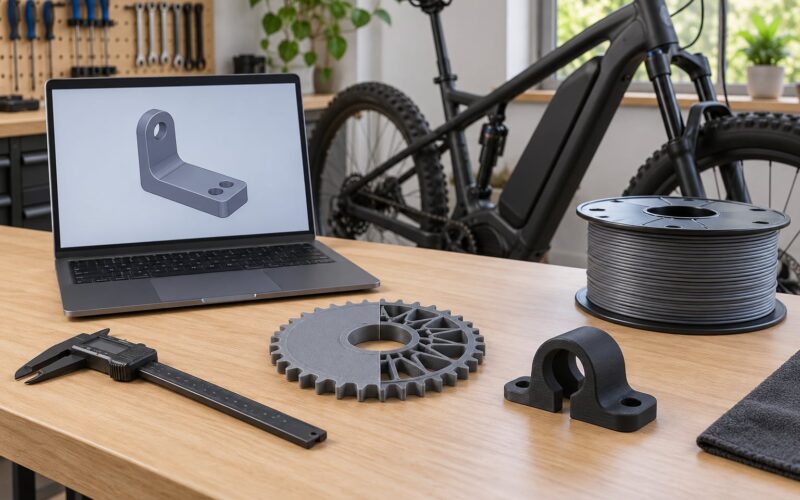
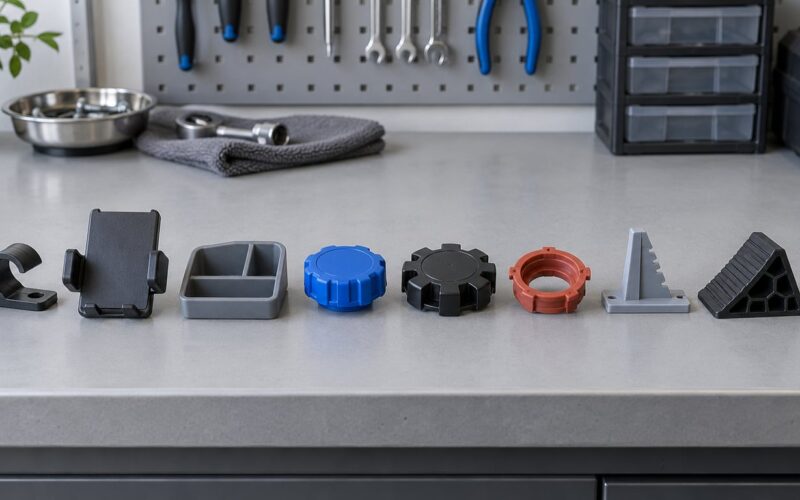
Assembly lines need jigs, welding fixtures, gauges and check fixtures. Every model change or new variant means new tooling, and printed fixtures turn a weeks-long purchase into an overnight job.
Maintenance and the aftermarket
Service centers need parts for cars built twenty or forty years ago. Printing those from scan data or archived CAD means carrying a file instead of a pallet of inventory.
Rivian runs an in-house printing lab with resin, powder and FDM machines specifically to build jigs and prototypes on demand, a model many suppliers are copying.
The Main Automotive 3D Printing Applications
Prototypes and design validation
GM built roughly 75 percent of the C8 Corvette prototype’s visible surfaces through additive processes, which let the team revise geometry while parts were still being fitted together. That is the core value: iteration speed measured in hours, not the six to ten weeks a conventional prototype tooling cycle eats up.
Jigs, fixtures and inspection tools
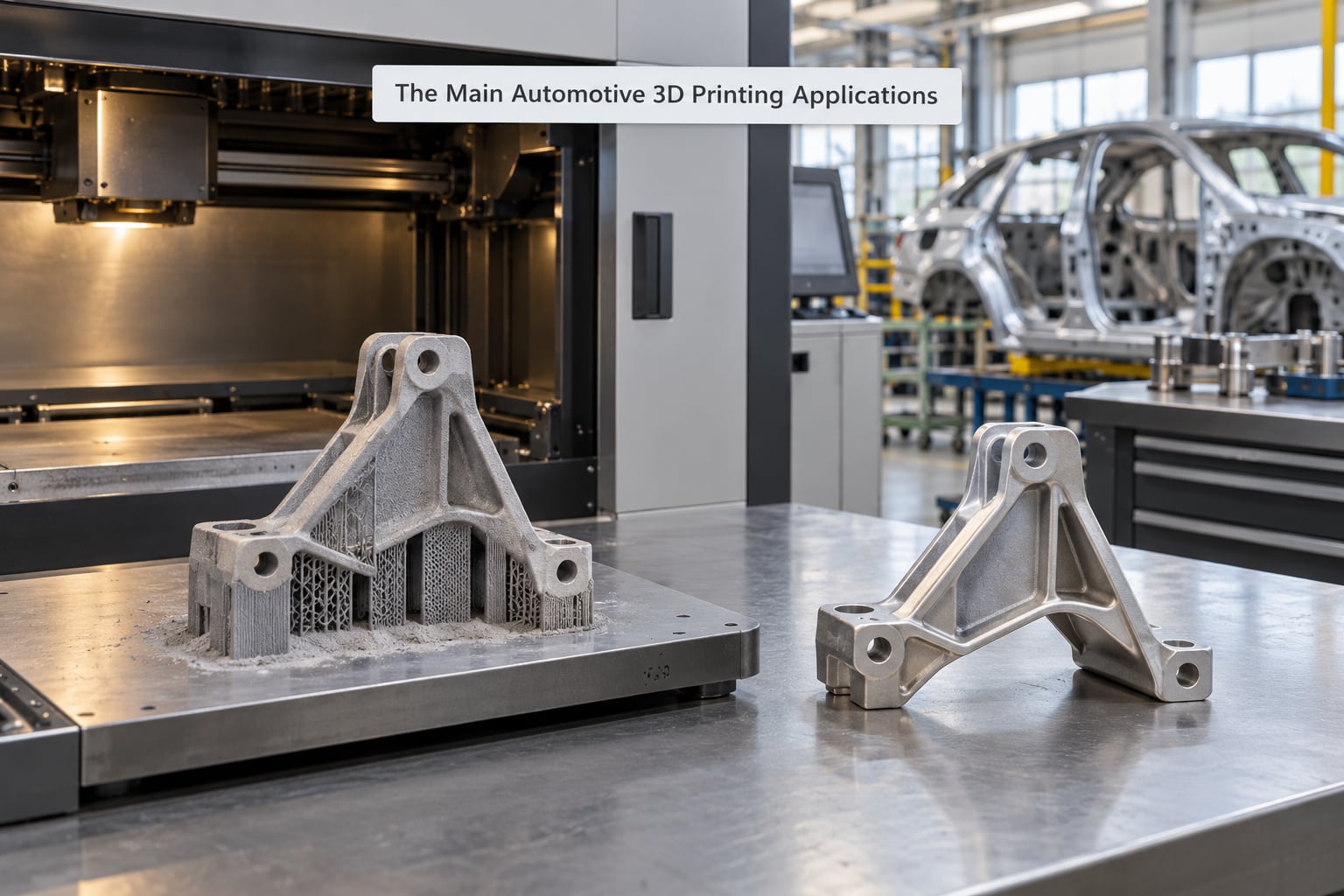
A jig holds and locates a part. A fixture supports the workpiece during machining or welding. Both get redesigned whenever the product changes, which makes them a perfect fit for printing. MX3D has documented a steel fixture for a new EV assembly line that took eight to ten weeks to source through traditional casting and days to produce with wire arc additive manufacturing.
End-use and structural parts
Bugatti’s eight-piston monoblock brake caliper, printed in a titanium alloy and finished by machining the critical surfaces, is the example every article cites. The Czinger 21C lists more than 350 additively manufactured components across bodywork and powertrain hardware.
Consolidation is the quieter win. An automotive seat bracket developed with Autodesk replaced eight separate stamped and machined parts with one printed design roughly 40 percent lighter and 20 percent stronger.
Legacy and discontinued spare parts
When a model leaves production, its tooling often goes with it. Manufacturers scan or retrieve the original CAD data, clean it up for a modern process, print the part and certify it. For low-volume spares with long tails, that is often the only economic way to serve the market.
Customized and performance parts
Printed parts follow performance programs, race teams and small-volume vehicle builders, where per-unit cost matters less than the ability to iterate aerodynamic surfaces between test sessions.
Electric vehicle components
EV architecture pushed printing into new territory. Battery housings need internal cooling passages and sealing surfaces that are hard to machine or cast, and the pressure to cut weight makes consolidation attractive.
How the Production Workflow Runs from CAD to Vehicle
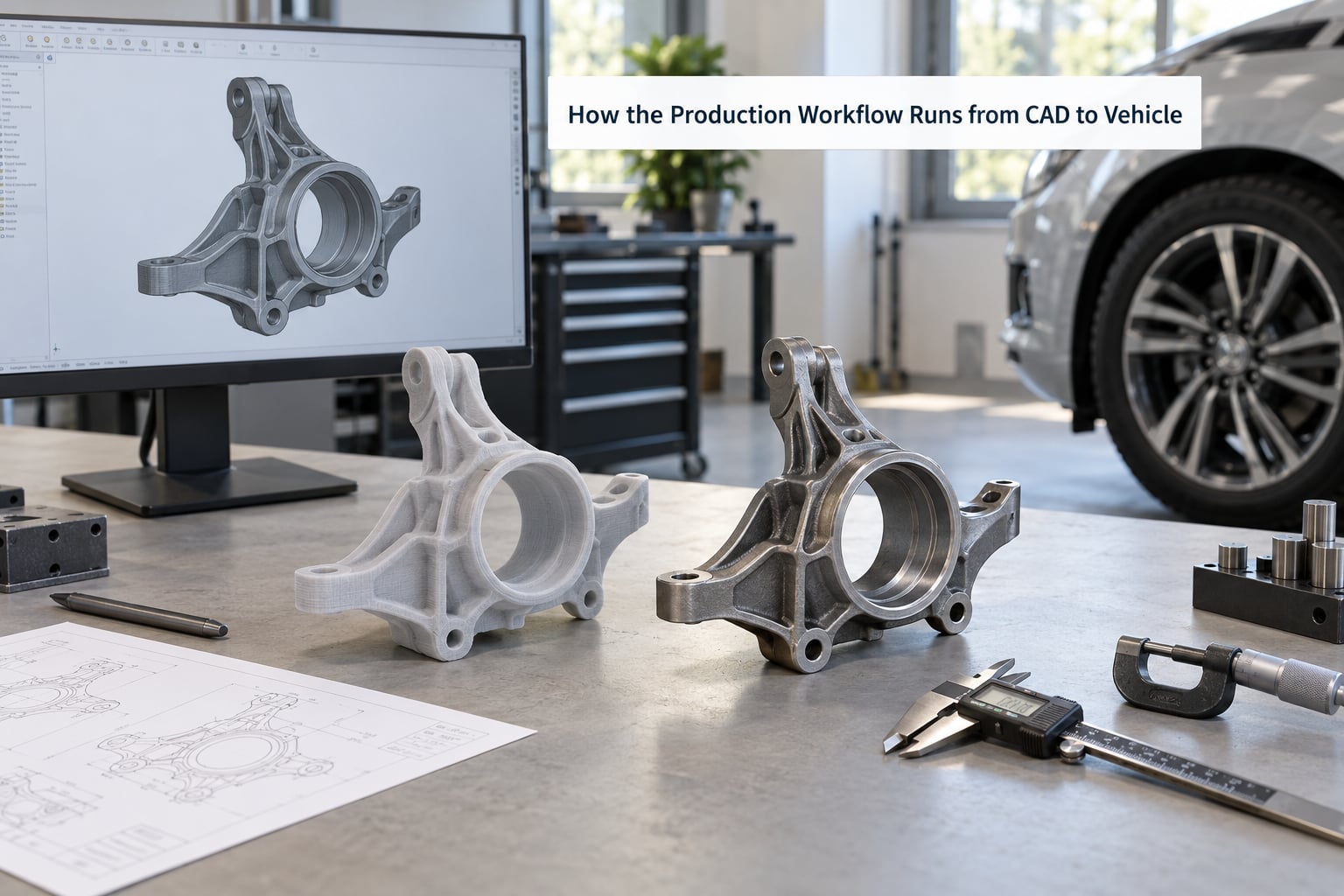
Getting a printed part onto a car is a documented process, not a trick. Engineering change control is the part most home printers never encounter and the part that surprises new suppliers.
Seven steps from CAD file to installed part
- Design intent. Engineers define the part in CAD with material, load direction and finish requirements marked up front.
- Simulation. Structural analysis runs against the geometry, often including generative design, which reshapes the part within a fixed load envelope and then removes material where the structure does not need it.
- Process selection. The team picks the machine family and material based on volume, tolerance, temperature and certification needs.
- Print preparation. The CAD file is oriented, sliced, given supports where overhangs need them, and nested into a build. Metal powders get a documented lifecycle and reuse plan.
- Printing. Polymer parts may finish in hours. Metal powder bed fusion parts take hours to days. Wire arc additive parts of a metre or more can take far longer.
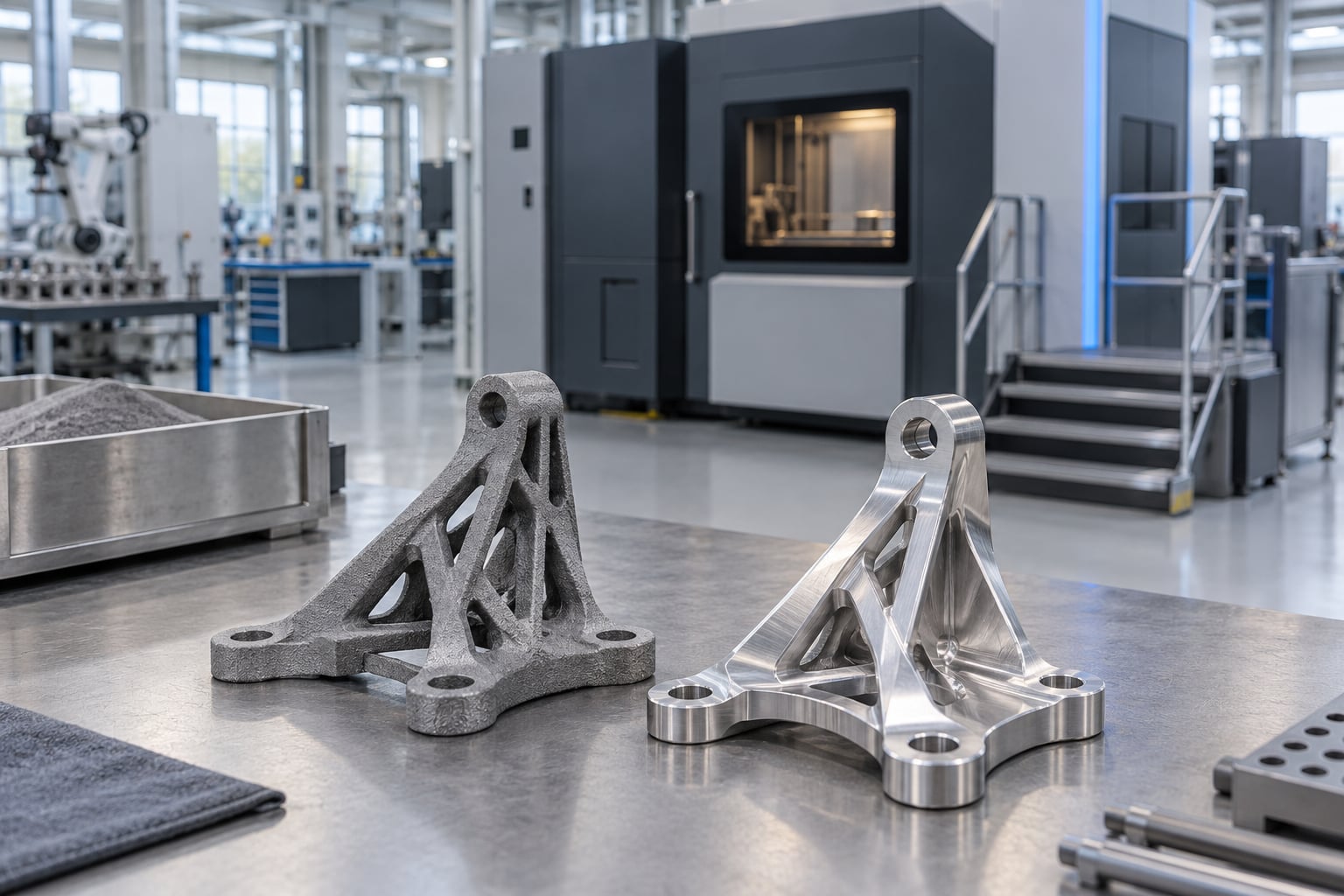
- Post-processing. Supports come off, stress in metal parts is relieved, parts are heat treated, machined on critical faces and bead blasted or polished.
- Inspection and release. Dimensional checks, mechanical testing and a digital record of the build become part of the part’s history before it ships to the line or the vehicle.
That last step is where printing diverges most from machining. A machined part’s quality is inferred from its material and its machine. A printed part’s quality is tied to a specific build, so the record has to travel with it.
Which 3D Printing Technologies Do Automotive Makers Use?
The choice of process tracks the job more closely than any brand of machine. This table maps the common automotive processes to what they print and where they fit on a vehicle program.
| Process | Typical materials | Best automotive use | Watch out for |
|---|---|---|---|
| Stereolithography (SLA) | Photopolymer resins | Detailed prototypes, pattern faces, master models | Brittle before curing, limited heat resistance |
| Digital light processing (DLP) | Photopolymer resins | Fast resin prototypes and functional fit checks | Resin handling and post-curing time |
| Fused filament fabrication (FDM) | PLA, PETG, nylon, TPU | Rough jigs, ducting mock-ups, low-cost fixtures | Layer lines, visible seams, anisotropic strength |
| Selective laser sintering (SLS) | Nylon, TPU, polyamide | End-use ducting, clips and covers without support | Surface roughness, slightly lower detail |
| HP Multi Jet Fusion (MJF) | Nylon, TPU, elastomers | Production-grade polymer parts and repeatable batches | Machine cost, powder reuse discipline |
| Laser powder bed fusion (LPBF/SLM) | Aluminum, 316L, maraging steel, Inconel | Consolidated brackets, calipers, ducting, heat exchangers | Cost per part, anisotropy, machining allowance |
| Directed energy deposition (DED) | Steel, nickel alloys, Inconel | Large metal parts, repair and cladding | Surface finish, machine size |
| Binder jetting | Metal and sand | Pattern faces and low-volume cast patterns | Green part handling and sintering shrinkage |
| Wire arc additive manufacturing (WAAM) | Low-alloy and stainless steels, Inconel | Metre-scale fixtures, tooling and heavy legacy parts | Lower detail, extensive machining afterwards |
BMW has used HP Multi Jet Fusion technology to print production parts since around 2010, which makes it one of the longer-running examples of polymer AM in series production.
Why Automakers Are Adopting Additive Manufacturing
Lead time. A printed fixture can exist tomorrow. A cast or machined one has a queue. That single difference changes how responsive an engineering team can be.
Tooling cost. Low-volume tooling is where printing wins hardest, because the setup cost of a traditional tool dwarfs the material in a printed one. Machining from solid stock can discard up to 80 percent of the material it buys; printing starts near net material in the part.
Part consolidation. One printed bracket can absorb the jobs of eight machined pieces, cutting assembly steps as well as weight.
Digital inventory. Keeping a revision-controlled CAD file is cheap compared with a warehouse of low-turn spares. The catch is that those files need revision control, validation and secure retention for decades, which most plants underestimate.
Supply chain resilience. Printing a discontinued part locally removes a supplier, a shipping lane and a lead-time estimate from the equation.
Materials Used for Automotive 3D Printed Parts
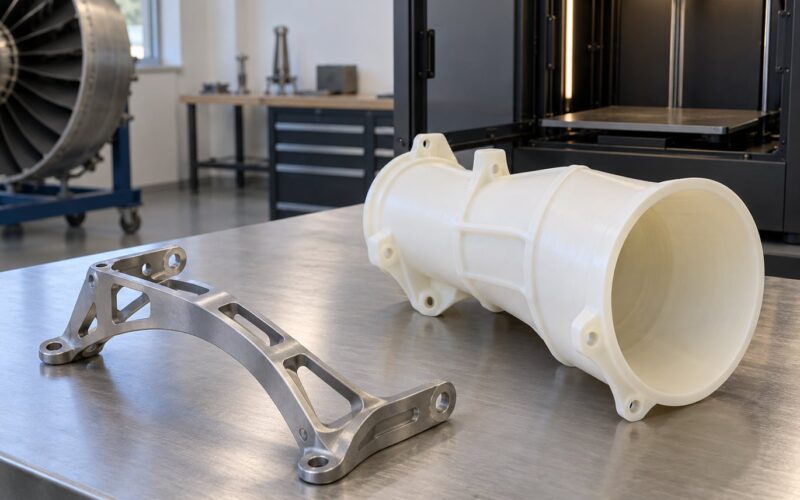
Polymers cover most of the volume. Nylon composites handle clips, covers and ducting that see heat and chemical exposure. Thermoplastic elastomers (TPU) take repeated flexing, which makes them useful for seals and bushings.
Photopolymers deliver the best surface detail and tight tolerances of any polymer process, and almost no heat tolerance. They serve pattern work and fit checks far better than under-bonnet parts.
Metals are where the serious end-use parts live: 316L stainless steel for corrosion resistance, aluminum alloys for low weight, maraging steels for tooling, and nickel superalloys such as Inconel where temperatures climb.
Composites combine printed fiber-reinforced thermoplastics with continuous reinforcement in overmolded or molded parts to reach stiffness that unfilled polymer cannot.
One materials-literacy gap deserves a word. PLA works fine for a mock-up and fails badly anywhere near heat, load or a road. Printing enthusiasts say it plainly, and they are right.
Quality, Safety, and Regulatory Requirements
A printed safety-critical part lives under the same automotive quality system as a cast one, which means it needs documented material provenance, mechanical test results and a permanent record tied to the specific build. Powder batches, machine parameters, support removal and heat treatment all need capturing.
Dimensional inspection catches the usual failures: warp from uneven cooling, support marks, and layer-line effects on mating surfaces. Where a printed part mates with a stamped or cast neighbor, engineers typically design in extra clearance or finish the critical face on a machine afterwards.
Certification is the real barrier for anyone moving from fixtures into end-use parts. Parts approved for production typically pass through production part approval processes inside a quality system such as IATF 16949, and specialist additive qualification standards exist for metal parts used in certified applications.
Change control is the quieter obstacle. A printed part can be edited in an afternoon, which is exactly the problem, because it lets design drift ahead of approval.
Why 3D Printing Has Not Replaced Conventional Manufacturing
It is worth being blunt here, because most of the search results on this topic skip it.
Build rate. A machine deposits material sequentially. Casting fills a cavity in seconds, stamping forms a panel in one stroke, and injection molding fills a tool in under a minute. Nothing in additive manufacturing beats that per unit at volume.
Cost per part. Machine time, labor, powder, support removal, heat treatment and machining all sit in the cost of a printed metal part. Below a few hundred units, that is fine. Above a few thousand, it usually is not.
Surface finish and material limits. Visible trim needs heavy finishing, and printed metals show directional strength from layer bonding until post-processing closes the gap.
Certification. Qualifying a printed structural part is slower than printing it. That gap, not machine speed, is what keeps most end-use volume in casting, forging, machining and molding.
Casting, forging, machining and injection molding remain the backbone of vehicle production, and they are not close to being obsolete.
How This Production Technology Is Expected to Develop
Multi-material builds, where a polymer print carries metal inserts for threads and bearings, remove a step from post-processing. In-process monitoring systems now watch melt pools and powder beds during the build, which helps machines decide whether a layer is good before the part is finished rather than after.
Automated inspection and machine learning applied to process data are moving from trials into production cells. These are developments in progress rather than settled outcomes, and shop-floor results vary widely by supplier.
Expect more localized production near service hubs, and a hybrid future in which a plant prints the bracket that would never justify a tool and machines the housing that ships by the pallet.
Frequently Asked Questions
Is 3D printing used for mass-produced cars?
Yes, but selectively. Most printed content on a mass-produced vehicle is jigs, fixtures, inspection tools and low-volume components rather than the headline body or engine parts. A handful of automakers ship printed production parts on series vehicles, including consolidated brackets, ducting and performance hardware. The rule of thumb is that printed parts win where volume is low, geometry is complex, or the part would otherwise require expensive dedicated tooling.
What automotive parts can be 3D printed?
In practice: prototypes and styling models, assembly jigs, welding fixtures, inspection gauges, air ducting, covers and shrouds, heat exchangers, cable guides, consolidated brackets, brake calipers, suspension links and replacement parts for older vehicles. What stays conventional at volume are engine blocks, gears, body panels and anything needing proven fatigue behavior in high numbers.
Which 3D printing technology is best for vehicle components?
There is no single winner, because the process follows the job. SLA or DLP handles detailed prototypes, FDM handles cheap rough fixtures, SLS or Multi Jet Fusion handle polymer production parts, laser powder bed fusion handles metal end-use components, and WAAM handles metre-scale tooling and heavy legacy parts. Pick the process that matches the volume, tolerance and temperature the part actually sees.
Are 3D printed automotive parts safe and legal?
They are, provided they go through the same approval route as any other production part. Safety-critical components need documented material provenance, mechanical test results and release under the automaker’s quality system. Printing a car at home is a different matter entirely: road legality depends on type approval and certification by an authorized body, not on how the shell was made.
Why is 3D printing often more expensive than injection molding?
Injected plastic tooling is expensive to build and then very cheap per part. A 3D printer is cheaper to buy but slow, because it works one layer at a time, and the machine time, labor, powder, support removal and finishing all land on the unit price. Printing wins below a few hundred units or where complex geometry would need expensive tooling to begin with.
Can 3D printing replace traditional car factories?
No, and the manufacturing economics explain why. Casting, stamping, forging and injection molding produce parts faster, at scale, with mature process capability. Additive manufacturing works as a complement, absorbing the low-volume, complex and tooling-intensive jobs the conventional line handles badly. The realistic picture is mixed lines, not a wholesale shift.
Conclusion: Start with a Production Bottleneck
If you want to understand how automakers use 3D printing in production, copy the shops that already did it. They start with one part that is low volume, geometrically awkward, tooling-intensive or hard to source, and they compare the printed version against the conventional alternative on lead time, total cost and certification load. If the printing case only holds on cost, it will probably not survive contact with the quality system. If it holds on all three, the program usually scales from there.