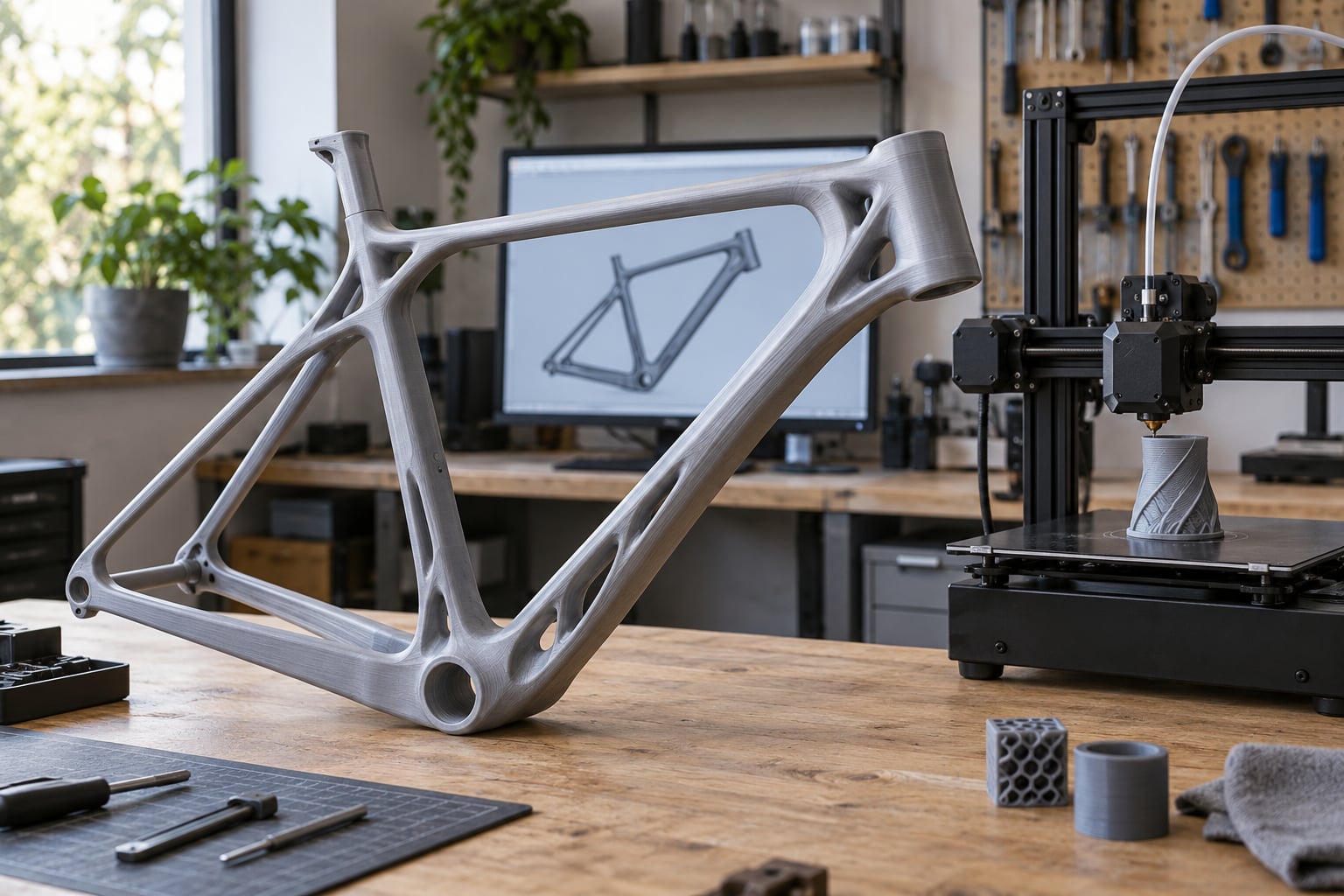
A 3D printed bicycle frame is a frame built by additive manufacturing. A machine builds it up layer by layer from a digital CAD model, using powder, melted metal or deposited fibre-reinforced plastic, rather than cutting tubes, bending them and welding or bonding them together. That one substitution is why a printed frame can carry shapes a welded frame cannot.
Most riders meet printed frames long before they meet a printed whole frame. Carbon frames with printed lugs and dropouts have been on the road for years, and metal-printed attachments appear on bikes from small builders. The full printed frame is rarer, and the reasons why are worth understanding properly.
This guide takes the idea apart in practice: how the frames are designed and built, what they are made from, where the engineering gets difficult, and which parts of the whole idea actually work today.
Table of Contents
- What Are 3D Printed Bicycle Frames?
- Printed frame or printed parts on a conventional frame?
- How Are 3D Printed Bicycle Frames Made?
- Which Materials Are Used for 3D Printed Bicycle Frames?
- Which printed material is strongest?
- What Are the Main Benefits of 3D Printed Frames?
- What Are the Engineering and Safety Challenges?
- How Do 3D Printed Frames Compare with Traditional Frames?
- Can 3D Printed Bicycle Frames Be Used for Riding?
- What testing applies
- How Do You Start Designing a 3D Printed Bicycle Frame?
- The key design decisions
- How to validate a prototype
- Frequently Asked Questions
- What materials are best for 3D printed bicycle frames?
- Are 3D printed bicycle frames lighter than aluminum frames?
- How strong and durable are 3D printed bicycle frames?
- Can you 3D print a complete bicycle frame at home?
- What is the main advantage of 3D printing a bicycle frame?
- Do 3D printed bicycle frames need testing before riding?
- Conclusion
What Are 3D Printed Bicycle Frames?
A 3D printed bicycle frame is one where the load-bearing structure is produced by an additive process rather than by conventional fabrication. There is no tube bending jig, no welding pass, and no mould holding prepreg plies in place. A digital model goes in, and material accumulates until the frame exists.
Conventional frames follow a fixed sequence. Tubes are dimensioned and cut, bent to the geometry, machined at the ends, held in a jig and welded or brazed together, or for carbon, laid up in a mould and cured under pressure. A printed frame replaces that entire chain with one build step plus finishing.
It helps to separate two things that often get tangled together. The process is how material is deposited, and the material is what gets deposited. Titanium can be printed with a laser and it behaves like titanium, not like plastic, because of how the powder is melted.
Printed frame or printed parts on a conventional frame?
This is the single biggest source of confusion in forum threads. Flying Machine has printed titanium lugs that bolt into conventionally made tubes. Urwahn builds frames whose parts are printed and then joined. Superstrata prints its entire carbon-fibre frame as one continuous piece rather than layering sheets in a mould.
All three are 3D printed bicycle frames in the broad sense, but only the third has nothing conventional left in it. When a buyer asks whether printed frames are safe, that distinction decides the answer.
How Are 3D Printed Bicycle Frames Made?
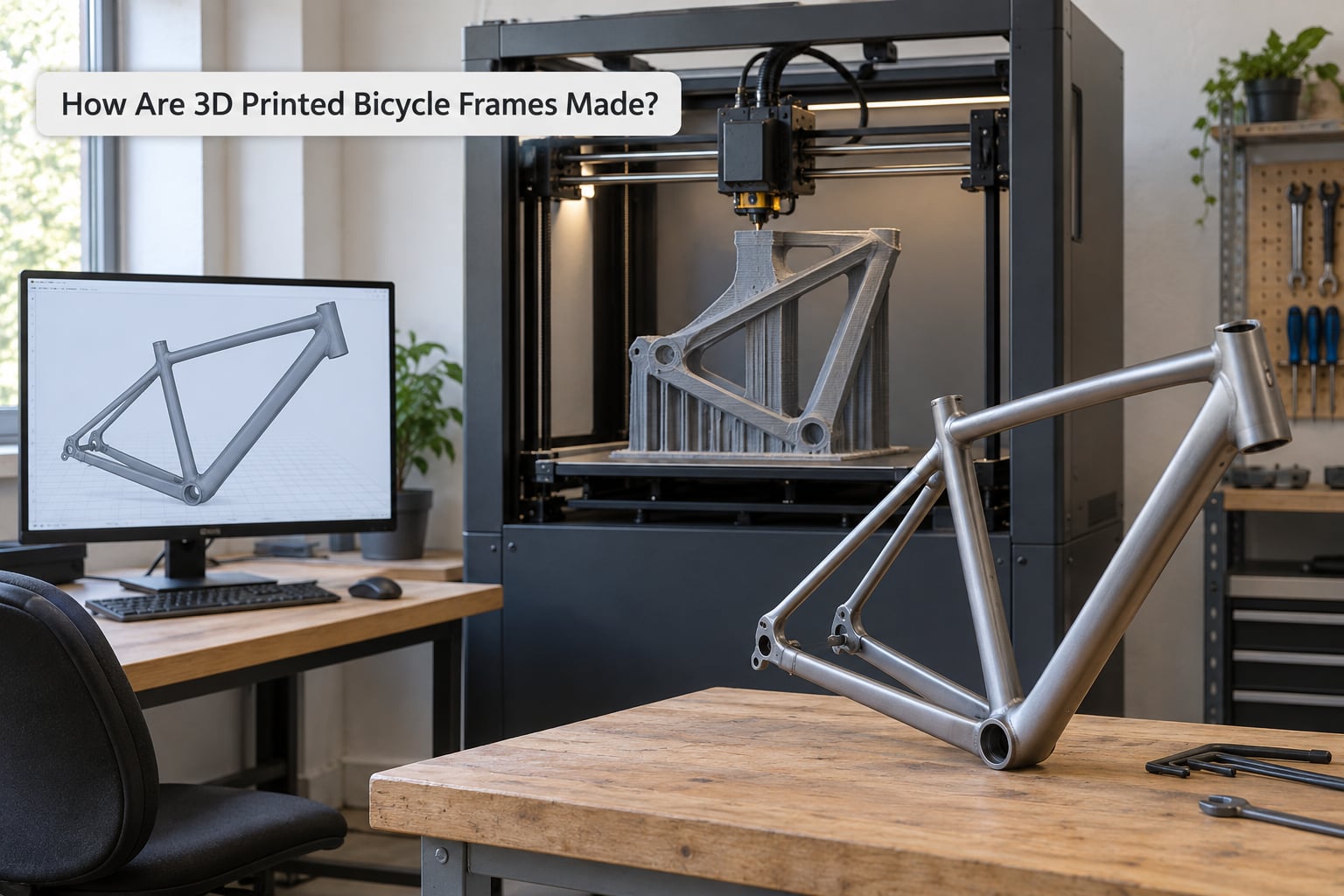
- Digital modelling. The frame starts as CAD geometry, often parametric so that stack, reach, head angle and tube diameters are variables rather than fixed numbers. From there the designer can add internal channels, lattice regions or organic tube profiles that no bending die could produce.
- Slicing and build planning. Software converts the model into layers and decides print orientation. This step decides more about final performance than most people expect, because layer direction sets the anisotropy of the finished part.
- Building the part. A powder bed process spreads polymer or metal powder across a platform, a laser sinters or melts the layer, the bed drops, and the cycle repeats. For composites, a nozzle deposits continuous fibre tow impregnated with thermoplastic instead.
- Removing the part and unbinding. Printed parts come out of a powder cake and need a support structure, or for polymers, sometimes a debinding and drying stage, before handling.
- Post-processing. Printed metal goes through stress relief, heat treatment and often hot isostatic pressing to close internal porosity. Printed polymer goes through drying and, if the resin demands it, a curing cycle.
- Finishing and machining. Supports come off, surfaces get bead-blasted or sanded, and critical interfaces such as dropouts, bearing seats and pivot bores get machined to tolerance. A printed frame cannot hold a tight bearing fit straight off the machine.
- Inspection. Geometry gets checked against the digital twin, critical surfaces get measured, and for structural frames the whole assembly gets proof tested and fatigue tested before anyone rides it.
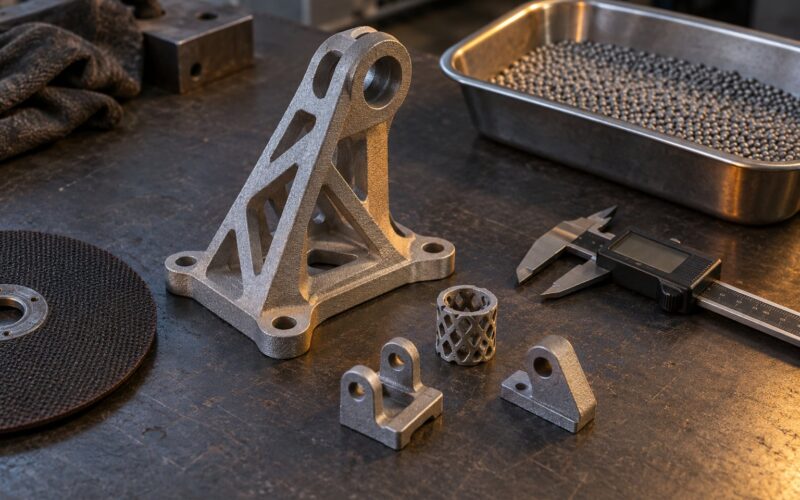
For metals, the post-processing step is not cosmetic. Porosity left inside a printed part acts as a crack starter, and hot isostatic pressing is what closes those pores before fatigue testing ever begins.
Which Materials Are Used for 3D Printed Bicycle Frames?
Material choice decides stiffness, weight, heat tolerance and how the part fails. The table below covers the options that appear in frame work.
| Material | Strength and stiffness | Flexibility | Heat resistance | Impact behaviour | Post-processing needed | Typical bicycle use |
|---|---|---|---|---|---|---|
| Nylon PA12 and PA2200 | Moderate strength, tough and resilient for a polymer | Slight give, absorbs vibration | Good up to roughly 150 to 180 Celsius | Forgiving; dents and deforms rather than snapping | Drying, support removal, surface finishing | Prototype frames, fittings, ducting, mounts |
| Carbon-fibre-reinforced thermoplastic | Higher stiffness, chopped fibres limit the gain | Low | Good, well above 200 Celsius | Stiff and brittle at thin sections | Cooling only, machining at interfaces | Dropouts, cranks, lugs, brackets |
| Continuous fibre composite | Highest specific strength when fibres run with the load | Very low along the fibre, higher across it | Excellent | Progressive failure, no sudden shatter | Cooling, trimming, machining of interfaces | Complete frames, forks, integrated structures |
| TPU | Low structural strength | Very high, rubber-like recovery | Limited | Excellent, returns to shape | Cooling only | Grips, protective parts, bumpers, saddles |
| PETG | Moderate, tough rather than rigid | Low | Fair, around 75 to 85 Celsius | Impact resistant | Cooling and finishing | Accessories, racks, brackets, jigs |
| PLA | Moderate when thick, brittle when thin | Very low | Poor, softens in a hot car | Sudden failure, no warning | Cooling only | Fit checks and jigging, not load bearing |
| Photopolymer resin | High stiffness for a polymer, brittle in thin walls | None | Moderate | Brittle, cracks rather than bends | Wash, cure, sometimes anneal | Detail models, master patterns, low volume tooling |
| Ti-6Al-4V titanium | Yield strength around 800 to 950 MPa, aerospace grade | None, rigid | Excellent | Ductile; deforms before it breaks | Stress relief, HIP, heat treat, machining | Lugs, dropouts, lugged and printed structural frames |
| AlSi10Mg and 316L steel | Cast aluminium and stainless levels respectively | None | Excellent | Aluminium deforms, steel holds | Heat treat, HIP, machining | Lugs, brackets, non-primary structures |
Which printed material is strongest?
For a load-bearing frame, printed Ti-6Al-4V wins on stiffness-to-weight and on fatigue behaviour. Continuous fibre composites come close and can be lighter, but their strength depends entirely on fibre orientation, which makes them far harder to design with confidence. Among consumer polymers, CF-TP is the strongest option you can buy as filament, and it still sits well below any structural metal.
What Are the Main Benefits of 3D Printed Frames?
Shapes a bending die cannot make. A welded frame is limited by tube diameters, wall thicknesses and bend radii. A printed frame can taper, flare and hollow a tube, run internal channels through a lug, and build in cable routing that would be impossible to braze. The limit here is design maturity rather than the machine.
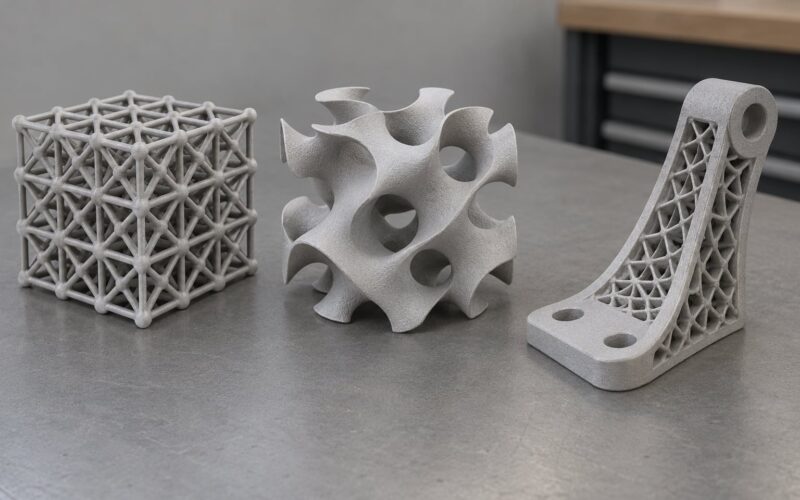
Lattice structures and topology optimisation. Generative design software removes material from low-stress regions and leaves a lattice behind, so stiffness stays while weight drops. One widely cited lightweighting project cut 45% of the weight from a printed metal bike frame while keeping strength, and gyroid and hexagonal matrices are the standard patterns.
Rapid iteration. A design change is a modelling change. You can go from one geometry to three variants and print them the same week instead of re-tooling. For test bikes and fit work, that speed is the whole argument.
Low-volume economics. No mould, no bending tooling, no minimum order. Service bureaus quote print times of about four days against three to four weeks for a precision casting run of the same lug, which matters for small brands and one-off parts.
Part consolidation. Features that would normally be separate welded or bolted pieces can be printed as one body. The BigRep Nera e-bike prototype is the often-quoted example, reaching an assembly reduced to about 15 parts, cutting both weight and the number of joints that could work loose.
Geometry matched to one rider. Because the model is parametric, made-to-measure stacks and reaches are practical at low volume rather than a luxury for a factory with thousands of units of the same size in its order book.
Each benefit has a matching catch. Complex internal channels are hard to inspect, consolidation makes a single crash ruin an expensive part, and lattice structures are only as good as the design rules behind them. Printed frames buy freedom, and the bill arrives at the inspection bench.
What Are the Engineering and Safety Challenges?
Layer adhesion and anisotropy. A printed part is not a homogeneous solid. Strength between layers is weaker than strength within them, so orientation becomes a structural decision. Print a tube vertically and you have built a stack of rings with weak interfaces.
Porosity in metals. Printed metal traps gas and can carry internal voids. Under repeated pedalling loads those voids become fatigue crack starters, which is why heat treatment and hot isostatic pressing are treated as structural steps and not finishing steps.
Fatigue versus impact. Conventional aluminium and titanium fail with visible warning in deformation before breaking. Composite frames can fail faster and quieter. A printed frame sits somewhere in between depending on material, and testing has to establish which behaviour applies rather than assuming.
Joints are the weak point. The head tube, bottom bracket shell and seat post cluster take the highest loads with the least material. Riders say this plainly on r/3Dprinting, where the bluntest comment on a home-printed frame thread was that it is not strong enough at exactly those joints.
Tolerances and interfaces. Bearing seats, dropouts and pivots need machined surfaces regardless of process. Printed clearance holes and threads are not production-grade, so every load-bearing interface becomes a secondary operation.
Moisture and heat. Nylon absorbs water and changes dimension and stiffness with humidity, and polymers soften in a parked car. A frame that fits perfectly in a workshop can fit differently after a summer.
Inspection difficulty. An internal lattice or channel cannot be checked without specialist methods. That makes quality control more expensive and less certain than on a welded frame with visible welds.
How Do 3D Printed Frames Compare with Traditional Frames?
| Criterion | Steel frame | Aluminium frame | Titanium frame | Moulded carbon frame | 3D printed frame |
|---|---|---|---|---|---|
| Typical frame weight | Heaviest of the group | Mid, the value benchmark | Moderate | Lightest | Metal prints comparable to titanium; composite prints can match carbon |
| Cost profile | Low material cost, low tooling | Low, highly automated at volume | High material cost, machining labour | High mould cost, low unit cost at volume | Low tooling, high per-part cost at low volume, uneconomic at high volume |
| Lead time | Short | Moderate | Long, machining bound | Long, mould first | Days for the print, plus finishing and QA |
| Custom geometry | Limited by available tube sizes | Limited by available tube sizes | Limited but easier to bend | Bound by the mould | Nearly unlimited from a parametric model |
| Internal features | Not practical | Not practical | Not practical | Possible in the layup | Channels, lattices and routing are straightforward |
| Consistency | Very repeatable | Very repeatable | Repeatable | Very repeatable | Varies more between builds; needs process control |
| Repairability | Rigid and straightforward to re-weld | Rigid, harder to repair than steel | Ductile, hard to re-weld in a workshop | Crack or impact damage is serious | Depends entirely: printed dropouts can be replaced, consolidated frames may not be |
| Failure warning | Good, deforms first | Good, deforms first | Very good, ductile | Sudden, quiet | Varies; metals warn, polymers and composites may not |
| Economic volume | Any | Thousands and up | Hundreds | Tens of thousands | One to a few hundred |
The short version: printing wins when the run is short and the geometry is unusual. It loses when you need ten thousand identical frames at the lowest unit cost, or when a damaged frame needs a cheap straight weld to fix.
Can 3D Printed Bicycle Frames Be Used for Riding?
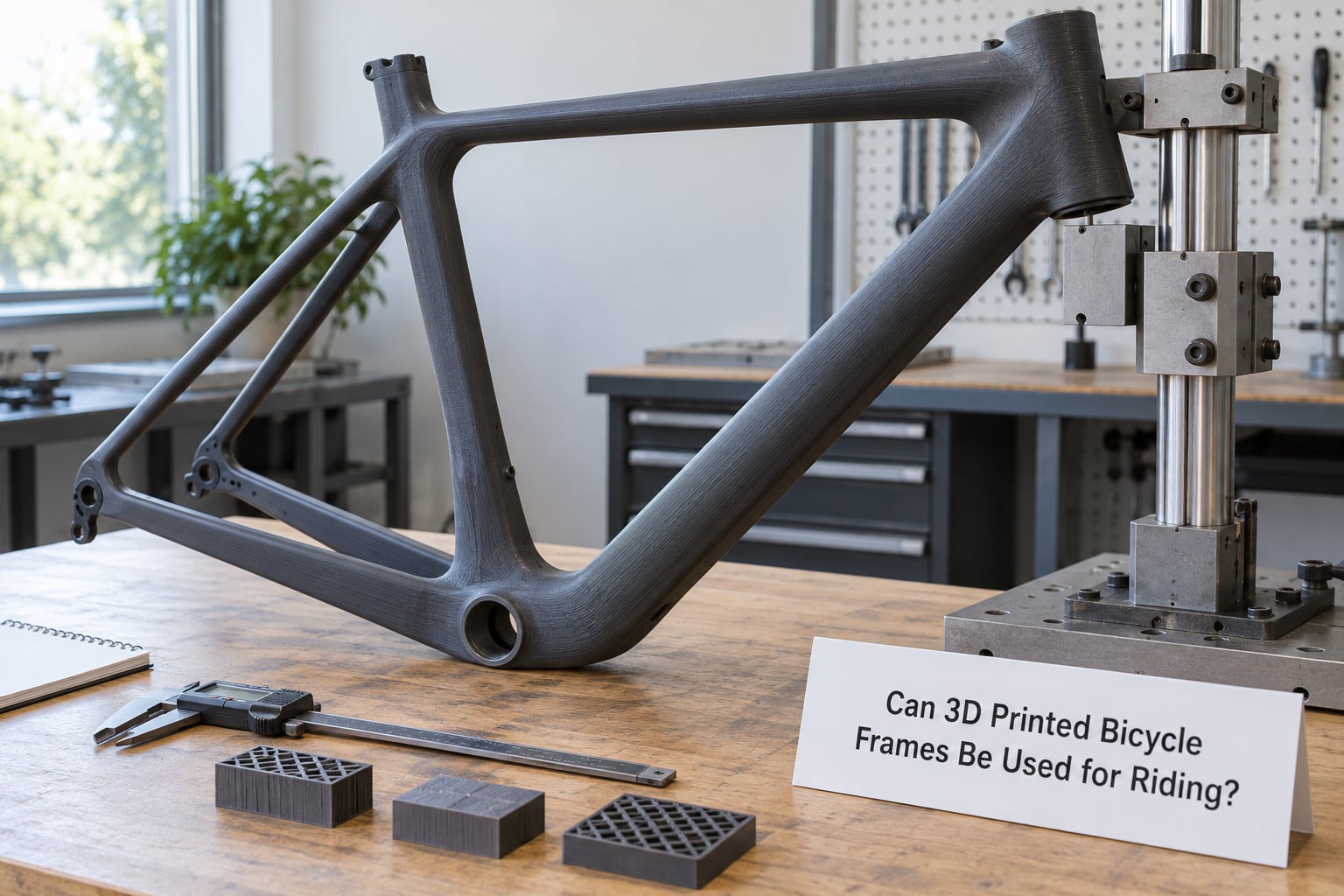
Yes, provided the frame was designed as a structure, made with a process that suits the loads, and tested. Riders are already doing it on commercially built frames with titanium lugs and printed dropouts, and full printed frames have been raced and ridden in trials and gravel use.
What is not established is the home-printed version. On r/3Dprinting, makers have reported being happy with how a printed frame looked and doubtful about the head tube and seat post. That gap is not a contradiction with the commercial bikes. A service bureau running laser sintering on PA12, or metal powder-bed fusion on Ti-6Al-4V with HIP and machining, is a different manufacturing operation from a desktop filament printer.
Rider weight comes up repeatedly in these discussions too, and it is a fair question. Frames get sized and rated for loads, and heavier riders and heavier terrain shift the design case. Any printed frame should be built and rated for the person using it rather than sold against a generic number.
What testing applies
Bicycle frames are covered by standards such as ISO 4210 for rims, wheels and cycles in general, and EN 14781 for racing bicycle frames and their elements. They set static load, fatigue and impact requirements. A printed frame has to meet the same standard as a welded one, and it can only be certified by testing documented specimens and a traceable production process.
For prototypes, jigs and fitting models, none of that is needed. Just be honest about which kind of frame you are holding.
How Do You Start Designing a 3D Printed Bicycle Frame?
Most first attempts fail at the joints, so plan the frame backwards from the loads rather than forwards from the shape. Work through geometry, load paths and orientation before you open the slicer.
The key design decisions
- Define load paths first. Pedalling torque, braking shear and vertical impact all enter through the bottom bracket, head tube and dropouts. Put material where those forces combine.
- Set the print orientation before the profile. Continuous fibre and powder-bed processes both behave best when the build direction and the main load direction agree.
- Design for the machine envelope. Check the printer’s build volume, and plan the orientation so supports land on surfaces you will machine anyway.
- Design the joints for machining. Bearing seats, pivots and dropouts should be modelled so a cutter can finish them, not so the printer hits them perfectly.
- Use lattices only inside known load zones. External lattice on a head tube is how frames get heavy and fragile. Keep it for interior volumes with understood stress.
- Plan the interfaces now. Bearings, bottom bracket standard, brake mounts and cable stops should follow standard dimensions so the rest of the bike can be assembled normally.
How to validate a prototype
Print a single joint or dropout first rather than a whole frame. A seat cluster or a bottom bracket shell is small, tells you about orientation and adhesion quickly, and fails safely on a bench instead of on a road.
Then iterate on weight like an engineering variable. On an r/cycling thread one maker took a printed part from 171g down to 138g through successive design passes, which is the normal rhythm: print, measure, take material out, print again.
Once a full frame exists, measure it against the model, statically load the head tube and bottom bracket, run a cyclic load well beyond a realistic ride, and only then consider riding it. Follow your local rules and the judgement of a qualified engineer or framebuilder, particularly if anyone else will ride what you build.
Frequently Asked Questions
What materials are best for 3D printed bicycle frames?
For load-bearing frames, printed Ti-6Al-4V is the strongest and most proven choice, with fatigue behaviour close to conventionally made titanium once heat treatment and hot isostatic pressing close internal porosity. Continuous fibre composites are lighter and can match carbon for stiffness-to-weight. Nylon PA12 suits prototypes and fittings, while PLA, PETG and TPU are practical for accessories rather than structural parts.
Are 3D printed bicycle frames lighter than aluminum frames?
Not automatically. A printed metal frame using lattices or topology optimisation can weigh less than an aluminium frame of the same geometry, because material is placed only where stress exists. Printed without lightweighting, it usually weighs more than aluminium because the process itself carries some overhead. Weight comes from the design decisions, not from the printer.
How strong and durable are 3D printed bicycle frames?
Strength depends on material, orientation and post-processing rather than on printing alone. Well-designed metal prints with stress relief, HIP and machining reach structural levels and can be fatigue tested to the same standards as welded frames. Polymer prints are usable in non-structural roles and prototypes. Anisotropy, internal voids and joint design are where failures actually originate.
Can you 3D print a complete bicycle frame at home?
You can print a complete frame on a desktop filament printer, and people do, but it is not something to treat as a riding frame. Build volume, layer adhesion and joint strength are the limits, and riders most often report weakness at the head tube and seat post. Printing accessories, mounts, dropouts and fittings at home is realistic and genuinely useful.
What is the main advantage of 3D printing a bicycle frame?
The main advantage is design freedom at low volume. A digital model can contain internal cable channels, hollow tapered tubes, lattice structures and geometry tailored to one rider without needing a mould, bending die or minimum order. Conventional processes cannot do those shapes, or need thousands of identical units before they become economical.
Do 3D printed bicycle frames need testing before riding?
Yes. Any frame intended to carry a rider should be proof tested, fatigue tested and inspected, and should meet standards such as ISO 4210 and EN 14781 where they apply in your market. Printed frames are harder to inspect internally than welded ones, so documented process control matters more, not less. Untested prints stay on a test stand, not on a road.
Conclusion
3D printed bicycle frames are most convincing when design freedom, rapid iteration or one-off geometry matters: low-volume runs, made-to-measure sizing, and parts with internal channels that no mould could produce. Structural use depends on material, process, post-processing and documented testing, not on the label.
Start by asking what the frame has to carry, whether the material suits that load, and who inspected it before it went out of the workshop. Get those three right and printing is a serious manufacturing route. Skip them and it is an expensive shape with a bicycle label on it.