3D printed implants are metal, ceramic or polymer implants built layer by layer so they match one patient’s anatomy instead of a standard size. The materials range from titanium alloys and cobalt-chromium to PEEK, bioresorbable polymers and zirconia, and each carries a different set of risks, indications and evidence.
Safety is not a property of the powder or the resin alone. It is the sum of the material, the print process, the post-processing, the sterilisation, the design and the clinical evidence behind that specific device. This guide walks through 3d printed implants materials and safety in the order a manufacturer would: what the device is, what it is made of, how the material behaves, how it gets tested, and where things go wrong.
Table of Contents
- What Are 3D Printed Implants?
- Which Materials Are Used for 3D Printed Implants?
- Titanium alloys, especially Ti-6Al-4V
- Cobalt-chromium alloys
- Stainless steel
- High-performance polymers: PEEK and PA12
- Bioresorbable polymers
- Bioceramics and zirconia
- Silicone and other elastomers
- How the materials compare
- How Does Material Choice Affect Implant Performance?
- Strength, fatigue and anisotropy
- Elastic modulus and stress shielding
- Corrosion and wear debris
- Imaging compatibility
- The process decides the defects
- How Is the Safety of 3D Printed Implants Evaluated?
- Mechanical and material verification
- Surface and defect characterisation
- Biocompatibility evaluation
- Sterilisation validation and clinical evidence
- What Safety Standards and Regulations Apply?
- Quality and design standards
- Biocompatibility and standards
- Regulatory pathways
- What Are the Main Risks and Failure Modes?
- Process risks, the ones that cause the most headlines
- Material and biological risks
- Design, handling and patient risks
- How Can Engineers Improve Implant Safety?
- Frequently Asked Questions
- Are 3D printed implants safe?
- What is the safest material for a 3D printed implant?
- What material is used for 3D printed teeth and dental restorations?
- Are 3D printed implants FDA approved?
- Are 3D printed implants sterile when they arrive?
- What are the health risks of 3D printing, and are they the same for patients?
- Conclusion
What Are 3D Printed Implants?
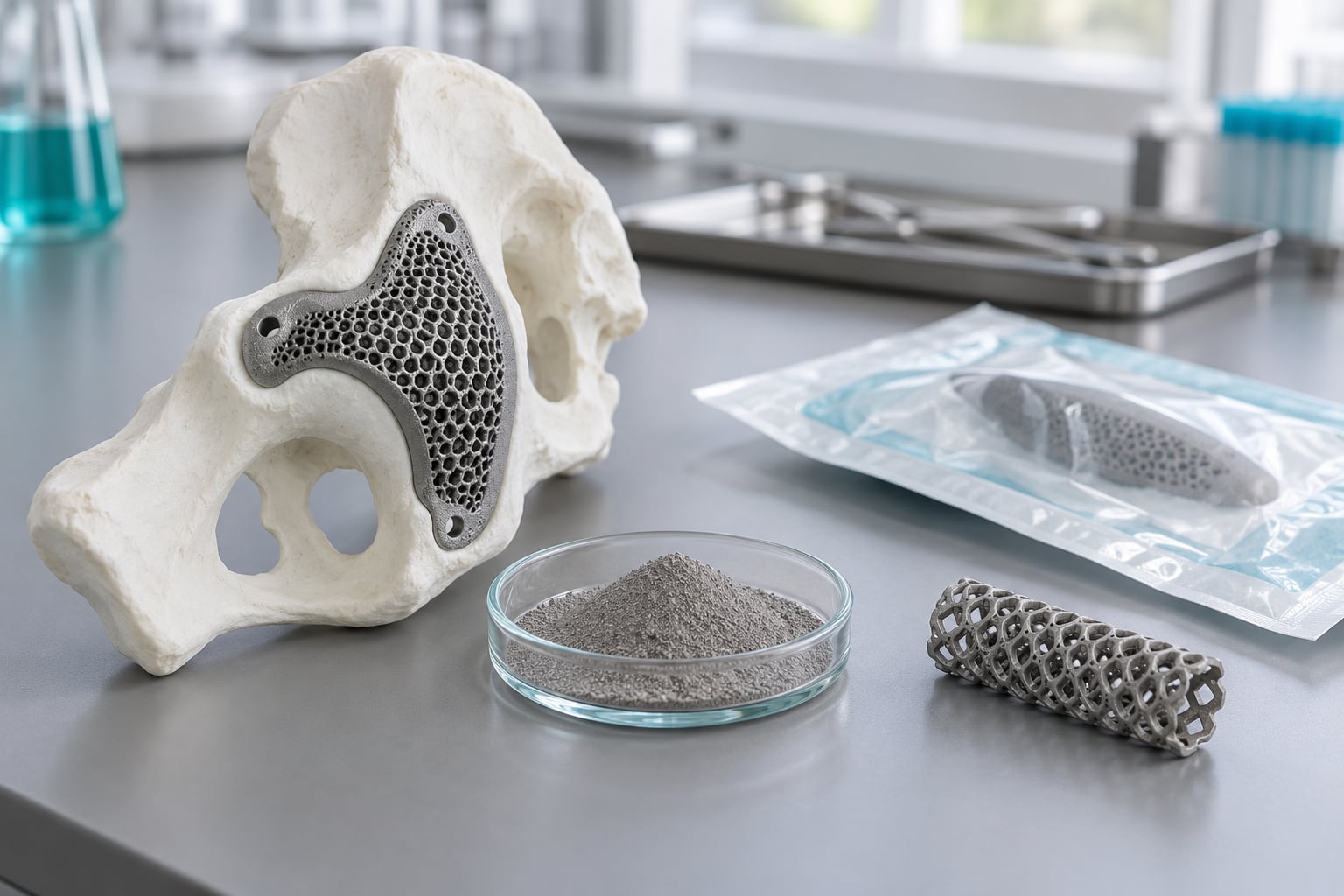
A 3D printed implant is a medical device produced by additive manufacturing, where a digital model is built up one thin layer at a time from metal powder, liquid resin or filament. Unlike a machined implant cut from a bar of stock, a printed one can be shaped to fit an individual skull, jaw, spine or joint exactly.
Two terms get mixed up. A patient-specific device is built from that one patient’s imaging, so it fits no one else. A patient-matched device comes from an anatomic range, where a size or shape is selected for a patient but the design itself was made in advance.
The common applications are cranial and craniomaxillofacial plates, dental implants and surgical guides, spinal cages, orthopaedic joint components, trauma fixation hardware, airway and tracheal stents, and facial or auricular prostheses. Anatomical models for surgical planning are printed too, though they never enter the body.
The critical distinction for safety: most of what circulates online about “3D printed medical devices” is a model, a guide, or a surgical instrument that only touches the outside of the patient. A permanent implant that stays in the body is regulated differently and carries a far heavier evidence burden.
Which Materials Are Used for 3D Printed Implants?
Six material families cover nearly all permanent 3D printed implants: titanium and titanium alloys, cobalt-chromium alloys, stainless steel, high-performance polymers such as PEEK and PA12, bioresorbable polymers, and bioceramics such as zirconia and hydroxyapatite. Elastomers like silicone cover facial and auricular prostheses, which sit on skin rather than inside tissue.
Titanium alloys, especially Ti-6Al-4V
Ti-6Al-4V is the default for load-bearing and cranial implants, and printing it does not change that. It combines high strength, low density, excellent corrosion resistance and a long record of osseointegration, meaning direct bonding with bone.
The print process matters more than it does for a machined part. Laser powder bed fusion leaves a rough, porous, orientated surface with internal defects, so a printed titanium component needs hot isostatic pressing or heat treatment, support removal, machining of bearing surfaces, and a cleaning cycle before it ever sees a steriliser. Alvanite is a variant used where higher strength is needed.
Cobalt-chromium alloys
Cobalt-chromium-molybdenum is the standard in joint replacement and dental applications where wear resistance drives the design. It is harder and denser than titanium, which makes it excellent for articulating surfaces that grind against each other over decades.
Its drawbacks are weight, a lower modulus than bone that can encourage stress shielding, and the release of cobalt and chromium ions. Ion release is a known concern in metal-on-metal bearing combinations, so printed cobalt-chromium parts are designed to minimise exposed bearing surface area.
Stainless steel
316L stainless steel appears in temporary fixation, sutures, staples and some non-permanent devices. It is easy to print and cheap, but it carries a higher risk of nickel release in sensitised patients and a lower fatigue limit than titanium. Most permanent load-bearing implants are titanium or cobalt-chromium instead.
High-performance polymers: PEEK and PA12
PEEK is the standout in community and clinical discussion because it is strong, lightweight, chemically inert, sterilisable, and radiolucent enough for MRI and CT. That combination makes it attractive for cranial implants, spinal cages and large orthopaedic components.
PEEK is not as strong as titanium, so it needs a careful design with generous radii and no sharp stress risers. Laser sintering also leaves it with more internal porosity than injection moulding. Implant-grade PEEK is blended with carbon fibre or hydroxyapatite, which changes both stiffness and how the material behaves under CT imaging.
PA12 is used more in surgical guides, temporary devices and external aids than in permanent load-bearing implants, mostly because of its lower mechanical performance and heat resistance.
Bioresorbable polymers
Polylactic acid and polycaprolactone are printed for implants that are meant to disappear, such as certain fracture fixation screws and some absorbable meshes. Their safety story runs in reverse: the implant has to break down predictably, release degradation products that the body can clear, and still hold enough load while it does.
Print orientation has a large effect on degradation rate, so a validated process matters here more than in permanent metal implants.
Bioceramics and zirconia
Zirconia, hydroxyapatite and alumina-based ceramic composites are printed for dental crowns and bridges, bone grafts and scaffolds. Zirconia is tough and fracture-resistant, while hydroxyapatite is chemically similar to bone mineral and bonds well with bone.
Ceramic printing is brittle and sensitive to defects, so a single pore or an incomplete sintering cycle can be the difference between a part that lasts and one that shatters in the mouth. Dental restorations are the most mature 3D printed medical devices in routine clinical use.
Silicone and other elastomers
Silicone is printed for facial, auricular and nasal prostheses, voice prostheses, and custom ear moulds. It is flexible, temperature-resistant and chemically stable, and it takes an accurate skin-surface match that is hard to achieve by hand.
Vendor and peer-reviewed sources agree the weak spot is long-term data. Biocompatibility looks fine in the short term, but decades of in-body stability data for printed silicone do not exist the way they do for metals.
How the materials compare
This table is the one thing you can print out and hand to a surgeon. The right column is the safety consideration that matters most for each material.
| Material | Key properties | Typical implant use | Main safety consideration |
|---|---|---|---|
| Ti-6Al-4V titanium alloy | High strength-to-weight ratio, corrosion resistant, biocompatible, osseointegrates with bone | Cranial plates, spinal hardware, dental implants, joint components, trauma plates | Porosity and residual stress from the print process, not the material |
| Cobalt-chromium-molybdenum | Very hard, wear resistant, higher modulus, heavier than titanium | Hip and knee bearings, dental frameworks, large joints | Metal ion release and stress shielding |
| 316L stainless steel | Strong, machinable, economical, magnetic | Temporary fixation, sutures, staples, non-permanent hardware | Nickel release in sensitised patients, lower fatigue limit |
| PEEK | Light, strong, inert, low artefact on MRI and CT, sterilisable | Cranial implants, spinal cages, large orthopaedic components | Lower strength than metal, sintering porosity, radiolucent follow-up |
| PA12 | Light, chemically stable, easy to print, moderate strength | Surgical guides, temporary aids, external devices | Heat resistance and mechanical limits restrict permanent use |
| Polylactic acid, polycaprolactone | Biodegradable, tunable degradation rate | Absorbable fracture fixation, scaffolds, meshes | Degradation products and premature loss of strength |
| Zirconia and hydroxyapatite | Hard, wear resistant, chemically like bone mineral, radiopaque | Dental crowns and bridges, bone grafts, scaffolds | Brittleness, single-defect sensitivity, incomplete sintering |
| Silicone and elastomers | Flexible, temperature resistant, chemically stable, skin-friendly | Facial and auricular prostheses, voice prostheses, ear moulds | Limited long-term in-body data for printed grades |
How Does Material Choice Affect Implant Performance?
Material choice sets the ceiling on strength, fatigue life, corrosion behaviour and how the body responds, but the printing process can hand you a worse version of a good material. Bone likes to grow into a rough, porous surface, and a printed part is rough and porous for free. The same features that help bone on the outside hurt fatigue strength on the inside.
Strength, fatigue and anisotropy
Layers bond to each other imperfectly. A defect sitting between layers acts as a stress concentration, and under millions of loading cycles that is where a printed part fails. The part is strongest along the build direction and weaker across it, so print orientation is a design decision, not a production detail.
Fatigue is the reason a static tensile test proves very little. An implant that survives a bench test at 60 percent of its limit can still crack in a hip after a decade of walking if it has large surface roughness and unclosed internal porosity.
Elastic modulus and stress shielding
Bone adapts to the load it feels. A material that is far stiffer than bone absorbs load and leaves the bone to weaken, so titanium’s stiffness matters as much as its strength. Engineers tune stiffness through the geometry, using a porous shell or a lattice rather than changing the composition, and this is one of the clearest reasons printing was adopted.
Corrosion and wear debris
Passivation is created during processing, so an improperly finished surface can corrode faster than a machined part. Where two metals meet, galvanic corrosion is possible if the more active metal is larger than the other and has a poorer surface. Over years, wear debris from any articulating pair generates local inflammation.
Imaging compatibility
Radiolucent polymers such as PEEK show up poorly on plain X-ray, so a radiopaque marker or additive is often included. That raises a follow-up problem community members raise often: the implant is harder to monitor on routine imaging, so clinical checks need a planned method and schedule.
The process decides the defects
Each technology has a signature set of defects, and this mapping is useful in its own right because it tells you what post-processing must fix before the device is clinically usable.
| Print technology | Materials used | Typical defect risks | Post-processing required |
|---|---|---|---|
| Laser powder bed fusion (LPBF, SLM) | Titanium, cobalt-chromium, steel, PEEK | Residual porosity, residual stress, roughness, anisotropy, lack of fusion | Heat treatment, support removal, HIP, surface machining, blasting, cleaning |
| Electron beam melting (EBM) | Titanium and cobalt-chromium | Elevated residual stress, rough surface, lower resolution, residual porosity | Heat treatment, HIP, machining of bearing surfaces, cleaning |
| Fused filament fabrication (FFF) | PLA, ABS, ASA, PA12, TPU | Interlayer voids, anisotropic strength, creep, thermal history | Support removal, thorough drying, mechanical testing, rarely sufficient alone for permanent load-bearing use |
| Polymer SLA or DLP | Photopolymer resins, dental ceramics | Uncured or partially cured resin, trapped support scars, shrinkage, brittle fracture | Support removal, complete washout, full UV or thermal post-cure, surface finishing |
| Binder jetting | Metal and ceramic powders | Binder residue, low as-built strength, high porosity by design | Dewax, infiltrate, sinter to full density, straighten and finish |
How Is the Safety of 3D Printed Implants Evaluated?
Safety is evaluated across the whole product lifecycle, not at the finished part. The chain runs from imaging to surgery, and every link has to hold. Design controls require documented verification that the design outputs meet the design inputs, which is why printing from a scan does not shortcut any of it.
Mechanical and material verification
Coupon-level testing establishes the material’s static strength, fatigue behaviour and fracture toughness, often compared against the equivalent machined standard. Then come tests on finished components: static load to failure, dynamic fatigue to a predicted service life, wear testing for articulating surfaces, and corrosion and fretting testing for junctions.
Surface and defect characterisation
Implant surfaces are examined for porosity, cracks, unmelted particles and support remnants. Depending on the process this means metallography, computed tomography of the part, surface roughness measurement, and inspection of the machining on bearing surfaces. This is a defined verification step, not an optional extra.
Biocompatibility evaluation
The ISO 10993 series is the standard test programme, chosen according to how long the device contacts the body and through which route. The series covers cytotoxicity, sensitisation, irritation, and, depending on the classification, systemic toxicity, implantation, and the chemical characterisation of what the device sheds. The chemical characterisation step matters more in additive manufacturing because a printed part can leach more than a machined one if the process left residues behind.
Sterilisation validation and clinical evidence
Sterilisation is validated for the specific device, with the worst-case material and the most awkward geometry, since a patient-specific implant has no identical earlier part to rely on. It is a residue study as much as a sterility assurance study, and ethylene oxide, gamma and e-beam all behave differently with polymers.
Preclinical work ends with bench and sometimes animal testing, then clinical data. Long-term outcomes for the newest materials remain thinner than for decades-machined titanium, and a review of custom 3D printed joint implants reports infection rates in the low single digits, with high precision of alignment correction. Those are encouraging numbers, not a substitute for a device’s own evidence.
What Safety Standards and Regulations Apply?
Implants are regulated as medical devices, and the rules differ by country and by risk class. Most permanent orthopaedic, cranial and spinal implants fall in the highest risk categories, which means a full premarket review rather than a simple notification.
Quality and design standards
ISO 13485 governs the quality management system for medical device manufacturing, covering everything from supplier qualification to complaint handling. ISO 14971 is the risk management standard that drives the risk analysis, hazard identification and control decisions across the lifecycle.
Biocompatibility and standards
ISO 10993 sets the biological evaluation requirements, as described above. ISO 17665, ISO 11135 and ISO 11137 cover moist heat, ethylene oxide and radiation sterilisation respectively. Cleanliness limits for packaging and manufacturing environments come under ISO 14644.
Regulatory pathways
In the United States, the FDA publishes specific technical guidance for additive manufacturing medical devices and evaluates printed devices through its premarket routes, with the 510(k) route available where a suitable predicate exists. The device regulatory file has to cover the software used to design the implant, the print parameters, the material certificates and the post-processing recipe, because all of it shapes the finished device.
That last point explains a common confusion. A material or process cleared for one device is not automatically acceptable for another. Approval attaches to a specific intended use, a specific design and a specific manufacturing process, so a change of printer, powder batch or build orientation can pull the device back into review.
Point-of-care manufacturing complicates it further. When a hospital prints a patient-specific implant on site, the questions of who controls the design, who holds the process and how the site is qualified all have to be answered inside the quality system. IMDRF additive manufacturing guidance addresses these topics and influenced both FDA and European thinking.
What Are the Main Risks and Failure Modes?
The dominant risks fall into four buckets: material risks, process risks, handling risks and clinical risks. Mixing them up is the most common mistake in this field, so it is worth separating them plainly.
Process risks, the ones that cause the most headlines
Residual porosity and lack-of-fusion defects reduce fatigue life and can act as initiation sites for corrosion. Residual stress builds up as the metal cools unevenly and can distort a part or drive cracking, which is why stress relief and HIP are mandatory rather than optional. Anisotropy means strength varies with build direction.
Incomplete resin cure is the best-known patient risk in dental printing. Uncured or partially cured photopolymer resin remaining in the part is a recognised toxicity concern, and complete washout plus full post-cure is what makes printed dental restorations clinically acceptable. Contamination from powders, cleaning agents, lubricants and support material is another quiet route. Sterilisation damage is real for polymers, where radiation can embrittle a resin and ethylene oxide needs full aeration time.
Material and biological risks
Metal ion release, galvanic corrosion at a mixed-metal junction, and wear debris from articulating surfaces are the long-horizon risks. On the polymer side, hydrolysis and thermal ageing can change stiffness and strength over years. For ceramics, a single critical defect is the whole story, since a ceramic does not tolerate a flaw the way metal does.
Design, handling and patient risks
A perfectly printed implant with a sharp stress riser in the design will still fail. Poor fitting or wrong orientation, machining a surface that should have been left rough, and contamination introduced during surgery are all outside the print process but inside the safety case. Patient factors complete the list: infection risk in an immunocompromised patient, an unfavourable anatomy, and a load-bearing expectation the device was not designed for.
How Can Engineers Improve Implant Safety?
Most of the improvement available to an engineer is in process control, not in discovering a new alloy. The practical measures are unglamorous and they work.
Validate the parameters and lock them. Qualify each parameter set on real coupons and real components, then treat it as a controlled recipe. Changing layer thickness, hatch spacing, scan strategy or powder batch without requalification is the same as changing the material.
Close the porosity. Hot isostatic pressing removes internal voids that no amount of surface work will fix, and stress-relief heat treatment before it prevents distortion. A vacuum or controlled atmosphere during melt avoids oxygen pickup that leaves brittle oxides in the microstructure.
Finish surfaces for their job. Bearing surfaces get machined to a defined finish; bone-contact surfaces get a controlled roughness or a lattice, sometimes with a coating. Then clean and inspect, checking for residual binders, support material and particles.
Keep the documentation intact. Material certificates with lot traceability, the print record, the post-processing record and the inspection results all form the device history. Add validated sterilisation for the worst-case geometry, and conservative clinical use that matches the indications in the cleared label.
Clinics deploying point-of-care printing face the same list, plus a change in the middle: the printing process becomes a manufacturing process, which means qualification, training, maintenance schedules and documented recipes, all inside an ISO 13485 system.
Frequently Asked Questions
Are 3D printed implants safe?
Approved 3D printed implants are safe to the standard every other implant must meet, which is a high one. Regulation attaches to a specific device, design, material and process, not to the words 3D printed. A printed part can only enter the body after design controls, mechanical testing, ISO 10993 biological evaluation, validated sterilisation and a regulatory review, and it carries the same evidence obligations as a machined device. Ask for that device’s own documentation, because a technology is not an approval.
What is the safest material for a 3D printed implant?
There is no single safest material, because safety depends on the body region and the load. Titanium alloys such as Ti-6Al-4V remain the benchmark for load-bearing and cranial implants because of their strength, corrosion resistance and long history of bone integration. Cobalt-chromium leads for wear surfaces, PEEK for radiolucent cranial and spinal components, and zirconia and hydroxyapatite for dental and bone applications. The right question is which material is proven for that specific use.
What material is used for 3D printed teeth and dental restorations?
Most 3D printed crowns and bridges are made from a ceramic or ceramic composite, either zirconia-based or a resin-matrix material reinforced with zirconia, alumina or glass filler. These are cured or sintered to full strength after printing. The material that must be fully removed and completely post-cured is the underlying liquid photopolymer resin, which is also the main patient-safety concern in dental printing.
Are 3D printed implants FDA approved?
Some are, and the approval is device-specific. The FDA issues technical guidance for additive manufactured medical devices and reviews printed implants through its premarket routes. Approval covers a particular intended use, design, material and manufacturing process, so a printer change, a new powder batch or a modified build orientation can trigger a new review. A 3D printed surgical guide or anatomical model is a much lower risk device than a permanent implant, and the two should not be treated alike.
Are 3D printed implants sterile when they arrive?
No. Patient-specific implants are normally manufactured under controlled conditions and then sterilised as a validated part of the production process, or supplied in validated packaging for sterilisation before use. Some point-of-care programs sterilise on site. In every case sterility is a validated process, not a property of printing, and residual chemical sterilants are themselves subject to limits, which is why cleaning and aeration steps are documented and audited.
What are the health risks of 3D printing, and are they the same for patients?
There are two separate sets of risks that get constantly mixed up. Patient risk concerns what ends up inside the body, such as uncured resin, metal particles, or a fatigue crack from porosity. Operator risk concerns the person running the printer, exposed to ultrafine particles and volatile organic compounds from melted filament and liquid resins. That second category is what NIOSH addresses in its guidance for makerspaces, schools and small businesses, and it is unrelated to implant safety.
Conclusion
When people ask whether 3D printed implants are safe, the honest answer is that printing is a manufacturing method, and the safety sits in the system around it: the material, the design, the validated parameters, the post-processing, the sterilisation, the regulatory evidence, and the follow-up. No material is safe on its own, and none of the approved 3D printed implants that carry strong clinical evidence hold a worse record than their machined equivalents.
If you are a patient, ask your surgeon what the implant is made of, whether it was printed or machined, and what evidence exists for that specific device in that specific body site. If you are an engineer or clinician building this work, start where the evidence is thinnest, which is long-term outcome data for the newer polymer and ceramic grades, and where the risk concentrates, which is post-processing.