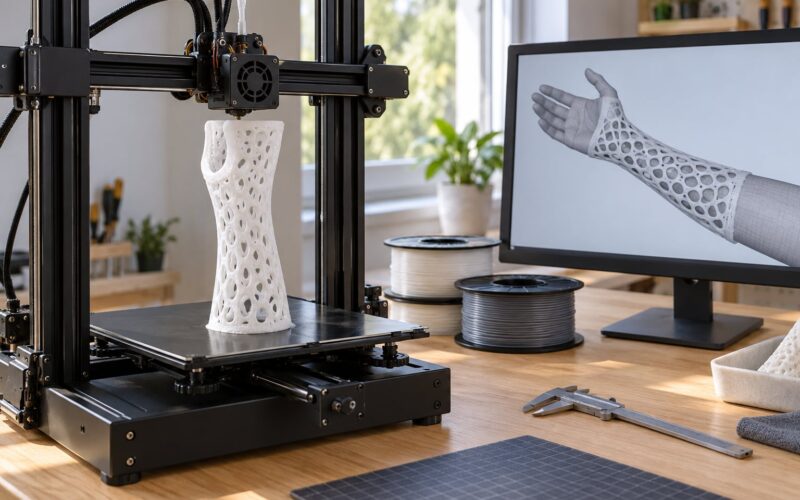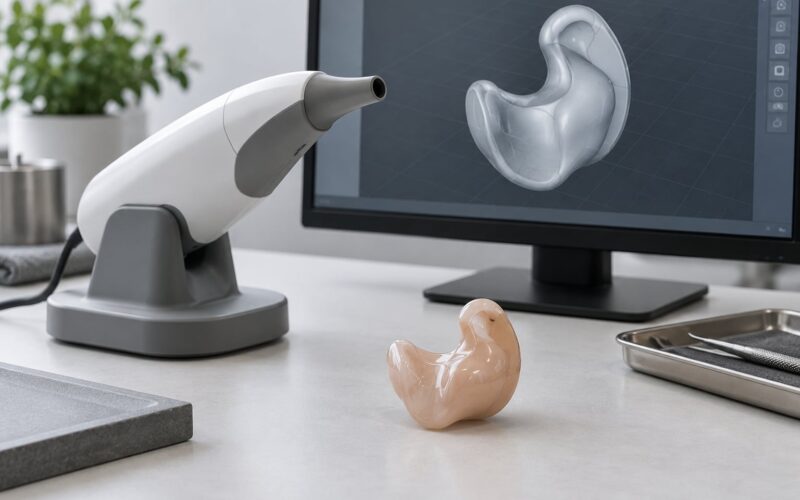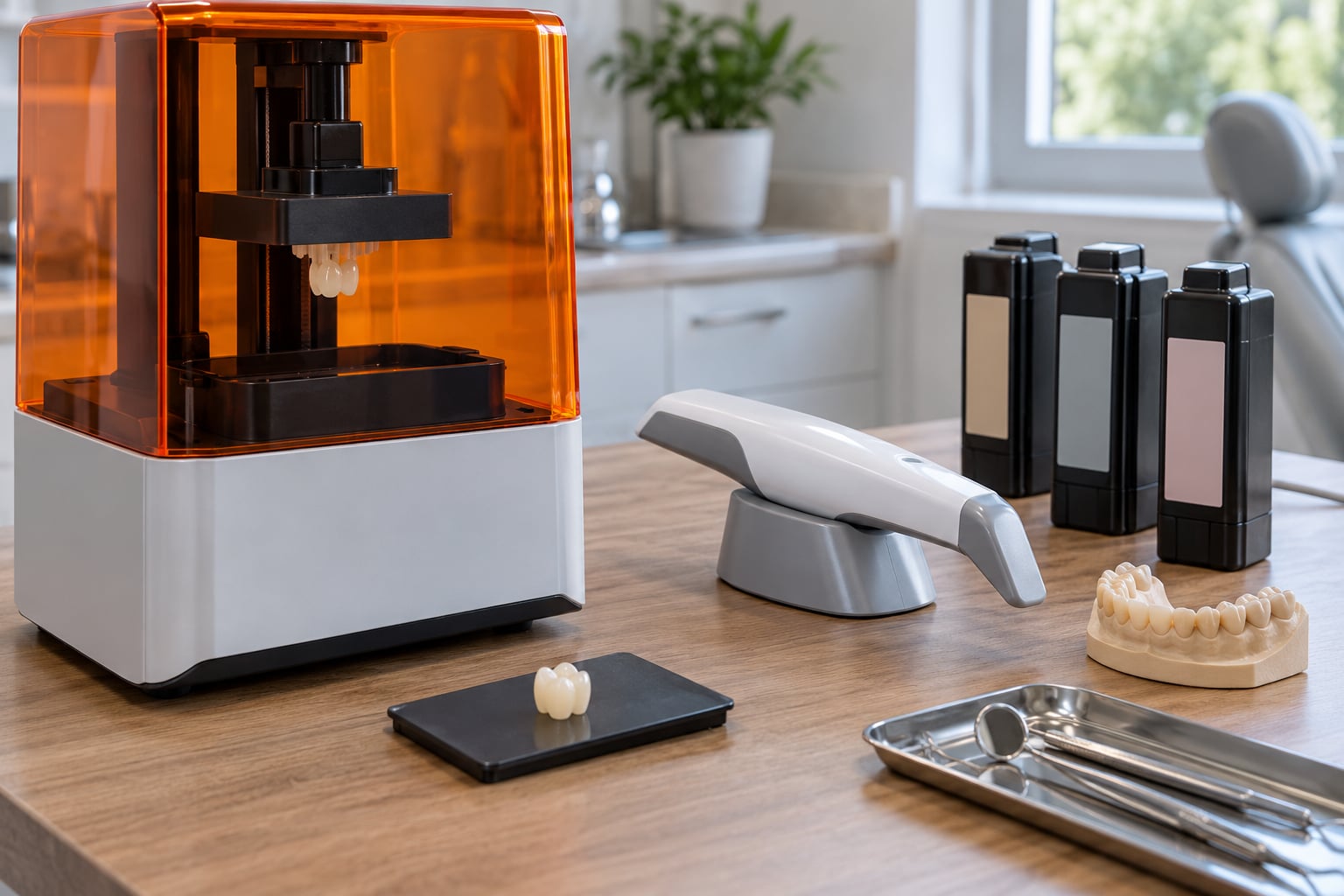
3D printing in dentistry means turning a digital scan of a patient’s mouth into a physical object, layer by layer, from resin or powder. In practice it is used to make crowns, bridges, aligners, retainers, surgical guides, dentures, night guards, bleaching trays and study models, most often from an intraoral scan rather than a silicone impression.
The interesting part is what disappeared. A crown that used to travel to a lab as a plaster model, came back as a wax pattern, got cast, and returned days later can now be designed on a screen and printed in an office during the same appointment. That shift is why how 3D printing is used in dentistry is now a question patients ask their dentist outright.
What follows is the workflow, the applications, and the honest limits. Nothing here replaces advice from your own dental professional.
Table of Contents
- What Is 3D Printing in Dentistry?
- How Does the Dental 3D Printing Process Work?
- 1. Capture the geometry
- 2. Design the object
- 3. Slice and nest
- 4. Print
- 5. Post-process
- Is 3D Printing the Same as 3D Scanning?
- What Dental Products Can Be 3D Printed?
- How Is 3D Printing Used in Restorative Dentistry?
- How Is 3D Printing Used in Orthodontics?
- How Is 3D Printing Used in Dental Surgery?
- How Is 3D Printing Used for Implants and Dentures?
- What Are the Main Benefits of 3D Printing in Dentistry?
- What Are the Limitations, Risks, and Safety Considerations?
- How Does 3D Printing Affect the Cost and Speed of Dental Care?
- How Can Readers Judge Whether a Dental 3D-Printed Product Is Suitable?
- Frequently Asked Questions
- What is 3D printing used for in dentistry?
- Is a 3D-printed dental crown as good as a traditionally made crown?
- How long do 3D-printed dental aligners take to make?
- Are 3D-printed dentures and dental implants safe?
- Can a dental 3D printer be used at home?
- Does 3D printing make dental care cheaper?
- Conclusion
What Is 3D Printing in Dentistry?
Dental 3D printing is additive manufacturing: a printer builds a solid object by adding thin layers of material, usually liquid photopolymer resin hardened by light. Most practices use stereolithography (SLA) or digital light processing (DLP), where a laser or a projector cures one ultra-thin layer at a time.
The six applications that come up most often in dental labs and practices:
- Crowns, bridges, veneers and inlays — ceramic resin restorations produced from a digital design of the prepared tooth.
- Clear aligners and retainers — transparent plastic trays shaped from a digital model of the full arch.
- Surgical guides — rigid templates that position drills and implants at planned coordinates.
- Dentures and denture bases — printed acrylic bases and teeth, sometimes as one monolithic piece.
- Dental and jaw models — working and study casts for planning, appliance fabrication and orthodontic labs.
- Splints, night guards and trays — occlusal splints, mouthguards and home-whitening trays printed from a bite scan.
Additive manufacturing earns its place here because it removes moulds. A lab no longer needs a plaster die, a refractory mould or a wax pattern to shape the final part. The digital file is the master, and the printer simply reproduces it. That is why a dentist with a scanner and a printer can produce a diagnostic model in an afternoon without involving an outside lab at all.
How Does the Dental 3D Printing Process Work?
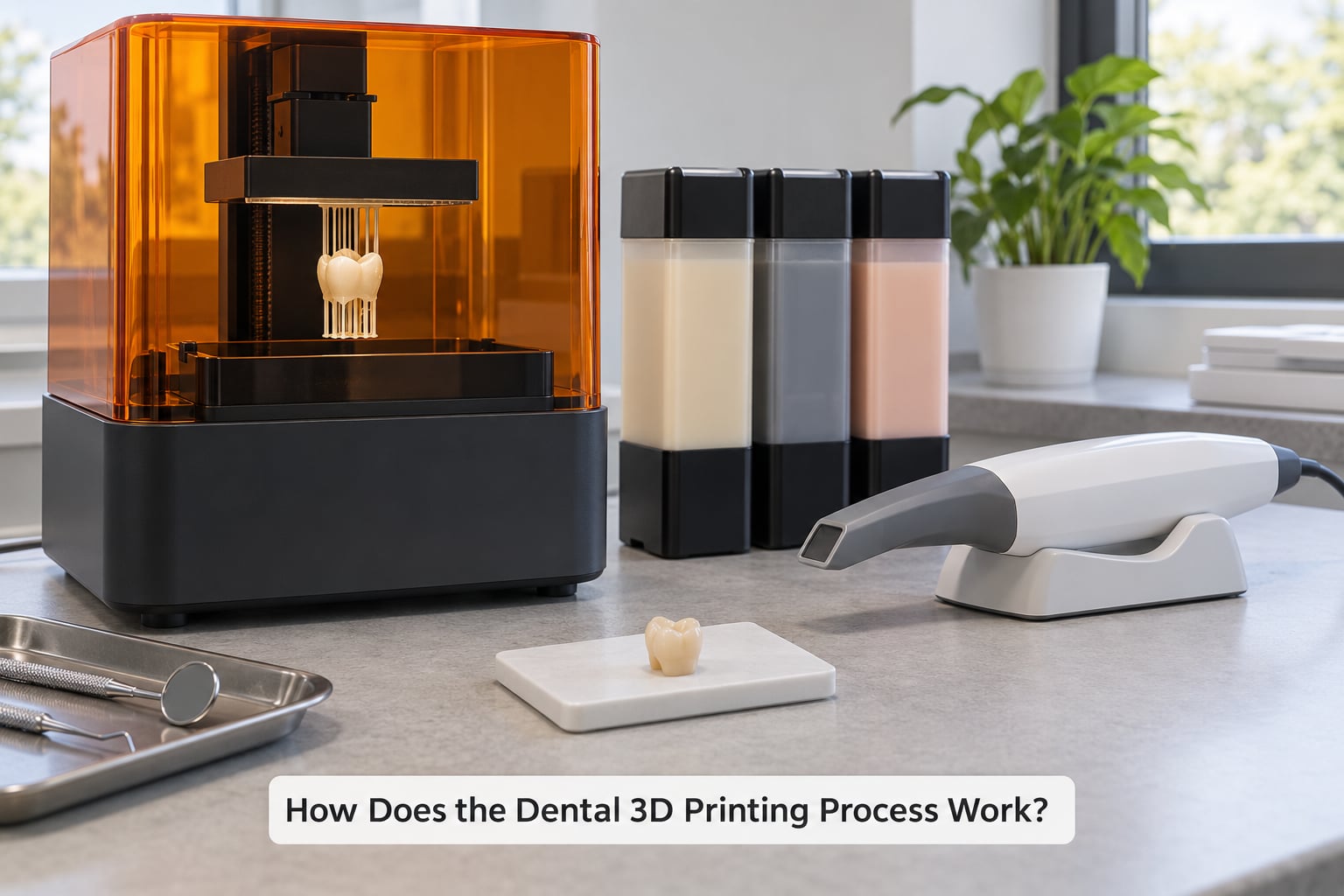
The workflow has five stages, and each one can introduce error that shows up in the finished appliance.
1. Capture the geometry
An intraoral scanner or a desktop lab scanner measures the teeth and gums, producing a point cloud that is turned into a mesh file, usually STL. Everything downstream depends on how clean that first capture is, which is why scanners get calibrated and why the surface is checked for artefacts before anyone designs on it.
2. Design the object
In CAD/CAM software, a technician or dentist draws the restoration, sets its margins, thickness and contacts, and matches it to the opposing teeth. The file may be designed from scratch or generated from a library of tooth shapes that gets adjusted to the patient.
3. Slice and nest
Slicing software converts the design into toolpaths and adds support structures for overhangs. Nesting software packs many parts onto one build plate at once, so a full plate of models costs the same resin as a single part and only takes the machine’s runtime.
4. Print
The printer cures layer after layer. Print time depends on geometry and layer height, and it ranges widely — a plate of study models may finish in roughly 20 minutes while a dense full-arch appliance can run for hours.
5. Post-process
Fresh prints are covered in uncured resin. They are washed in solvent, fully cured in a UV light or heat oven, then support material is removed and the piece is trimmed, sanded and polished. Skipping or rushing this step is the most common route to a weak or rough appliance.
Every clinical choice in that chain — material, thickness, design, timing — belongs to a qualified dentist or dental technician, not to the printer.
Is 3D Printing the Same as 3D Scanning?
No. They are opposite halves of one process, and mixing them up is the most common confusion.
3D scanning captures. A wand or camera sweeps across your teeth and records their shape as points in space. Nothing is made; you end with a digital model that exists only on a screen.
3D printing produces. A digital design is fed to a machine that builds a physical object you can hold, try in, or send to a lab.
They feed each other in a loop. You scan, print a model or a guide, use it in the mouth, then scan again to check fit and feed the corrected file back into the printer. Each pass around the loop tightens the accuracy.
What Dental Products Can Be 3D Printed?
| Application | Typical material | Customisation benefit | Main limitation |
|---|---|---|---|
| Crowns, onlays, veneers | Ceramic or hybrid resin | Matches individual tooth shape and bite | Strength depends heavily on material and post-processing |
| Clear aligners and retainers | Thermoformable plastic sheet | Built from that patient’s full arch | Only works as well as the plan that generated it |
| Surgical guides | Rigid sterilisable resin | Transfers virtual implant positions to the mouth | Useless if the scan or planning model was wrong |
| Denture bases | PMMA or cross-linked acrylic | Fits the ridge scan, fewer lab stages | Base strength lags milled acrylic in some studies |
| Dental and jaw models | General-purpose dental resin | Reproduces fine detail for appliances | Handling and storage damage without care |
| Night guards and splints | Flexible or rigid dental resin | Shaped to the patient’s bite | Thin layers can split without adequate curing |
| Bleaching and custom trays | Standard dental resin | Seals to the teeth, low waste of gel | Few risks, but fit still depends on the scan |
How Is 3D Printing Used in Restorative Dentistry?
Restorative work is where printing has moved furthest. A crown starts as a scan of the prepared tooth, gets a margin and internal geometry designed in CAD/CAM, then prints as a single piece with no joins or layered seams to weaken it.
Temporary crowns and bridges are the easiest place for a practice to start, because the appliance is worn for weeks and then discarded. Long-term zirconia or ceramic restorations still often come out of a milling machine, since subtractive cutting gives the material a dense, low-porosity surface.
Fit is the whole game. A printed restoration that contacts too hard at one point or leaves a gap at the margin will not seat, and the appointment gets longer. Good labs compensate with offset parameters, printed test pieces and a check of the bite before the piece goes back to the chair.
Dentists are candid about this. One r/Dentistry user describes printing all of a practice’s occlusal guards and reporting hardly any complaints, which tells you something different from the fracture stories below. The variable is not the technology alone; it is the material, the curing, and the quality control behind it.
How Is 3D Printing Used in Orthodontics?
Orthodontics leans on printing more than most specialties because every appliance is shaped to one mouth.
Aligners are the visible example. A scan of both arches produces a digital model that is segmented into individual teeth, moved through a simulated treatment sequence, and used to form plastic sheets over each step. Retainers come off the same scan, and study models get printed in batches for the lab.
Batch printing matters more than it sounds. One r/3Dprinting user reported fitting 13 models on a single run to streamline aligner production, and a dentallabnetwork member described printing a full plate of models on a consumer printer in about 23 minutes. Speed like that only comes from nesting many parts at once.
None of that replaces an examination. An aligner is a delivery mechanism for a treatment plan, and the plan comes from a clinician who has looked at the bite, the bone and the patient’s history.
How Is 3D Printing Used in Dental Surgery?
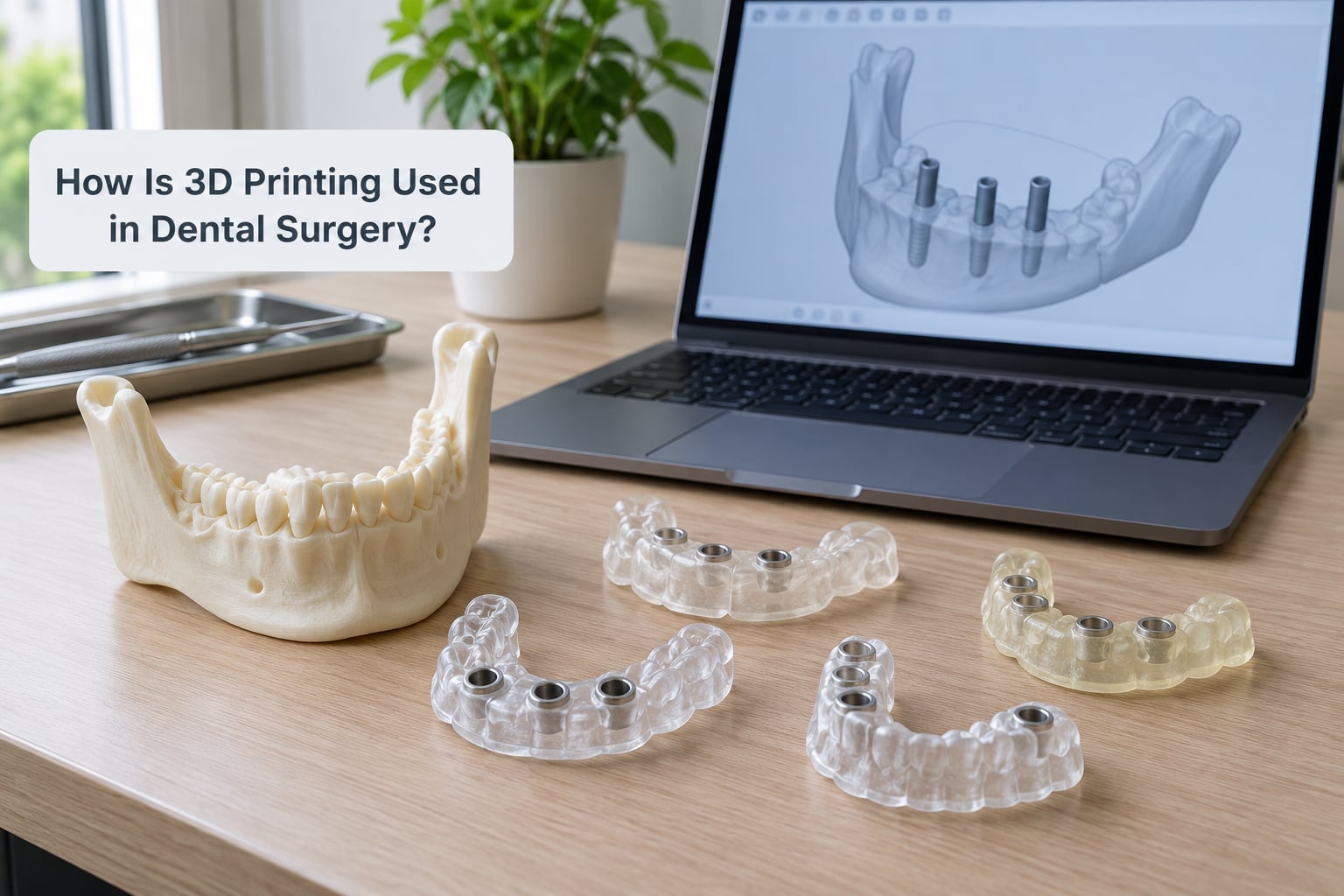
Surgical guides are the clearest case of printing removing real risk. A surgeon places an implant on a screen using scans and planning software; the planned position, angle and depth are then printed as a rigid sleeve that sits on the teeth and directs the drill.
What gets printed for surgery:
- Implant surgical guides that transfer virtual coordinates onto the clinical arch.
- Drill guides and sleeves controlling entry point and angulation.
- Anatomical models of a jaw with a tumour, defect or planned resection rehearsed on a physical replica.
- Planning aids and verification models used to check a plan before the patient is in the chair.
A printed jaw model can show a surgeon the exact shape of the bone they will work in, which is something a two-dimensional scan does not convey well. It costs a print to make one.
What printing cannot do is decide whether surgery is right for you. Diagnosis, risk assessment and the choice to operate belong to a licensed dental professional. A guide is only as good as the scan and the plan behind it.
How Is 3D Printing Used for Implants and Dentures?
Implant work uses printing as a support tool rather than a finished product: guides during surgery, provisional abutments and healing caps while the implant integrates, and anatomical models for planning. Fully printed implant fixtures remain the exception rather than routine practice, because the regulatory and long-term evidence bar is much higher for a part that stays in the jaw.
Dentures are a bigger story. Printing takes a full-arch scan and produces a base, sometimes with the teeth printed in and no separate acrylic processing. Fewer lab stages and no mould flask means a digital file that can be reprinted later, which matters when the ridge changes over the years.
Strength is the honest weak point. Studies cited in dental material research put flexural strength for 3D-printed denture bases in the region of 120 to 137 MPa, with highly cross-linked milled acrylic reported higher at around 146 MPa; the ISO threshold for denture base polymers sits at 65 MPa. All three clear the standard, but the gap is real.
That gap shows up in practice. One r/Dentistry user reported a lab switching to 3D-printed dentures and then several fracturing within weeks, prompting a return to traditional methods. Lab technicians weighing the choice should ask about validated printer, resin, washer and curing combinations, because resin chemistry does not transfer freely between machines.
What Are the Main Benefits of 3D Printing in Dentistry?
The proven wins are workflow wins, not magic ones.
- True customisation — every piece derives from an individual scan, so it matches that patient’s anatomy rather than an averaged mould.
- Reproducibility — keep the digital file and the appliance can be produced again years later, which matters for dentures worn against a changing ridge.
- Complex geometry — undercuts, thin walls and internal channels are awkward to mill but ordinary to print.
- Digital records — no plaster models to chip, lose or store.
- Shorter iteration — a design change is a software edit and a reprint, not a new lab conversation.
- Less material waste — printing adds material instead of cutting it away, though support material and failed prints still waste resin.
- Less discomfort — many patients avoid physical impressions entirely, which matters for anyone with a strong gag reflex.
Claims of universal cheaper treatment, faster healing or better long-term survival are marketing until a dentist can show you data for your specific case. Same-day production is real and depends only on how long the printer needs. Everything downstream is a clinical judgement.
What Are the Limitations, Risks, and Safety Considerations?
Nothing here is alarming, but it is worth knowing before you ask for a printed appliance.
- Material certification — only resins cleared for the intended use belong in your mouth. Not every general-purpose resin is biocompatible, and colourants are a common culprit.
- Dimensional accuracy — scanner error propagates. A dirty tooth, moisture or an unscanned margin shows up in the finished piece.
- Shrinkage — resin shrinks as it cures, so software compensation matters and a badly tuned printer drifts out of tolerance.
- Surface finish and porosity — printed surfaces are rougher than milled ones. Roughness harbours plaque, which is one reason denture bases get surface treatment and why denture stomatitis stays a clinical concern.
- Residual monomer — incompletely washed and cured prints can leach unreacted chemicals that cause tissue irritation. A print straight off the build plate is not a finished appliance.
- Strength trade-offs — as the flexural figures above show, some printed bases are weaker in bending than milled acrylic.
- Upfront cost — scanners, printers, washers and curing units plus training are a real investment, and small practices feel that first.
- Ongoing upkeep — printers need calibration, resin needs replacing, and failed prints waste material and time.
If something feels rough, causes soreness, or a printed appliance cracks or fractures early, stop wearing it and contact your dentist. Persistent pain, swelling or a loose fit needs professional review, not another reprint.
How Does 3D Printing Affect the Cost and Speed of Dental Care?
Speed is the headline, and it is real for the right applications. A model, a guide or a night guard can move from scan to delivery inside a single visit. Aligner sets need batches of prints and a shipping step, so they are not same-day. Final dentures are the slowest case because they may need a try-in, a wax assessment and a reline.
Cost is harder to generalise. Printing can cut a laboratory fee because there are fewer manual steps, but in-house equipment, software subscriptions, resin and staff time shift that expense rather than erase it. What a patient pays depends on the material, the complexity, the number of appointments, the local market and whether the appliance is temporary or permanent.
So the honest answer to does 3D printing make dental care cheaper: sometimes the lab gets faster and simpler, and the price you pay may not change at all.
How Can Readers Judge Whether a Dental 3D-Printed Product Is Suitable?
Before accepting a printed appliance, six questions get you most of the way there.
- Who designed it? A dentist, a technician, or an automated library that nobody adjusted for your bite.
- What is it made from? You should get a material name and confirmation that it is cleared for intraoral use.
- Was it made from your own scan? A generic or stock appliance is not a custom fit, however well printed it is.
- Did your dental professional approve it? Prescription appliances need clinical sign-off, not just a purchase receipt.
- Is the finish right? Smooth, fully cured, no visible layer lines or rough patches against the tissue.
- What happens if it fails? A lab with a digital file can remake it quickly. Ask who holds that file and how long they keep it.
Frequently Asked Questions
What is 3D printing used for in dentistry?
Dentists and labs use it to make crowns, bridges, veneers, clear aligners, retainers, surgical guides, denture bases, night guards, whitening trays and study models. The scanner captures your teeth, CAD/CAM software designs the appliance, and a printer builds it in thin cured layers of resin, usually for a temporary or same-day restoration.
Is a 3D-printed dental crown as good as a traditionally made crown?
It depends on material, thickness and post-processing rather than the printing itself. Printed ceramic resin performs well for short-term and moderate cases, while long-span zirconia restorations are still commonly milled because the material stays denser after cutting. Your dentist decides per tooth, based on how much you chew and where the crown sits.
How long do 3D-printed dental aligners take to make?
A full series needs several print runs plus the manufacturer or lab that forms and trims each tray, so expect days to a couple of weeks rather than one appointment. Individual replacement retainers and single night guards can often be produced the same day. Timing depends on the scanner, the design software and whether the lab is local or shipping the steps out.
Are 3D-printed dentures and dental implants safe?
Safety rests on the material and the finish. Resins cleared for intraoral use, fully washed and cured, are used routinely in practice. Studies put printed denture bases around 120 to 137 MPa in flexural strength versus roughly 146 MPa for highly cross-linked milled acrylic, both above the 65 MPa ISO threshold. Implants themselves are still placed surgically and are not usually fully printed.
Can a dental 3D printer be used at home?
Printing a study model at home is straightforward, and some labs run consumer printers for that work. Printing something that goes in your mouth is a different matter. You would need a validated printer, resin, wash and curing combination, plus a clinician to design and approve the appliance. Buying a printer does not make you a dental technician.
Does 3D printing make dental care cheaper?
It can reduce laboratory steps and shorten turnaround, particularly for models, guides, night guards and temporary restorations. Patient cost often stays the same, because scanner, printer, resin, software and training costs move into the practice instead. What you pay still depends on the material, the complexity, the number of visits and local dental fees.
Conclusion
3D printing in dentistry is now an ordinary part of the workflow: scan the mouth, design the appliance on screen, print it, cure and finish it, then check the fit in the chair. It has made temporary restorations, surgical guides, models, night guards and some dentures far faster and more precisely personalised than the mould-and-cast route it replaced.
It has not made dentists optional. Material choice, clinical decisions and quality control still decide whether a printed appliance works well, and the published strength data shows real trade-offs in long-term applications.
If you are curious whether a printed option makes sense for you, book an appointment and ask your dentist whether your case suits a digital workflow, what material they would use, and who would be responsible if the appliance needed remaking.