Wet filament is the quiet reason good printers produce bad parts. Learning how to store 3D printer filament to prevent moisture comes down to three things: a container that seals, desiccant that pulls water out of the trapped air, and a room temperature that does not swing all day. Get those right and most spool problems disappear.
The whole job takes about ten minutes per spool plus a two-minute check every week or two. No special equipment needed for a small setup, though a gasket bin and a cheap hygrometer change everything on humid days.
Table of Contents
- What You Need
- How to store 3D printer filament by material type
- How to Store 3D Printer Filament to Prevent Moisture: Step by Step
- 1. Start With Clean, Fully Dry Filament
- 2. Choose a Container With the Right Seal
- 3. Add the Right Amount of Desiccant
- 4. Control the Storage Environment
- 5. Label Spools by Opening Date
- 6. Check the Storage System on a Schedule
- 7. Avoid the Mistakes That Ruin the Setup
- Common Mistakes
- Frequently Asked Questions
- Do PLA and PETG filament spools need to be sealed after opening?
- Can silica gel packets be reused when storing 3D printer filament?
- Is a vacuum bag enough to protect filament from moisture?
- Should opened filament be stored in a refrigerator or freezer?
- How can I tell whether 3D printer filament has absorbed moisture?
- Does factory-sealed filament still need moisture protection during long-term storage?
- Conclusion
What You Need
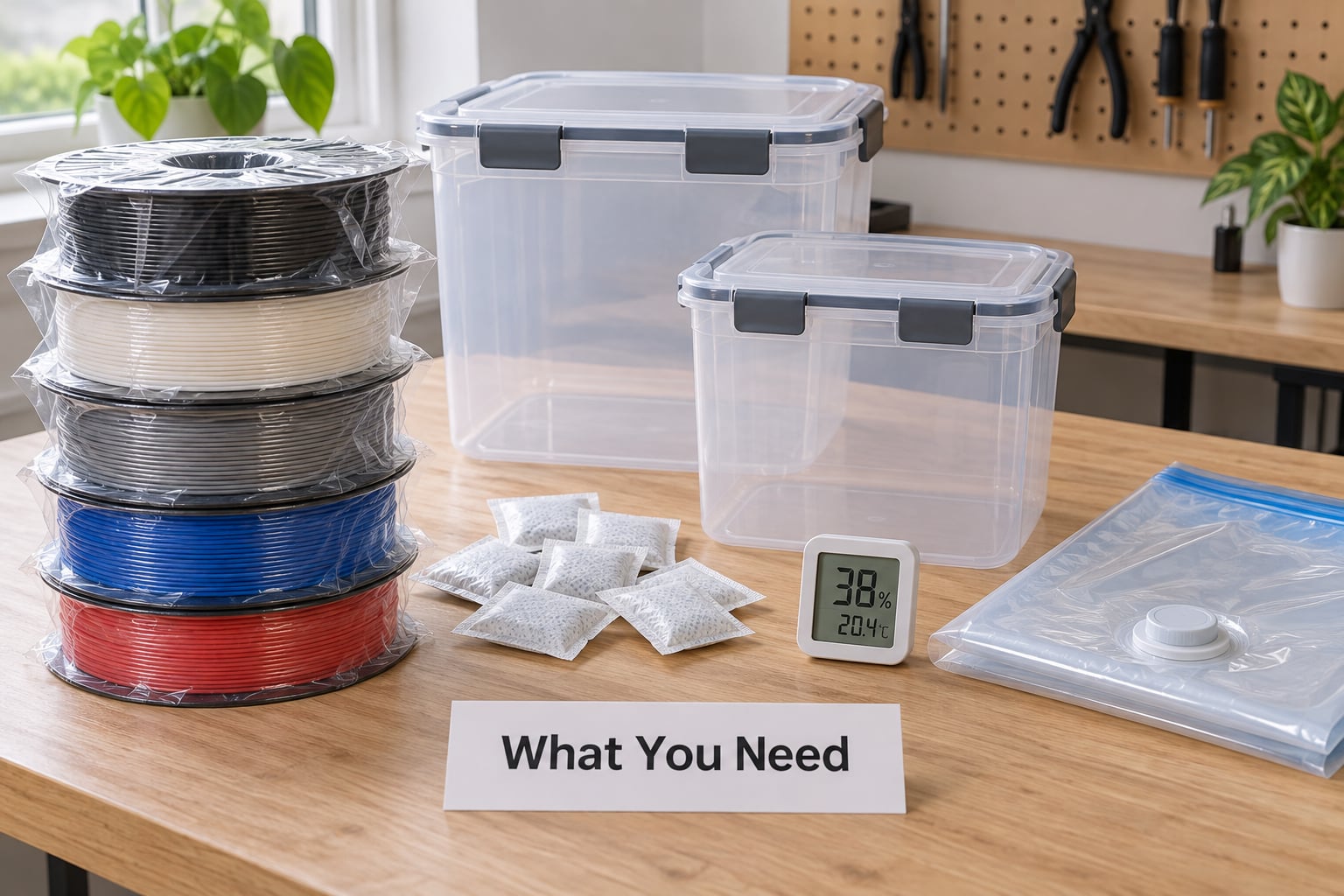
Hygroscopic simply means a material pulls water vapor out of the air. PLA, PETG, ABS, ASA, TPU and nylon all do it, and PETG, TPU and nylon do it fastest. Desiccant is the drying agent that traps that water so the filament never sees it.
Relative humidity, or RH, is how much water is in the air as a percentage. Aim to keep filament containers under 15% RH, and under 10% for nylon and TPU.
Here is the kit list. Everything on it is optional except the container and something to reseal with.
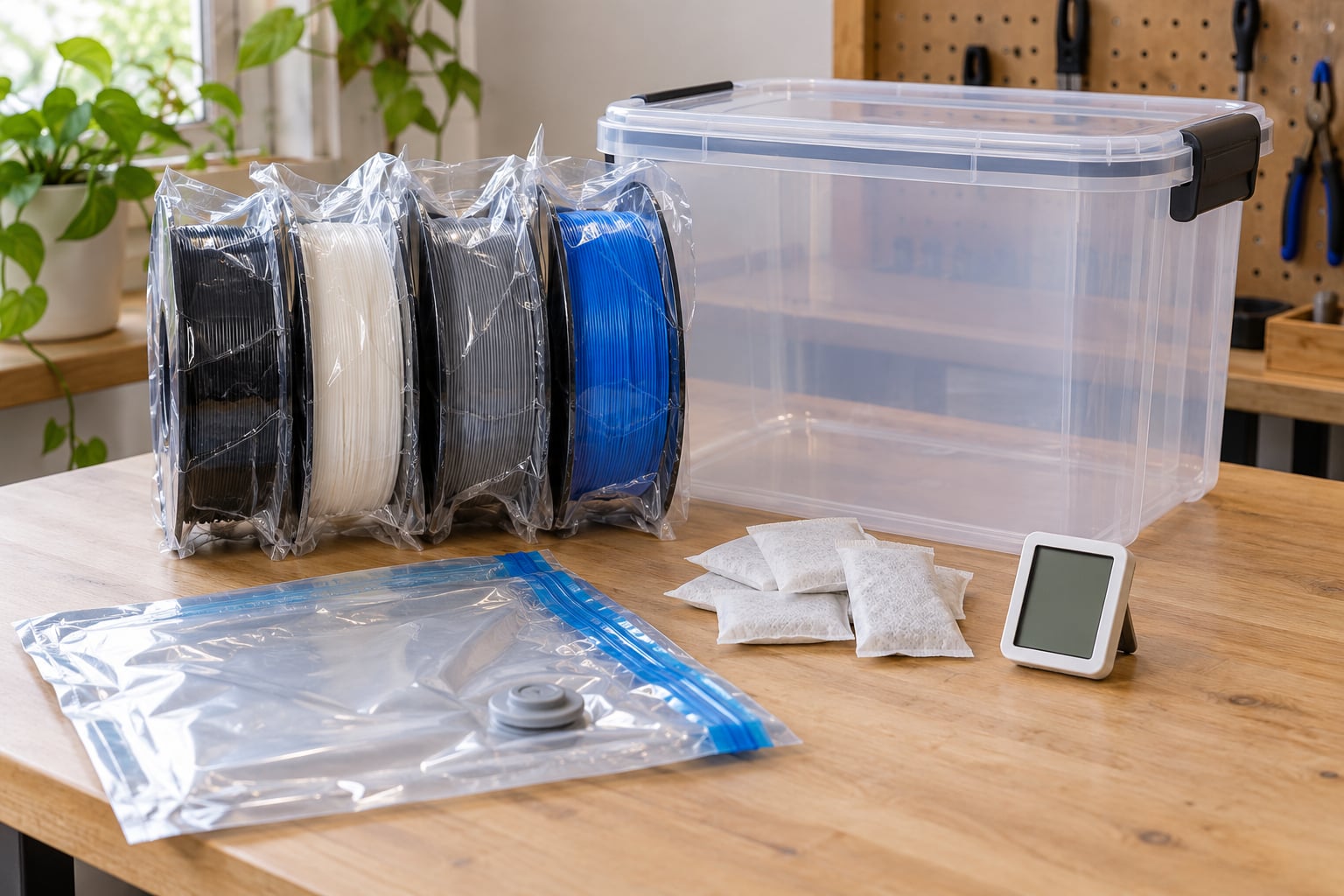
- A rigid airtight tub with a gasket seal, one spool per tub
- Color-indicating silica gel packets, enough for roughly one packet per spool
- A vacuum storage bag and hand pump if you want a second layer of protection
- A small digital hygrometer you can leave inside a container or read from the shelf
- A dry box with a feed port for the spool you are printing from right now
- A clean, dry shelf away from direct sunlight, heaters and exterior walls
Not all of these need to happen on day one. Most people start with a gasket bin and silica gel, then add a hygrometer once they realize their garage is a very different place than their living room.
How to store 3D printer filament by material type
This table is the whole material story in one place. The guidance column is roughly how much protection each one needs once the spool is open in a normal indoor room.
| Material | Moisture sensitivity | Practical guidance |
|---|---|---|
| PLA | Moderate | Sealed tub and one silica packet is plenty. Reseal within a few days of opening. |
| PETG | High | Stringing and popping appear fast. Seal immediately, target under 15% RH. |
| ABS and ASA | Moderate to high | Store sealed. Warping complaints are often actually moisture. |
| TPU | High | Keep under 10% RH. Bubbles in the strand make print feeding difficult. |
| Nylon | Very high | Sealed or not, it will absorb water. Dedicated dry storage, under 10% RH. |
The recurring mistake is treating PLA like nylon. Someone opens a PLA spool, leaves it clipped to the printer for three weeks, and blames the printer when layers separate.
How to Store 3D Printer Filament to Prevent Moisture: Step by Step
1. Start With Clean, Fully Dry Filament
You cannot store what has not been dried. Any spool you are about to seal should be dry first, and factory-sealed vacuum bags are the easy case because the material was dried at the factory before packing.
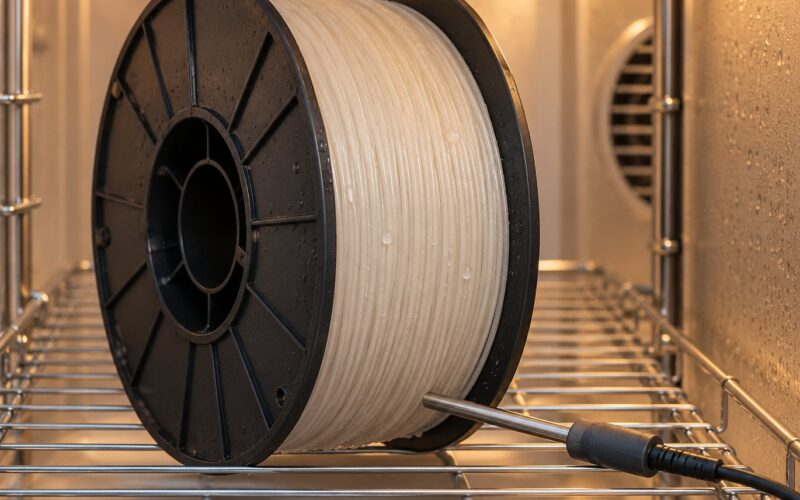
Avoid heating sealed filament. A vacuum bag in a warm oven builds pressure, and nylon can absorb moisture in the bag before it ever reaches your dryer.
The visible sign of success is simple: the filament goes into the container dry, and the dryer’s own time and temperature reading, not a guess.
2. Choose a Container With the Right Seal
The container matters more than the brand. Four options cover almost every budget, and each one trades cost against how well it blocks air.
- Resealable plastic tubs: the everyday choice. Cheap, stackable, and good enough for PLA if the lid has a real gasket.
- Filament-safe storage boxes: thicker walls and locking latches, built to take repeated opening without warping.
- Vacuum bags: a strong second layer, especially around back-to-back prints or spools you will not touch for months.
- Dry boxes: for the spool mounted on the printer, with a feed port so filament runs straight from a dry chamber into the extruder.
On Reddit, cereal containers from the brands people actually keep for years come up again and again as the cheap winner, usually paired with orange color-indicating silica gel so you can see moisture getting in.
A frequent disappointment is buying a bin advertised as airtight with no gasket at all. Test it: close the lid, then squeeze the sides. If air moves, it is not sealed and no amount of desiccant saves it.
3. Add the Right Amount of Desiccant
One packet of silica gel per one-kilogram spool is a sensible starting point, and more is fine in a large bin holding two or three spools. Place the packet on top of the spool or beside it in a small 3D-printed holder so beads never roll against the plastic.
Color-indicating beads absorb up to about a third of their weight in water. Blue or clear means dry, and pink means spent. Replace spent beads rather than shaking them off, and recharge them in a low oven or a dehydrator, then let them cool inside the closed container so they do not reabsorb humidity on the way back down.
Signs the desiccant is doing its job: the indicator still reads dry weeks after sealing, and the filament inside has no visible fizz or bubbles when you extrude a test length.
4. Control the Storage Environment
Containers do more than block incoming humidity. They trap whatever air is already inside, so the room around them still matters. Keep the shelf away from exterior walls and heat sources, and check the readings from your hygrometer rather than assuming.
Under 15% RH inside is the working target. A closet in a dry winter often reads differently from a garage in July, and that gap is exactly where condensation sneaks in.
Condensation shows up as droplets on the inside of the lid or tub wall, usually after a cold night in a garage or shed. It forms because warm humid room air gets sealed inside during the day, then the container cools overnight and the vapor drops out as water. Steady indoor temperature avoids this; big daily swings do not. Knowing how to store 3D printer filament to prevent moisture means treating the room as part of the container.
People in dry inland climates report getting away with much less, and they are mostly right, but a dry climate is not a substitute for sealing. Cheap bins without gaskets fail in Colorado too.
5. Label Spools by Opening Date
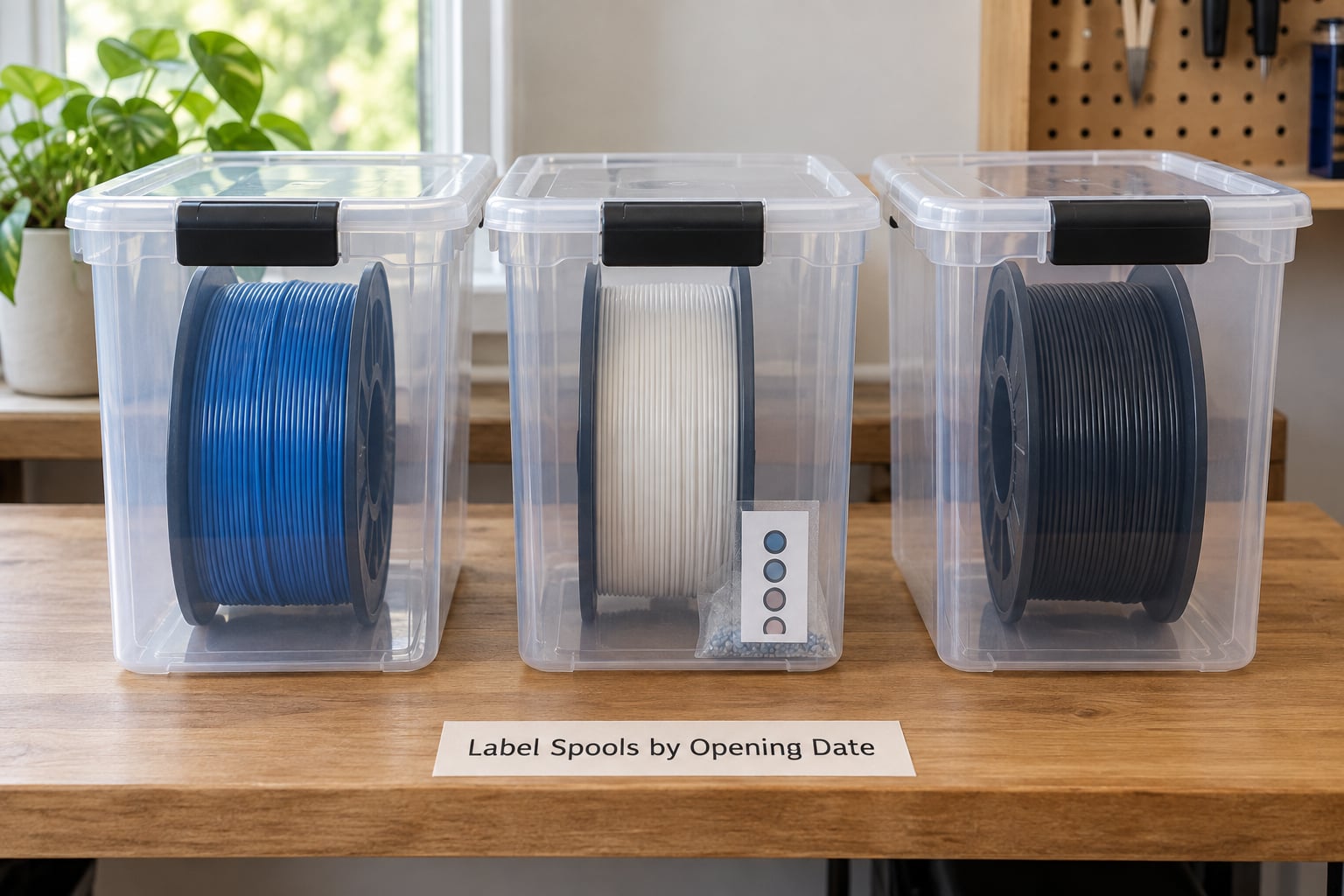
A five-second label saves you from guessing later. Write the material type, the date you opened it, and whether it went straight into a sealed tub or needs drying first. For bigger collections, note the expected use order so the oldest opened spool prints next.
This FIFO habit matters most once you own more than a handful of spools, because resealing every single container after each print stops happening. The label tells you which ones are already open, so you know exactly what to test before it hits the plate.
You will see this pattern again on r/3Dprinting and the Prusa forums: people with thirty spools still manage them because everything lives in one place with a date on it, not because their storage is clever.
6. Check the Storage System on a Schedule
Once a week for a small setup, once a month for a large collection, run the same loop. Check that every lid is fully seated. Look at the silica gel and replace anything pink. Look for condensation or a dull, chalky surface on the filament.
Then watch the printer itself, because it tells you what a lid cannot. Audible popping or crackling at the nozzle, steam or bubbles in the strand, heavy stringing, a matte or rough surface, and layer lines that separate under a fingernail all point at moisture.
The pop test settles it in ten seconds: extrude a short length of filament into the air. Steady and quiet means dry. Bubbling, spitting, or a hiss that sounds like steam means wet, and that spool should be dried before it goes back into storage.
7. Avoid the Mistakes That Ruin the Setup
- Using ordinary thin zip bags with no desiccant and calling it stored
- Leaving containers in humid rooms, basements or unheated garages
- Overfilling tubs so the lid cannot seat properly and the seal fails
- Dropping desiccant beads straight onto the spool
- Assuming a sealed spool means a dry spool
- Returning damp filament to storage without drying it first
Common Mistakes
Zip-top bags are the most debated option in this topic, so here is the honest answer. Freezer bags do work for short-term storage in a dry room, but they are thin, they flex with humidity, and they rarely hold a seal for months. Double-bagging helps a little. Putting a color-indicating packet inside and writing the open date on the outside helps more.
Treat a bag like a container you reseal immediately after every use, and think of it as a temporary holding spot rather than storage. Once you have more than a few spools, a gasket tub per spool is less fuss than resealing ten bags.
A second big error is drying a spool and then leaving it on the printer’s spool holder, where it starts absorbing water again within a day or two. Dry, then reseal, immediately.
People also spend on a dedicated filament dryer before solving storage, then wonder why the problem keeps returning. Storage is prevention, drying is recovery, and recovery only lasts as long as the prevention holds.
For tight spaces, one large container with several spools beats several small ones, provided you add a packet per spool and open it less often. For mixed materials, separate tubs by family, keep nylon and TPU in the driest spot, and never store a hot or damp spool next to dry ones. For a setup that gets opened constantly, the dry box feeding the printer is usually the better investment than a bigger shelf.
Frequently Asked Questions
Do PLA and PETG filament spools need to be sealed after opening?
Yes. Once a spool is opened, treat it as an ongoing moisture risk, especially PETG, TPU and nylon. Reseal it in a gasket-sealed tub with a color-indicating silica gel packet as soon as your print finishes. PLA tolerates open air longer, usually weeks in an ordinary indoor room, but sealing costs nothing and removes the guesswork. Vacuum bags or a dry box work well for spools you return to regularly.
Can silica gel packets be reused when storing 3D printer filament?
Yes, once they are fully recharged. Color-indicating beads turn pink when they are saturated, so replace them at that point or bake them until the colour returns to blue or clear. Let them cool inside the closed container so they do not pick up humidity on the way down. Reused packets are fine as long as they are dry again; a packet that stays pink after recharging has usually been baked too hot.
Is a vacuum bag enough to protect filament from moisture?
A vacuum bag is a good second layer, not a complete storage plan. It removes most of the air, so it slows moisture gain while the seal holds, and it works well for spools stored for months. It does nothing about condensation if the bag sits somewhere with big temperature swings, and it is easy to forget to re-pump. Pair it with a desiccant packet and a stable, dry location.
Should opened filament be stored in a refrigerator or freezer?
No. Cold storage brings real downsides: repeated temperature cycling causes condensation inside the container, and the moisture problem returns once the spool warms up again. If you already keep filament somewhere cold, let the sealed container reach room temperature before opening it, so condensation forms on the outside of the tub instead of on the filament. A stable indoor shelf beats a cold one every time.
How can I tell whether 3D printer filament has absorbed moisture?
Run the pop test: extrude about 30 cm of filament into the air and listen. Dry filament feeds quietly and comes out smooth. Wet filament bubbles, spits, or hisses like steam at the nozzle. In a print, the same moisture shows up as popping, heavy stringing, a rough matte surface, bubbles in the strand, and layer lines that split under light pressure. PETG and TPU fail fastest; nylon can be wet without any obvious surface change.
Does factory-sealed filament still need moisture protection during long-term storage?
It depends on the packaging. Spools packed in a factory vacuum bag with desiccant stay protected as long as the bag is intact and you do not open it, so those can sit on a normal shelf. Spools sealed only in a cardboard box or an unsealed plastic bag are already slowly absorbing water from the cardboard. Either way, store sealed spools off the floor, away from exterior walls and heat, in a room you can check with a hygrometer.
Conclusion
Start tonight. Put your cleanest, driest spool into a sealed tub with a color-indicating silica gel packet, close it properly, and put a hygrometer on the shelf beside it. That single step fixes more wet-filament problems than any gadget.
Once it is in place, the routine is what keeps it working: reseal immediately after every print, check the beads and the lid on a schedule, and dry anything that pops before it goes back on the shelf. Once you have the habit down, learning how to store 3D printer filament to prevent moisture stops being a chore and just becomes part of how you print.