Yes, 3D printers release fumes, and the answer to most “is it safe” questions is that 3D printing ventilation and fume safety is a matter of capturing emissions where they happen rather than hoping a room’s air will handle them. A heated nozzle gives off volatile organic compounds (VOCs) and sub-100-nanometre particles that you cannot see or smell reliably, so the practical setup is an enclosure plus a slow, filtered exhaust that pulls air out of the chamber and vents it outdoors.
That is the whole idea, but the details matter. Which filament you print, where the printer sits, and how the duct is sized decide whether the setup actually works. Get a fan too powerful and it defeats the filter you paid for; skip the enclosure and emissions spread across the whole room instead of staying in one place.
This guide covers what actually comes off a printer, which materials deserve the most caution, how to vent an enclosure properly, and what filtration can and cannot do.
Table of Contents
- What Is Emitted During 3D Printing?
- Why odour is a bad warning signal
- Health effects worth knowing about
- Which 3D Printing Materials Require the Most Caution?
- How Do You Ventilate a 3D Printer Safely?
- Negative pressure beats recirculating filtration, most of the time
- Size the airflow from your enclosure volume
- Why an open window alone is not enough
- Check that the enclosure is actually under pressure
- Watch for the door-open release event
- Do You Need a HEPA or Carbon Filter?
- How Can You Build a Safer 3D Printing Setup?
- What Safety Checks Should You Do Before Printing?
- How Do You Choose Ventilation and Fume Safety Equipment?
- Room-based choices
- What actually separates good equipment from bad
- What respirators do and do not solve
- Frequently Asked Questions
- Is PLA safe to print without ventilation?
- Do I need ventilation for ABS and ASA?
- Will a HEPA filter remove 3D printer fumes?
- Is an air purifier enough for 3D printing?
- Do I need to seal my printer while using an enclosure?
- When should I use a respirator instead of relying on ventilation?
- Where to Start
What Is Emitted During 3D Printing?
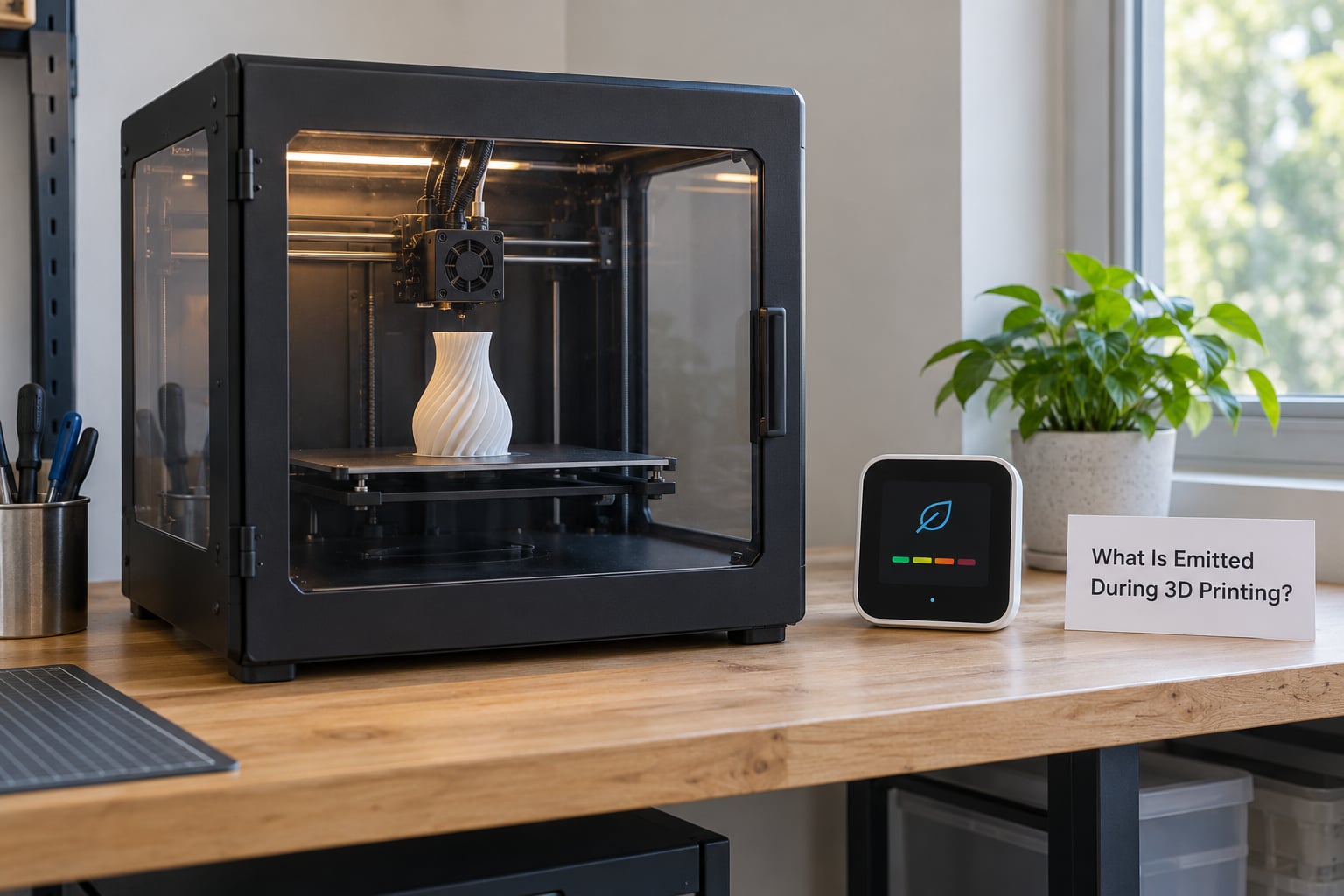
Two things matter: ultrafine particles and volatile organic compounds. Ultrafine particles (UFP) are airborne particles under 100 nanometres, small enough to reach deep into the lungs and, at some sizes, across into the bloodstream. VOCs are the gases given off when polymer is heated past its melting point, and they include whatever the manufacturer put in the filament along with breakdown products of the polymer itself.
The particles are the reason an enclosure cannot simply be ignored. In the one test on the ranking pages that published actual numbers, a dental printer’s chamber measured more than 500,000 particles per cubic foot while printing, roughly 72,000 per cubic foot at three feet away, and near zero once the air was drawn through HEPA extraction. That drop tells you the emissions were concentrated in the chamber and that capture-at-source works.
Why odour is a bad warning signal
Your nose detects a few compounds at fairly high concentrations. Styrene, caprolactam and acrolein can all sit well below the smell threshold while still being present in concentrations you would rather not breathe. So “I can’t smell anything” tells you very little about the air, and the absence of odour in an enclosure can mean the enclosure is working, not that the chamber is clean.
Health effects worth knowing about
Short exposures usually show up as eye, nose and throat irritation, headache, nausea and dizziness, and that is what people report after a long ABS job in a closed room. Longer or repeated exposure is the part to take seriously: styrene is classified by the International Agency for Research on Cancer as a possible carcinogen, and styrenated filaments are the ones that produce it. Fine particles also carry a cardiovascular load, because ultrafine counts have been associated with increased cardiac events in air-quality research generally.
In the United States there is no OSHA permissible exposure limit specific to 3D printing, so the practical reference points are the safety data sheet for your filament, ACGIH industrial hygiene limits for the specific compounds, and whatever your local workplace rules require. In a classroom or a small business, the safety data sheet is the document to ask for.
Which 3D Printing Materials Require the Most Caution?
PLA is the quietest material most people print, and for typical room-temperature prints in a room with normal air exchange it is genuinely low concern. The fumes people worry about come overwhelmingly from styrenated and high-temperature polymers, and from liquid resin, which has its own separate chemistry.
Here is how the common materials compare.
| Material | Main emission | Caution tier | What to do |
|---|---|---|---|
| PLA | Lactide and small amounts of VOCs at high temperature | Low | Normal room ventilation is enough for most prints; avoid 60C-plus chamber temperatures |
| PETG | Low-level VOCs, no styrene | Low | Room ventilation; keep the bed off enclosed builds that heat the chamber |
| TPU | Similar profile to PETG, slightly higher | Low to medium | Room ventilation, and no sealed chamber with a bed heater on |
| PLA/PETG blends | Low-level VOCs | Low | As PLA |
| ABS | Styrene, butadiene, acrylonitrile | High | Enclosure with filtered exhaust outdoors, every time |
| ASA | Styrene and acrylonitrile, UV-stable | High | Same as ABS; the outdoor rating is about weathering, not fumes |
| Nylon | Caprolactam, ammonia | High | Enclosure plus exhaust; nylon also needs a dry chamber, which means a heated, closed box |
| Polycarbonate | VOCs including phenol and bisphenol derivatives | High | Enclosure plus exhaust, and expect very high chamber temperatures |
| PVB and other water-soluble filaments | VOCs on heating, plus moisture | Medium to high | Enclosure plus exhaust; store sealed or it degrades |
| Resin (SLA/DLP/LCD) | Acrylate and methacrylate monomers, plus ethanol and acetone during washing | Highest | Dedicated ventilation for printing, washing and curing; gloves for handling |
| Metal-filled filaments | Metal nanoparticles in addition to polymer emissions | High | Enclosure plus HEPA-grade extraction, and never a shared room filter |
Two notes on this table. Metal-filled filaments are not just a particle problem: the metal content means fine solids that a household filter is not built for. And resin printing is a three-part problem, because the print, the wash station and the UV cure box each emit, and a filter near the printer does nothing for the alcohol vapour coming off the wash tub.
How Do You Ventilate a 3D Printer Safely?
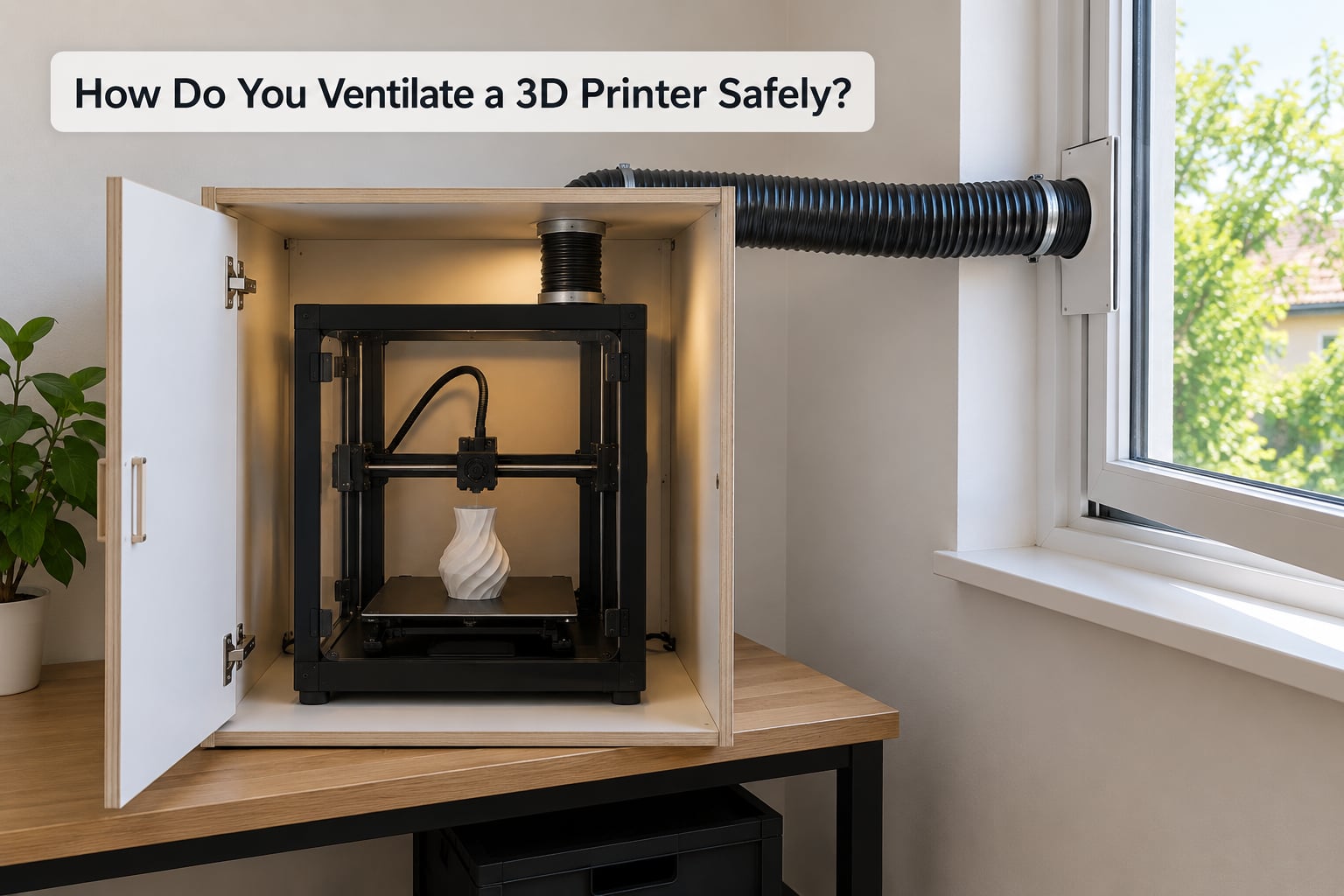
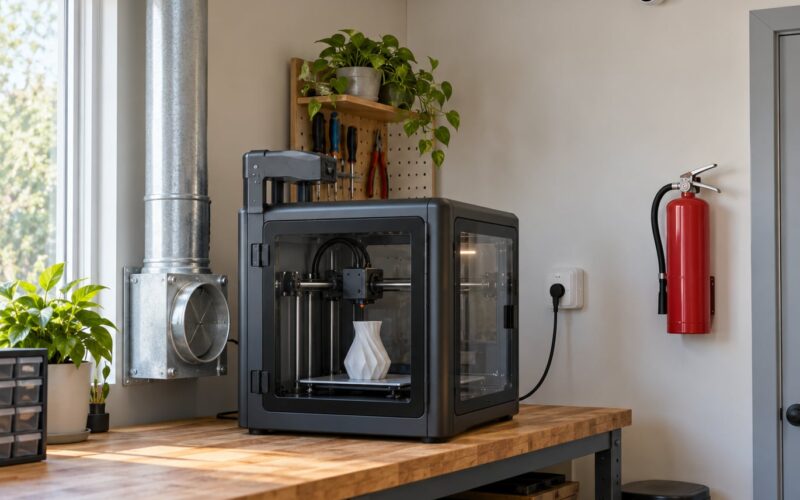
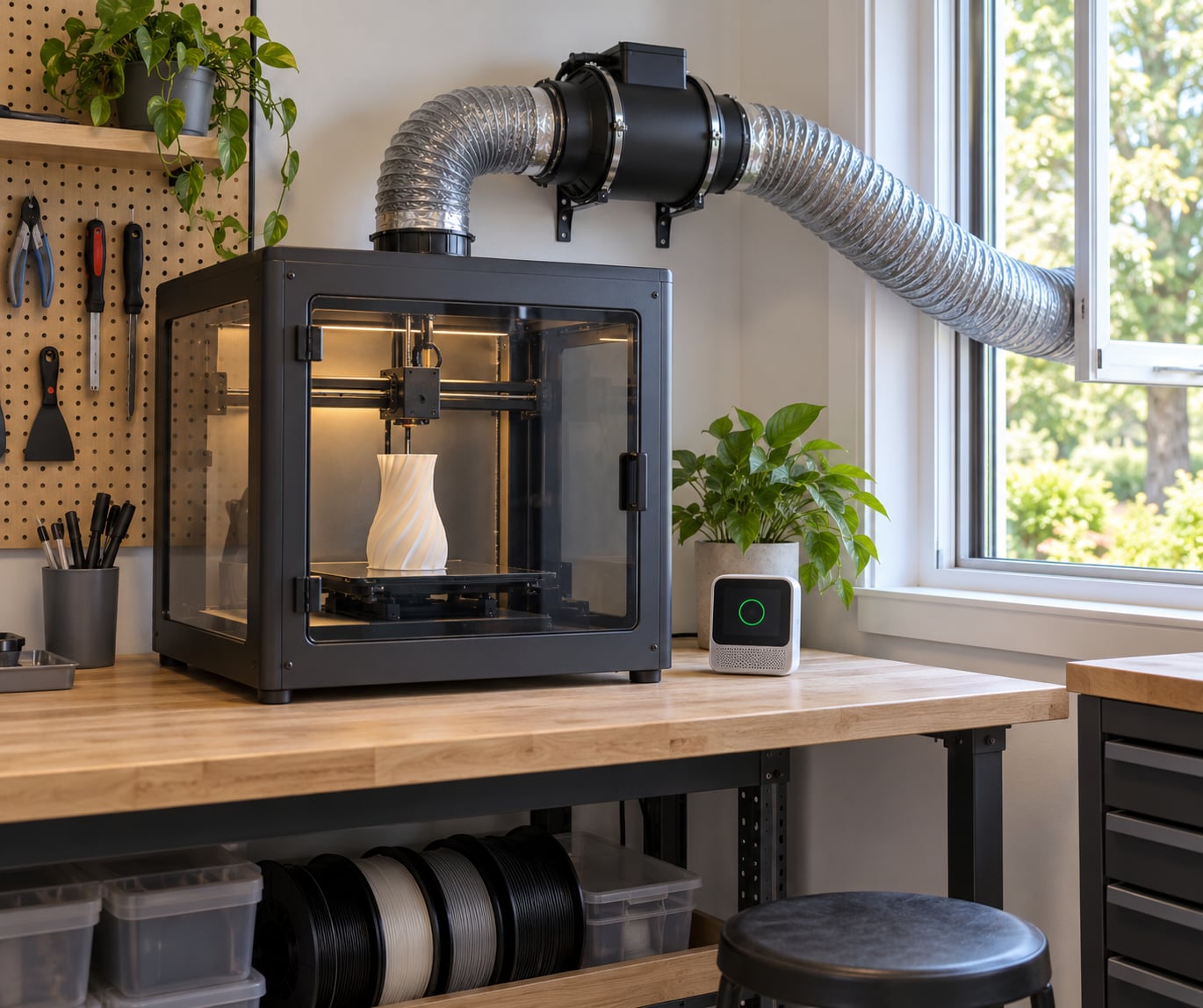
The correct control is local exhaust ventilation: capture the contaminated air at the printer and remove it, rather than diluting it into the room and hoping. In practice that means an enclosure that holds the chamber air in, a slow fan that pulls a small volume of air through the enclosure, filtration on that stream, and a duct that discharges outside.
Negative pressure beats recirculating filtration, most of the time
The goal is for the enclosure to sit slightly below room pressure so air flows in through gaps and out through the duct. That behaviour is worth checking, because community consensus on this topic favours exhaust over recirculating filters whenever high chamber temperatures are not required. A recirculating carbon unit inside the enclosure does reduce what builds up next to the nozzle, but it does not stop emissions entering the room over a long job, and it fights a losing battle when the print is running at 70C or more.
Owners of enclosed printers with a factory-fitted exhaust report repeatedly that the built-in fan alone does not create measurable negative pressure. Adding a small inline blower is the usual fix.
Size the airflow from your enclosure volume
You do not need a lot of air, and asking for too much is the most common mistake. The method is simple: measure the internal volume of your enclosure in cubic metres, pick a target of somewhere between 6 and 12 air changes per hour, and multiply.
A grow tent with an internal volume of about 0.5 cubic metres, at 10 air changes per hour, needs 5 cubic metres of air per hour. That is roughly 175 cubic feet per hour, or under 3 CFM. A larger 1.2 cubic metre tent at 6 air changes per hour needs about 7 cubic metres per hour, around 4 CFM. Both figures are small enough that a 120mm inline blower is more than sufficient.
Contrast that with room ventilation. A 30 cubic metre bedroom at 6 air changes per hour needs 180 cubic metres per hour, which is over 100 CFM. That is a room air exchanger or an open window, not a duct fan. Keeping these two numbers apart is what stops people from installing a fan that shreds their filter media and then wondering why the room still smells.
Why an open window alone is not enough
An open window works as dilution in a room you are also ventilating for comfort, and for low-emission filaments in a well-ventilated room it is a reasonable answer. It fails as a primary control for styrenated prints because dilution depends on mixing, and the plume leaving an open door or a small window does not reliably clear the breathing zone of someone sitting nearby. Capture at the source, then dilute as a second layer.
Check that the enclosure is actually under pressure
Three quick checks. Hold a tissue near the door seam while the fan runs and confirm it is drawn inward rather than blown outward. Run a smoke pencil or an incense stick around the enclosure seams and watch for smoke pulled into gaps. Finally, put a cheap PM2.5 sensor or particle counter at breathing height and compare readings at idle, during a print, and a minute after the door opens. That last comparison is the one that exposes the release event.
Watch for the door-open release event
This is the part enclosure owners most often miss. While the door is shut, particles accumulate inside the chamber. The moment you open it to grab the print, that accumulated air leaves in a burst, and the concentration at your face can be far higher than anything measured at the closed-door steady state. Let the part cool inside the chamber, run a purge cycle with the fan running before you open, and avoid hovering over the door with your face close to the opening.
Do You Need a HEPA or Carbon Filter?
You need both, because they do completely different jobs. A HEPA filter captures particles, including ultrafine ones above roughly 0.1 microns. Activated carbon captures gases and vapours by adsorption. Neither substitutes for the other, and this is where most buying decisions go wrong.
| Filter type | What it captures | What it misses | Typical use |
|---|---|---|---|
| HEPA (H13 or better) | Particulates, including metal-filled and wear particles | All VOCs, all gases, most odour | Exhaust stream, resin rooms, metal-filled prints |
| Activated carbon | Vapours and odour, with capacity set by grams of media | Ultrafine particles, many acidic gases | Exhaust stream for ABS, ASA, nylon, PVB |
| Carbon plus HEPA combination | Both particle and vapour loads | Saturated carbon still lets everything through | The default choice for a mixed-material printer |
| Pre-filter | Large dust and plastic fuzz that would blind the carbon | Anything fine | First stage of any multi-stage unit |
| Room air purifier with HEPA | Particles that escape into the room | VOCs, unless it has a substantial carbon stage | A useful second line, not a primary control |
Size carbon by mass, not by surface area. Consumer units marketed for odour often hold a few tens of grams of carbon, which is meaningful for a smell but thin against the vapour load of a 40-hour nylon print. Where you can, weight the carbon in your hand; where you cannot, look for a stated media weight rather than a fan speed claim.
Watch for saturation. A carbon filter does not announce that it is full. The practical signals are odour returning to the chamber, airflow dropping noticeably through the unit, and the filter looking grey or coated after a few months of heavy ABS use. A replacement interval measured in months of printing hours beats a calendar reminder.
How Can You Build a Safer 3D Printing Setup?
A workable home setup is unremarkable once it is assembled. Work through these points in order, because each one removes a source or a path.
- Pick the room first. A room with an external wall and a window you can open will make everything else easier. A sealed internal room, a bedroom you share with other people, or a shed with no ventilation will need a more deliberate build.
- Enclose the printer. A rigid box or a grow tent both work. Rigid is quieter and holds temperature better; a tent is cheaper and disposable when it eventually gets coated in plastic. Either way the door should close with a real seal, not just a zipper flap.
- Add filtered exhaust. One outlet low on the back or side of the enclosure, a slow inline blower, a combined carbon and HEPA stage, and ducting that runs outside and discharges away from any opening people use.
- Control temperature deliberately. High chamber temperatures raise emission rates sharply and shrink the air volume through the filter, which is the opposite of what you want. If your printer has an active chamber heater, treat it as a source to manage rather than a feature to max out.
- Handle resin separately. The wash station and cure box need their own ventilation, ideally ducted outdoors with a carbon stage. Wear nitrile gloves for uncured resin and wash prints in a ventilated area, not over a kitchen sink.
- For multiple printers, treat the room as the control. In a farm of several machines, per-printer extraction gets complicated fast. Run the room itself as a ventilated space, size the air exchange for the total heat and emission load, and add a HEPA purifier near the breathing zone as a backstop.
- Measure rather than assume. A particle counter in the room, one at the enclosure outlet and one at your seat will show in an evening what a month of guessing will not.
- Keep up maintenance. Wipe residue off the bed and enclosure walls, because the build plate is a source of accumulated polymer, and clear the pre-filter on a schedule.
What Safety Checks Should You Do Before Printing?
Run this before the first print of a session, and again whenever you move the machine or change the filament.
- Confirm the duct is still connected and discharges outdoors, not into the room, a loft or a neighbouring space.
- Check the door seal. Run a tissue test at the seam while the fan runs and confirm it pulls inward.
- Confirm the filter is the right stage for the material. Swapping from PLA to ABS or nylon without a carbon stage is the most common miss.
- Walk away from the machine for ten seconds and smell the room. If you can detect emissions at the chair, the capture is not working yet.
- Clear the area of solvents, paper, and anything else that will burn, and check the bed is not loaded near the edge.
- Decide whether the print can run unattended. Long jobs at high chamber temperature are where people skip the checks.
- Check the particle readings before and after the door opens, so you learn your own machine’s release event.
Treat fire as the companion risk. A thermal runaway usually begins with a failed part or a jam that keeps the nozzle against the build plate, and the risk is highest in a heated, closed enclosure with limited air. Run long unattended prints only where you can be woken by a sound or have someone else in the room, keep the printer on a non-combustible surface, and keep a lid or a metal sheet nearby. An enclosure that manages fumes very well can also keep heat in longer, which is worth knowing before you run a 400-hour nylon job in a sealed cabinet.
How Do You Choose Ventilation and Fume Safety Equipment?
Start from the room, not from the product. Match the control to the setting and the material mix you actually print.
Room-based choices
In a bedroom or a shared apartment with a window, an open window plus a HEPA purifier with a carbon stage is a reasonable baseline for PLA and PETG. Move to an enclosed printer with ducted exhaust as soon as you print ABS, ASA, nylon or polycarbonate, and treat resin as its own project.
In a workshop, classroom or university lab, assume more than one person and more than one machine. Extract per printer where you can, and run room ventilation sized for the total load. In a small dental or medical practice where patients sit close to the printers, capture at source plus room extraction is the only combination I would be comfortable defending.
What actually separates good equipment from bad
- Airflow at the filter face. Check what static pressure the unit can hold, not just its free-air number. A fan rated generously at zero static pressure may barely move air through a dense carbon bed.
- Filter media weight. Grams of carbon, and the HEPA grade. Everything else on the box is secondary.
- Noise. A blower quiet enough to run overnight matters more than peak airflow, because a loud fan gets switched off.
- Portability and serviceability. Can you replace the pre-filter yourself, and does the unit still print with its door off?
- Ongoing cost. Consumables add up; a unit you will actually keep filters for beats a cheaper one you abandon.
What respirators do and do not solve
A half-face respirator with VOC cartridges is a reasonable secondary measure for maintenance tasks, resin handling and situations where you cannot get capture-at-source working quickly. It is not a substitute for ventilation: cartridges have a limited service life, they do not protect against carbon monoxide in any fire scenario, and they only work if they fit. Use the change schedule from your cartridge manufacturer rather than an odour test, because odour is again a poor indicator of breakthrough.
Professional local exhaust ventilation is the right call when the printers run long jobs with styrenated materials, when people work near the machine for hours, when resin is handled routinely, or when local workplace rules require an assessment. In a school classroom, that conversation should happen with whoever owns the building’s health and safety policy, not just with a maker.
Frequently Asked Questions
Is PLA safe to print without ventilation?
For most people, yes. PLA emits relatively low levels of VOCs and almost no styrene, and in a room with normal air exchange, PLA printing is generally considered low concern. Two qualifiers matter: avoid chamber temperatures at the high end, because emission rates climb sharply with temperature, and run long unattended jobs in a room with an open window or an extractor. PLA is not zero-emission, it is simply the quietest material most people print.
Do I need ventilation for ABS and ASA?
Yes, for both, every time. ABS and ASA are styrenated polymers and produce styrene, which the International Agency for Research on Cancer classifies as a possible carcinogen. Print them in an enclosure with a slow filtered exhaust vented outdoors, never in a closed room relying on dilution. Headaches, nausea and eye irritation after a print are the short-term signal; the reason to be careful is repeated exposure over months and years.
Will a HEPA filter remove 3D printer fumes?
Not on its own. A HEPA filter captures particles, including ultrafine ones above roughly 0.1 microns, but it does essentially nothing for gases and vapours. The VOCs from heated filament need activated carbon, and a carbon stage on its own will not stop the ultrafine particle load. For any material other than PLA, run a combined carbon and HEPA unit, and size the carbon by media weight rather than by fan speed.
Is an air purifier enough for 3D printing?
As a second line, yes. As your only control, no. A room purifier captures particles that escape the printer area and can take the edge off odour if it has a real carbon stage, but it cannot capture emissions at the source and it does nothing about a burst of concentrated particles released the moment you open the enclosure door. Use it alongside enclosure and exhaust, not instead of them.
Do I need to seal my printer while using an enclosure?
Seal it well, but not hermetically. The goal is for the enclosure to sit slightly below room pressure so air flows in through small gaps and out through the exhaust duct. If the enclosure is perfectly airtight with no inlet, airflow drops and your filter stops doing useful work. Leave the door closed during a print, check the seal with a tissue test, and cool the part inside the chamber before opening it so the accumulated particles do not come out in one burst.
When should I use a respirator instead of relying on ventilation?
Use one as a second measure, not a replacement. A half-face respirator with VOC cartridges makes sense for uncured resin handling, cleaning the machine, and any short task where capture-at-source has not been set up yet. It does not protect against carbon monoxide in a fire, cartridges have a finite service life, and the seal has to fit properly. Follow the cartridge change schedule rather than waiting for odour to tell you.
Where to Start
Start by identifying your riskiest filament. If it is PLA or PETG, an open window and a HEPA purifier in the room is a sensible first step, and that is genuinely enough for many hobbyists.
If you print ABS, ASA, nylon, polycarbonate or resin, the first real upgrade is an enclosure with a slow filtered exhaust ducted outdoors, sized from your enclosure volume rather than from the fan’s packaging. Add a particle counter, check your readings before and after opening the door, and set a filter replacement reminder based on printing hours. That covers most of what matters for 3D printing ventilation and fume safety in a home setup, and it scales up to a workshop or a farm without changing the principle.