If you keep filament sealed and dry, 3D printer filament usually stays usable for 2 to 3 years before you open it, and anywhere from a few weeks to about a year once it is exposed to air. The exact answer depends on the plastic, not the calendar. Sealed PLA and PETG hold for years, opened ABS and ASA hold for 6 to 12 months, and opened TPU can turn rough in a month. Here is the full breakdown, plus how to tell whether a spool is still worth printing.
The short version of how long 3D printer filament lasts: unopened, vacuum-sealed spools are good for 2 to 3 years, and opened spools range from 2 to 4 weeks for TPU up to 6 to 12 months for ABS and ASA.
There is no printed expiry date on most filament spools, and that is not because manufacturers hide the number. It is because time on its own does not ruin plastic. Moisture does. Filament stored in a dry cabinet in a temperate climate can outlive the spool it was bought with, while filament left open on a garage shelf through one humid summer can be printable again only after drying.
That distinction matters because the failure looks like a printer fault. A print that pops, strings, loses layer adhesion, or clogs the nozzle gets blamed on calibration or the hotend, and people spend a weekend tuning a machine that was never the problem.
Table of Contents
- How Long Does 3D Printer Filament Last?
- What Changes Filament Shelf Life?
- The factors that actually shorten shelf life
- How to Tell Whether Filament Is Still Good
- Physical signs before you print
- Symptoms that show up mid-print
- A cheap test before a long print
- How to Store Filament So It Lasts Longer
- Storage Methods for Moisture-Sensitive Materials
- Can You Dry Old Filament and Make It Usable Again?
- Frequently Asked Questions
- Does 3D printer filament expire?
- Can I store filament in the freezer?
- How long does opened PLA last?
- Why does old filament make bubbles and stringing?
- Is discolored filament always unusable?
- Can I use filament after a print failure?
- Conclusion
How Long Does 3D Printer Filament Last?
Unopened, vacuum-sealed filament lasts 2 to 3 years in normal indoor storage. Once the seal is broken and the spool sits in room air, that window shrinks to anywhere from 2 to 4 weeks for TPU to 6 to 12 months for ABS and ASA. Dry, dark, cool storage pushes every number in the table below toward the long end.
| Material | Unopened, vacuum-sealed | Opened, stored indoors | Opened, sealed in a dry box |
|---|---|---|---|
| PLA | 2 to 3 years | 6 to 12 months | 12 months or more |
| PETG | 2 to 3 years | 4 to 6 months | 9 to 12 months |
| ABS | 3 years or more | 6 to 12 months | 12 months or more |
| ASA | 3 years or more | 6 to 12 months | 12 months or more |
| TPU | 2 to 3 years | 2 to 4 weeks | 2 to 3 months |
| Nylon | 1 to 2 years | 1 to 3 weeks | 2 to 4 months |
| Polycarbonate | 1 to 2 years | 2 to 4 weeks | 2 to 4 months |
| PVA | 1 to 2 years | 1 to 2 weeks | 3 to 6 weeks |
These ranges are what manufacturers and the printing community converge on rather than lab test results, so treat them as planning numbers. A spool in a dry box in a climate-controlled room will beat them. A spool in a shed in a coastal climate will lose to them.
The one rule of thumb worth memorising: moisture, not time, is the primary driver of degradation. If you control humidity, you control most of the shelf life.
What Changes Filament Shelf Life?
Two different numbers are often confused here. Shelf life is how long the material stays chemically intact in storage. Usable print life is how long it still produces reliable parts. A spool can extrude perfectly and still print parts weaker than you want, and that gap is where most frustration with old filament lives.
The factors that actually shorten shelf life
Moisture. Most 3D printing polymers are hygroscopic, meaning they pull water out of the air on their own. PLA absorbs slowly, nylon and TPU quickly. That water sits inside the polymer until the hotend turns it into steam, and it also drives hydrolysis, a slow chemical reaction that breaks the ester bonds holding the polymer chains together. Shorter chains mean lower molecular weight, lower tensile strength, and brittle filament that snaps instead of bending.
Heat. Warm storage speeds every reaction above. A spool in a garage that hits 40C in summer ages faster than the same spool kept at 20C, even at identical humidity.
Ultraviolet light. UV exposure drives photo-degradation. Colours fade first, then the polymer chains shorten. Clear and white plastics yellow, which is the most visible sign that a spool spent too long in a window or under a workshop lamp.
Oxidation. Oxygen attacks the chain ends slowly. This is the mechanism behind the greasy or oily feel that owners notice on badly aged filament, and it does not reverse when you dry the spool.
Packaging integrity. Vacuum-sealed bags with a desiccant packet are not marketing. They hold relative humidity near single digits inside the bag, and once you cut that bag the protection is gone.
Repeated opening. Every time a spool goes from a sealed box to open air and back, it takes on another cycle of humidity. Spools on a printer’s external spool holder pick this up weekly.
Contamination. Dust, pet hair, and skin oil on the outer windings can end up inside a hotend. This one is a handling problem rather than an age problem, and it hits open spools far more than sealed ones.
How to Tell Whether Filament Is Still Good
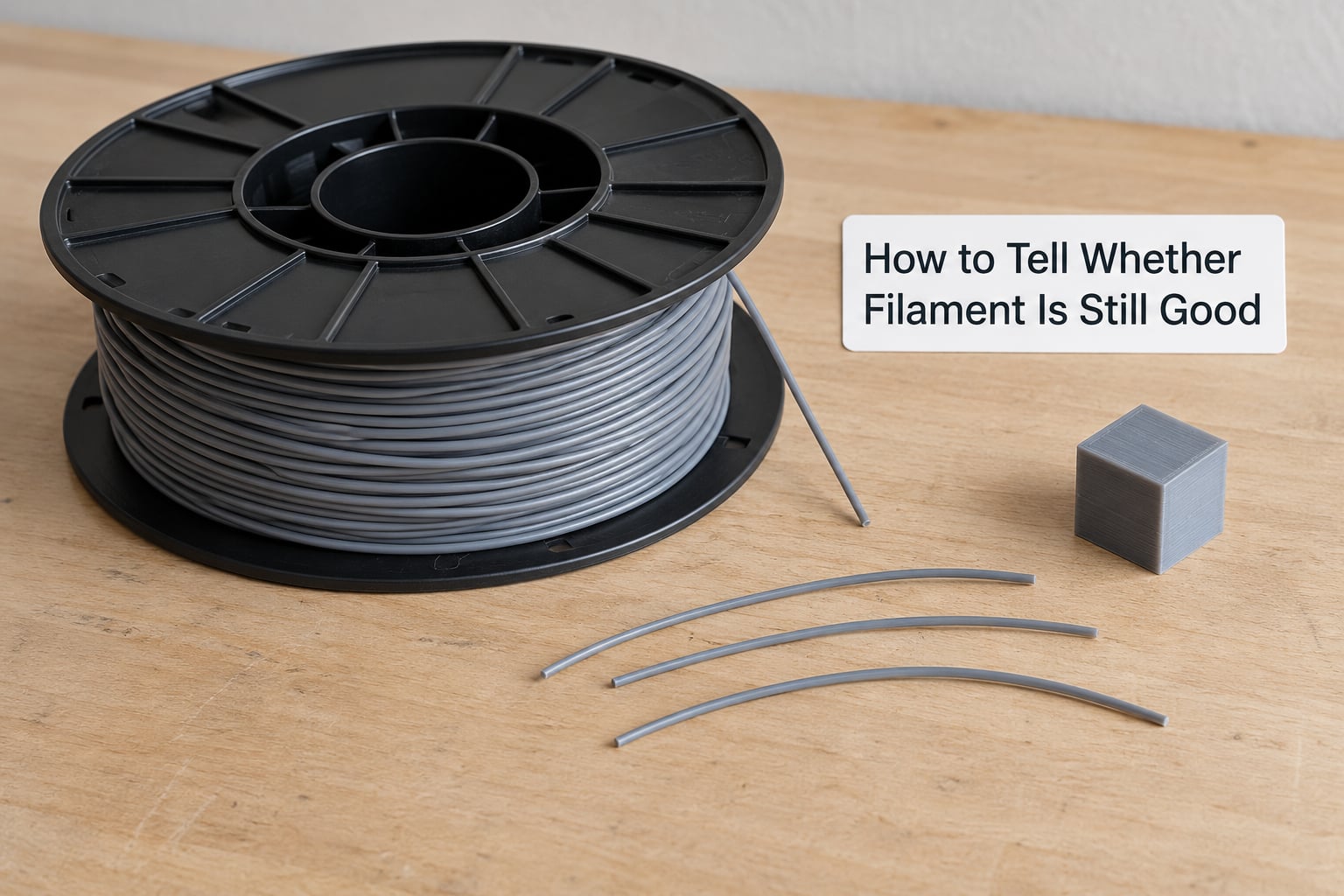
Check the spool before you commit a 20-hour print to it. Most of the useful signals are visible in under a minute.
Physical signs before you print
- Cracks and brittle breaks. Bend the filament sharply. Good 1.75mm filament snaps cleanly with a slight resistance. Filament that cracks with a sharp tick, or snaps while still feeding smoothly, has lost molecular weight.
- Surface roughness or a dusty coating. A chalky, flaky, or slightly greasy outer layer is oxidation combined with moisture pickup. It also flakes into the extruder.
- Bubbles in the strand. Hold the filament up to light. Small voids or air pockets inside the strand mean moisture is already inside the material.
- Diameter variation. Old or tensioned filament runs unevenly. If the spool rocks on the desk instead of rolling smoothly, the outer layer was wound under tension and the effective diameter changes as it unwinds.
- Discoloration and yellowing. Clear plastics that have gone amber were exposed to UV and heat. This is a warning, not a verdict.
- An unusual smell. Members of the r/3Dprinting vintage filament thread describe the smell of well-aged filament as unmistakable, and their consensus was consistent: as long as the strand is not oily and it is dried properly, it usually prints fine.
Symptoms that show up mid-print
- Popping or crackling in the nozzle. The classic moisture signature, small bursts of steam escaping the melt zone.
- Stringing. Wet filament foams slightly at the nozzle and drags a hair between parts.
- Rough, matte surfaces. Bubbles break the melt and leave a pitted, sandy texture on the outer wall.
- Weak layer adhesion. Layers part under light force. Water at the interface stops the layers fusing properly, which is why wet prints snap rather than bend.
- A nozzle that clogs repeatedly. Swollen, degraded filament can partially block the channel, and flakes of residue make it worse.
Normal colour variation is not degradation. Two spools of the same colour from the same batch can look slightly different under a lamp, and pigment settling toward the outside of the spool is cosmetic. What matters is whether the material still handles like plastic: firm, consistent, and free of residue.
A cheap test before a long print
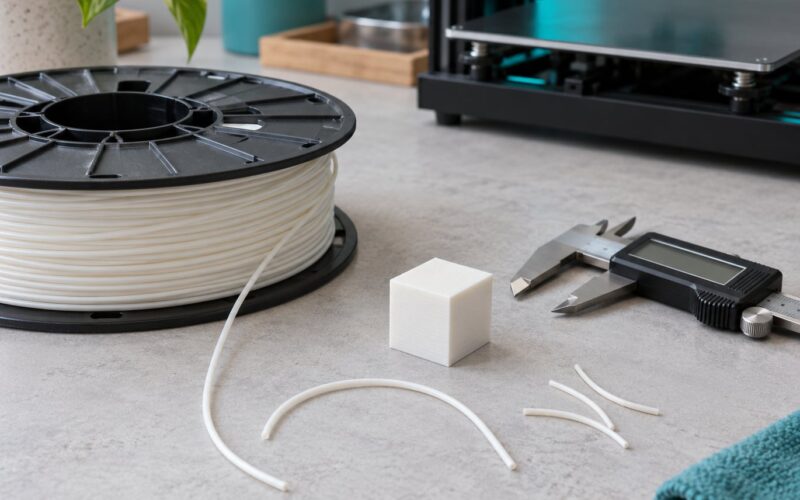
Run a 20-minute single-wall calibration cube and watch it. Look for clean perimeters, no popping, consistent wall thickness, and normal colour. That test catches roughly everything that will ruin a long print and costs one small cube.
People on the LulzBot forum who have kept old ABS report years-old spools printing normally, and the fix they land on is storage and drying, not binning the plastic. One described running 3mm ABS left in an open cardboard box for a year with no ill effects, and another recommended a vacuum sealer combined with desiccant for long-term storage rather than throwing material away.
How to Store Filament So It Lasts Longer
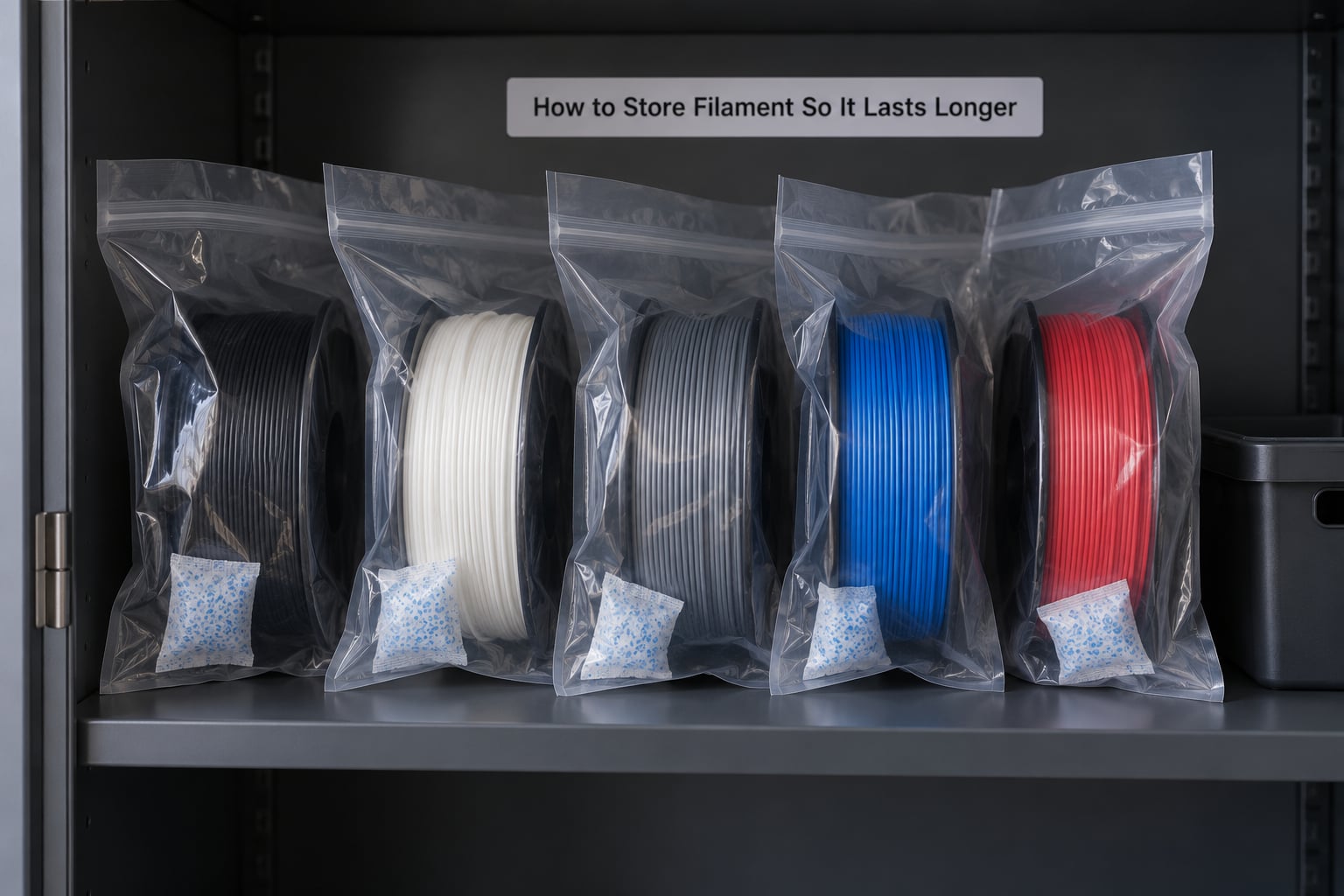
Storage is a five-minute job per spool and it roughly doubles how long an opened spool stays printable. What follows is the routine that works.
- Keep sealed spools sealed. Until the moment you need it, leave filament in the original vacuum bag with its desiccant. Do not open the outer box and re-tape it; that buys nothing.
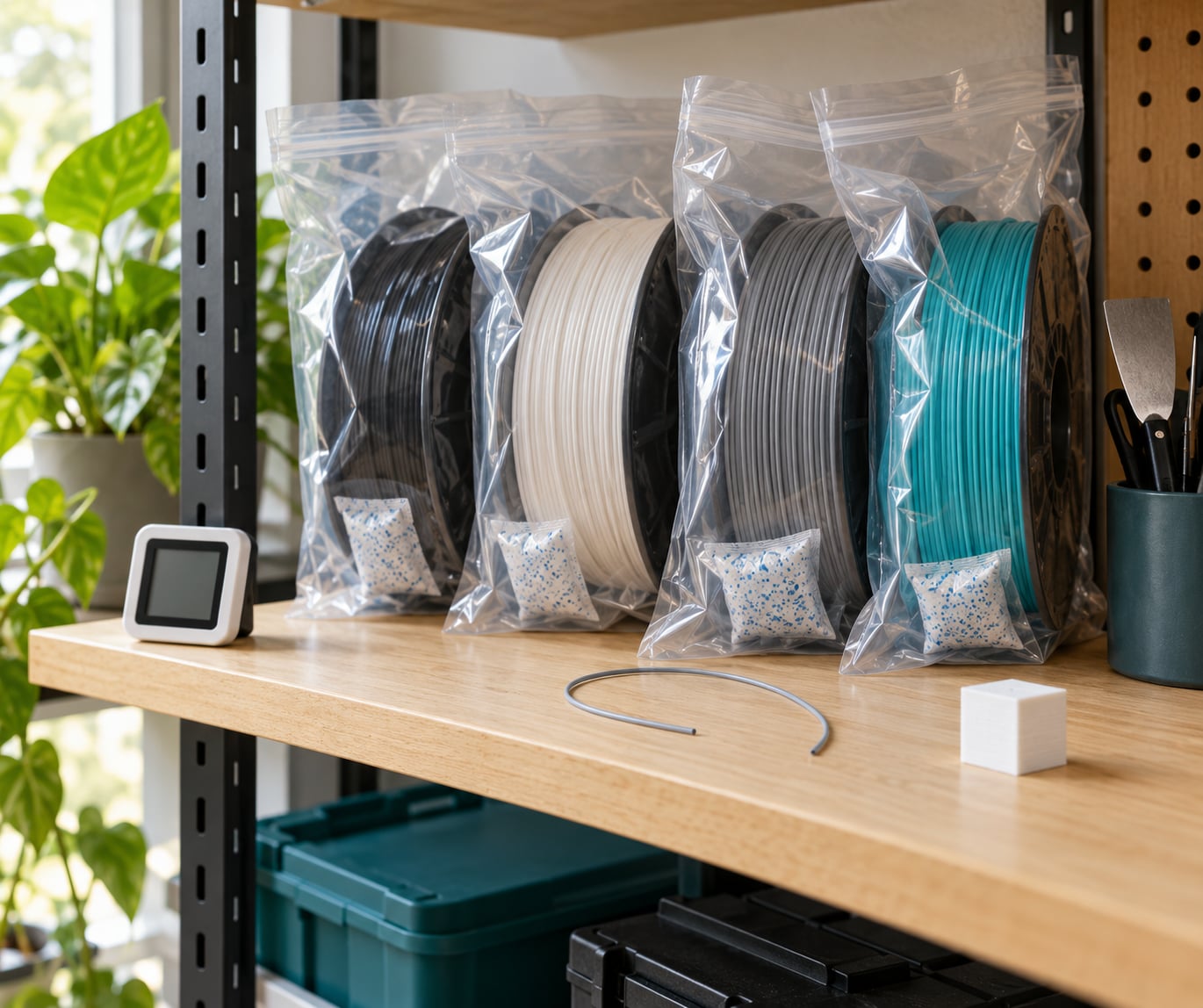
- Bag an opened spool immediately. Put the spool in a sealed bag with fresh silica gel or other desiccant and squeeze out the air. Reuseable vacuum bags with a hand pump work well and cost very little.
- Keep the relative humidity low. Aim for under 30% relative humidity around your filament storage, and under 20% for nylon and TPU. A cheap hygrometer in the cabinet is worth more than any guess.
- Store cool and dark. A shelf out of direct sunlight, ideally between 20 and 25C, keeps reactions slow. Avoid attics, unheated garages, and anything that swings between cold and hot.
- Keep spools off the floor. Concrete and tile wick moisture. A shelf or a plastic bin with a lid gets you out of the worst of it.
- Rotate stock first in, first out. Label the bag or the box with the date you opened it and write the date on new purchases. This is the single habit that stops a queue of forgotten spools from quietly ageing.
- Buy the spool size you will actually finish. A casual printer printing a few hours a month will finish a 1kg spool over many months. Smaller spools remove the ageing problem instead of solving it, which is cheaper than any container.
Bag storage is a legitimate answer to the question people ask most on this topic. A resealable bag with a desiccant packet keeps filament acceptable for months in a normal indoor room, so an expensive dry box is a convenience upgrade rather than a requirement.
Storage Methods for Moisture-Sensitive Materials
PLA is forgiving. Nylon, PETG, TPU, polycarbonate, and PVA are not, and they deserve a different standard.
| Material | Moisture sensitivity | What it needs |
|---|---|---|
| PLA | Low | Sealed bag with desiccant, ordinary indoor shelf |
| PETG | Moderate | Sealed bag, dry box in humid months |
| ABS | Moderate | Sealed bag, dry box in humid months |
| ASA | Moderate | Sealed bag, dry box in humid months |
| TPU | High | Dry box or filament dryer with humidity control |
| Nylon | High | Dry box or filament dryer with humidity control |
| Polycarbonate | High | Dry box or filament dryer with humidity control |
| PVA | Very high | Airtight, desiccant, sealed the moment it is opened |
Nylon is the extreme case. It absorbs enough water in humid air that spooled nylon left open is usually undryable within a day or two, and it stays spongy rather than brittle. Polycarbonate and TPU sit close behind. Both absorb water into the melt and both print badly straight from a damp spool without a drying step first.
Four storage options cover the range:
- Resealable bag plus desiccant. The cheapest option and genuinely useful for a few weeks to a few months per bag. Replace the desiccant when it stops feeling dry or when the indicator tips.
- Vacuum bag with a pump. Better air removal, so it suits nylon and TPU better than a plain resealable bag. Still not humidity-controlled over long periods.
- Filament dry box. A sealed box with a heater and a humidity display. This is the practical choice for anyone printing nylon or TPU regularly, and it keeps multiple spools at a stable relative humidity instead of one bag at a time.
- Printer-integrated drying. Many printers now have a filament drying chamber and a drying cycle. Convenient for a nylon spool the night before a print, though the box is usually too small to be the long-term home for your whole stock.
Can You Dry Old Filament and Make It Usable Again?
Often, yes. Drying fixes absorbed moisture, and moisture is the most common reason an old spool misbehaves. Drying does not reverse hydrolysis, oxidation, or physical damage, so a spool that is brittle and cracked before it goes in the dryer will still be brittle and cracked after.
| Material | Typical drying range | Typical duration |
|---|---|---|
| PLA | 40 to 45C | 4 to 6 hours |
| PETG | 55 to 65C | 6 to 12 hours |
| ABS / ASA | 65 to 75C | 6 to 12 hours |
| TPU | 50 to 60C | 6 to 8 hours |
| Nylon | 70 to 80C | 12 to 24 hours |
| Polycarbonate | 70 to 80C | 8 to 12 hours |
Always follow your filament maker’s own temperature and time figures, because these ranges are general guidance rather than specifications. The one hard limit is the glass transition temperature. PLA sits around 60C, and drying it much above that softens the strand, changes its diameter, and can cause feed problems for months afterwards.
Drying works because water leaves the polymer at elevated temperature and low humidity. If you can only manage one thing, use low humidity rather than high heat. A warm, dry chamber dries filament more effectively than a hot, humid one.
The follow-up question almost nobody answers is how long a dried spool stays usable once you open it. If you dry a spool and then leave it on a spool holder in open air, you are back to square one within days for nylon and within weeks for PETG. Put it straight into a dry box or a sealed bag with fresh desiccant, and treat the dryer as the last step before a print rather than as storage.
Frequently Asked Questions
Does 3D printer filament expire?
No, not in the way food does. Most spools carry no printed expiry date because time alone does not ruin plastic. What ends a spool’s life is moisture, heat, and UV exposure. Sealed filament in a cool, dry cabinet routinely prints well past two years, and forum owners report five-year-old spools that came out of the bag fine. The number that matters is your storage conditions, not the calendar.
Can I store filament in the freezer?
You can, and it works, but it is more trouble than most people expect. Freezing stops moisture absorption while the spool is cold, yet condensation forms the moment the spool warms up, so you must let it reach room temperature inside a sealed bag before opening it. Freezing also makes some spools brittle, which can break filament during handling. A dry box under your desk is easier to maintain.
How long does opened PLA last?
Six to twelve months in a typical indoor room if you bag the spool with a desiccant packet after each use. Left on an external spool holder in open air, expect closer to four to six months before it starts popping and stringing. PLA is the most forgiving common material because it absorbs water slowly, so a small airtight bag genuinely buys you a lot of time.
Why does old filament make bubbles and stringing?
Because the moisture stored in the plastic becomes steam inside the hotend. Those bubbles expand at the melt temperature, swell the deposited bead slightly, and drag a hair between parts. The same water blocks layer adhesion, which is why wet prints crack apart under light force. Popping, crackling, and pitting usually appear together for this reason, and drying the spool usually resolves all three.
Is discolored filament always unusable?
No. Yellowing in clear plastics and fading in coloured ones point to UV and heat exposure, which shortens polymer chains but rarely stops a spool from printing. Clear PLA that has gone amber usually still extrudes and still makes parts that only fail if the part is load-bearing or dimension-critical. Brittle filament that cracks or a surface covered in oily residue is a different story, and that is worth drying and testing first.
Can I use filament after a print failure?
Usually, yes, because a failed print is often a filament problem rather than a machine problem. Pull the strand out and check it for cracks, residue, or bubbles, then run a short calibration cube to see what changed. If the cube prints cleanly, the original failure was probably a detachment, flow, or temperature setting. If it pops and strings, dry the spool and try again before touching your printer settings.
Conclusion
How long 3D printer filament lasts comes down to two numbers: 2 to 3 years sealed and dry, and 2 to 12 months once opened depending on the plastic. Time alone is not the enemy. Humidity, heat, and light are, and all three are manageable with a bag, a desiccant packet, and a shelf away from a window.
Do three things next time you pick up a spool. Check it for cracks, residue, and bubbles. Run a short calibration cube before trusting it with a long job. Then bag every spool you open with fresh desiccant, date it, and use the oldest one next. That routine costs almost nothing and it is the reason most makers never have to throw filament away.