Short answer: 3D printer fumes can be dangerous, but the risk swings wildly by printer, material, nozzle temperature, ventilation and print length. A PLA part printing in a ventilated room is a low-risk situation. ABS, high-temperature thermoplastics and resin printing in a sealed bedroom are a completely different conversation, and the difference comes down to what the machine puts into the air and how long you sit in it.
There is no single authoritative answer, which is exactly why the forum threads on this topic read like a debate with nobody winning. Some people print next to their desk for years and feel fine. Others describe sinus irritation and chest tightness and stop printing entirely. Both can be true, because the honest answer depends on variables most hobbyists never measure.
So here is the practical version, built on published research, manufacturer safety data, and what makers have actually measured in their own homes. The three questions that decide your personal risk are simple: which material, which room, and how long. Everything below unpacks those.
- Low risk: PLA or PETG, open-frame printer, ventilated room, normal nozzle temperatures, a few hours a week.
- Moderate risk: ABS, ASA, Nylon or polycarbonate in an unventilated room, or a long unattended print in a bedroom or basement workshop.
- Highest risk: Resin printing, failed and overheated prints, filament with undisclosed pigments and additives, and anyone with asthma or chemical sensitivity in the space.
Table of Contents
- What Does a 3D Printer Release Into the Air?
- Which Pollutants Are Common 3D Printer Emissions?
- Are 3D Printer Fumes Dangerous During Long Prints?
- Which Materials and Printers Pose the Most Risk?
- What Symptoms Can 3D Printer Fumes Cause?
- How Can You Reduce 3D Printer Fume Exposure?
- Are Air Purifiers, Masks, and Resin Printer Enclosures Useful?
- Frequently Asked Questions
- Do all 3D printers release dangerous fumes?
- Is it safe to run a resin printer in a home?
- How long can you safely run a 3D printer in a room?
- Do HEPA filters protect against 3D printer VOCs?
- Can 3D printer fumes cause headaches or nausea?
- What Should You Do First?
What Does a 3D Printer Release Into the Air?
A 3D printer releases ultrafine particles and volatile organic compounds, and how much depends on the polymer you melt, how hot you melt it, and whether the air can get out of the room.
When filament is heated to its melt temperature, the polymer degrades slightly as it extrudes. That thermal degradation releases two families of emission. The first is volatile organic compounds, abbreviated VOC, which are gases: acetaldehyde, formaldehyde, styrene, toluene and others. The second is ultrafine particles, or UFP, which are solid aerosol droplets and fragments under 100 nanometres across.
That size is why ultrafine particles get attention. Particles around 2.5 to 10 micrometres are caught in the nose and upper airway. Below roughly 100 nanometres, they slip past the body’s natural filtration and reach deep lung tissue, where they can cross into the bloodstream.
Two variables control the volume of emissions more than anything else. Melt temperature is the big one: ABS and Nylon melt far hotter than PLA, and hotter means more degradation and more of both particles and gases. Nozzle temperature is the second, which is why dropping your PLA by 10 to 15 degrees cuts emissions for no visible difference in most prints.
Odour is a poor exposure meter. A strong smell usually means emissions are happening, but smell drops off quickly with concentration, and by the time a room has faded to “no smell” the level may still be meaningful. Treat a noticeable hot-plastic smell as a prompt to ventilate, not as a reading.
Which Pollutants Are Common 3D Printer Emissions?
Four emission types account for nearly everything researchers have measured coming off consumer FDM printers, and each behaves differently in your lungs.
| Emission type | What it is | Where it comes from | Reported concern |
|---|---|---|---|
| Ultrafine particles | Solid fragments and droplets under 100 nm | Polymer degradation, extrusion, and heating of the chamber | Deep lung penetration, oxidative stress in lab cell studies |
| Aldehydes | Acetaldehyde, formaldehyde and related compounds | Thermal breakdown of PLA, PETG and ABS | Eye, nose and throat irritation; formaldehyde is a recognised carcinogen |
| Styrene and other aromatics | Styrene, toluene, nonanal, octamethylcyclotetrasiloxane (D4) | ABS, ASA, styrenic blends and some coloured filaments | Styrene is a recognised irritant and possible carcinogen |
| Fumes from degraded or overheated polymer | Sharper, acrid smoke from burning or charring plastic | Failed prints, jammed nozzles, blocked vents, wrong temperature | The most concentrated exposure in the hobby; similar to burning plastic |
The exact mixture depends on the resin or filament, the extruder temperature, print time and the printer’s design. A machine with a heated and sealed chamber keeps fumes concentrated instead of dispersing them, which is a real benefit for the person printing and a real downside for the person breathing nearby.
Are 3D Printer Fumes Dangerous During Long Prints?
Longer prints raise exposure because emissions accumulate in a room that never gets an air change. A six-hour overnight job is not six times a one-hour print in a well-ventilated room; in a closed bedroom it is closer to six hours of steadily rising concentration while you sleep next to it.
The 2019 study from Georgia Tech and UL Chemical Safety, published in Environmental Science & Technology, found something useful and counterintuitive. PLA particles were more reactive per particle than ABS particles in cell assays, but ABS emitted far more of them overall, which made ABS the bigger problem in practice. They also concluded that repeated exposure over time could be comparable to the particle exposure of living in a polluted urban environment.
Occupational limits used by NIOSH and OSHA exist for the chemicals involved, and makers tend to be well under them in normal single-printer use. A long-running thread on the Prusa forum put it plainly: recorded VOC levels are very low, well under one part per million even in a closed space, so a typical home setup is trivial next to daily exposures like cooking or traffic. The caveats people agreed on there were pigments, additives and multi-printer setups, which is where the simple reassurance breaks down.
Which Materials and Printers Pose the Most Risk?
PLA and PETG are the quietest common filaments; ABS, ASA, nylon and polycarbonate are meaningfully worse; resin printing is a different category entirely.
| Material | Emission level | Odour | Ventilation | PPE |
|---|---|---|---|---|
| PLA and PLA+ | Low | Low to mild | Normal room ventilation | None |
| PETG | Low | Mild | Normal room ventilation | None |
| TPU | Low to moderate | Mild, sometimes rubbery | Recommended for long prints | None |
| ABS and ASA | Moderate to high | Strong, styrene-like | Enclosure with filtration or exhaust | None for normal use |
| Nylon and blends | High | Strong | Enclosure with filtration or exhaust | None for normal use |
| Polycarbonate and PC blends | High | Strong | Enclosure with filtration or exhaust | None for normal use |
| Filled filaments (carbon fibre, glow-in-the-dark, silk) | Moderate to high, and inconsistent between brands | Varies widely | Enclosure with filtration; treat unknown pigments as higher risk | None, but check the safety data sheet |
| UV and SLA/DLP resin | Highest | Pungent, acrylate-like | Dedicated room or exhaust to outdoors | Nitrile gloves; safety glasses; ventilate during washing and curing |
Resin deserves its own category because the exposure is not only airborne. Uncured liquid resin contacts skin readily, and it can cause dermatitis and sensitisation, which means a later trivial exposure triggers a reaction. Handle it in nitrile gloves, wash prints in a ventilated area before curing, and read the safety data sheet that ships with the bottle.
Three things hide in the “I don’t know” column. Filament additives are largely undisclosed, so two spools labelled ABS can emit very differently. Coloured and pigmented filaments carry a documented concern: black filament has been reported to contain polycyclic aromatic hydrocarbons, and red filament azo dyes. And a failed print that sits and cooks at high temperature produces far more degradation than a clean print, which is why a burnt-smell incident is the worst exposure most hobbyists ever get.
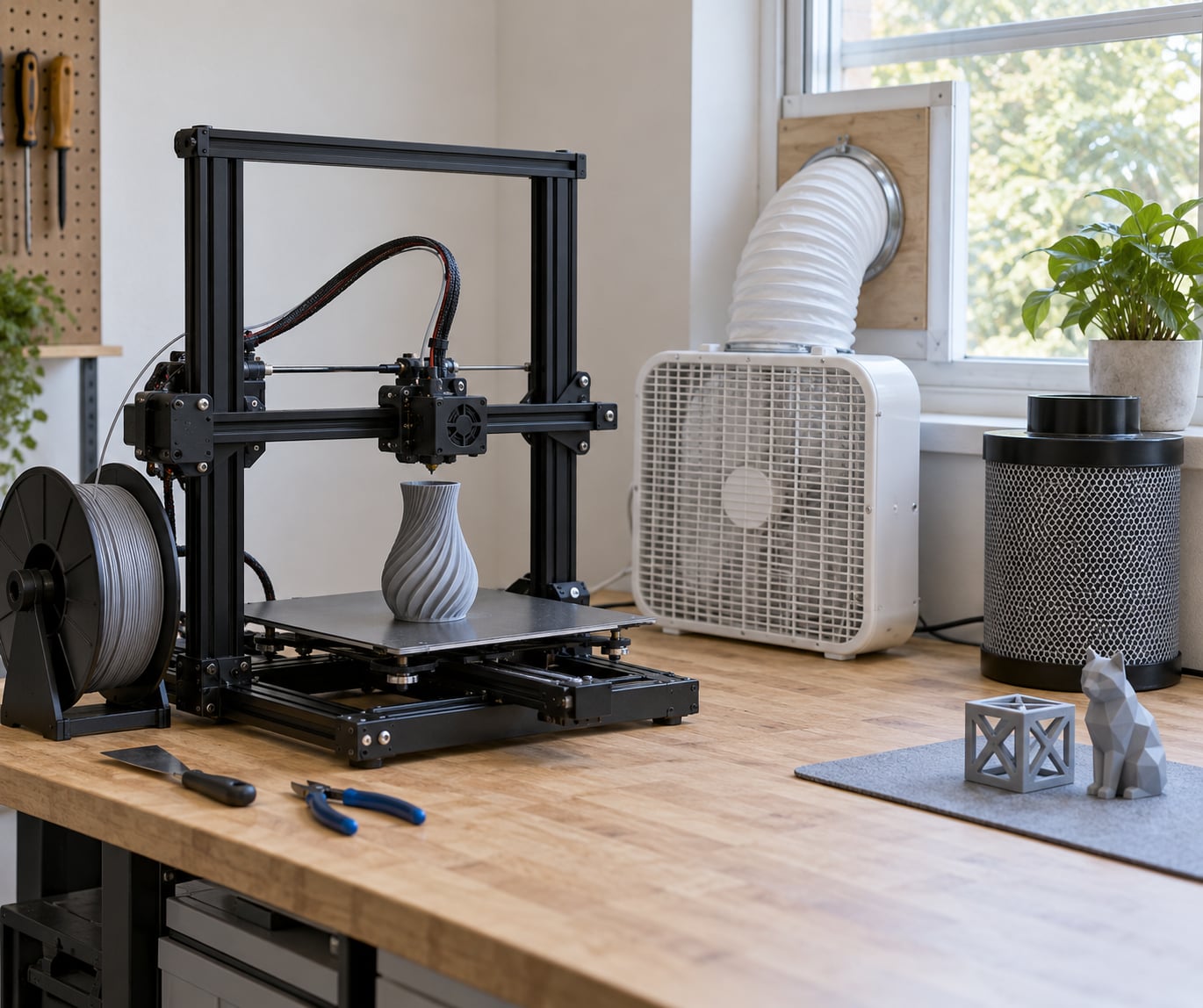
There is also a difference people mix up constantly. An enclosure contains fumes so they can be filtered. An activated carbon plus HEPA filtration unit removes them from the air inside that enclosure. An exhaust system carries them out of the building entirely, and only that third option removes the pollutants instead of moving them somewhere else in the room.
What Symptoms Can 3D Printer Fumes Cause?
The symptoms people report are mostly irritation, and they cluster into short-term effects and long-term questions that science has not answered yet.
In the hours after a print, makers describe burning eyes, a dry or scratchy throat, sinus pressure, cough, nausea and headache. One detailed account on a Prusa forum thread described heaviness in the chest after a four-hour carbon-fibre PETG print, traced to repeatedly opening the enclosure door and leaning in to inspect the nozzle. Their sensor jumped the moment the door opened. That is the peak-exposure moment, and it is the one most people never think about.
Longer term, the honest answer is that we do not know. Repeated exposure to ultrafine particles and to VOCs like styrene is associated with airway irritation and respiratory effects in occupational studies, but there is no established body of evidence about decades of hobby-scale printing in a home. Researchers in both studies cited here were careful to say the risk at typical domestic exposure appears low, and equally careful not to call it zero.
For anyone with asthma, chemical sensitivity or allergies, treat the low average as irrelevant and plan for your own sensitivity, which may sit far below the population average.
If you notice irritation while printing, stop the print and get to fresh air. For symptoms that persist after leaving the room, or any breathing difficulty, contact a healthcare professional. Poison control services handle chemical exposure questions, and they are the right call for an accidental strong exposure.
How Can You Reduce 3D Printer Fume Exposure?
Ventilation does most of the work. Everything else trims the edges. This is the order I would work through it.
- Print in a ventilated space. A cross-flow room with an open window and something moving the air does more than an expensive filter in a sealed corner. Opening a door to another room is weaker than you think if the air simply settles.
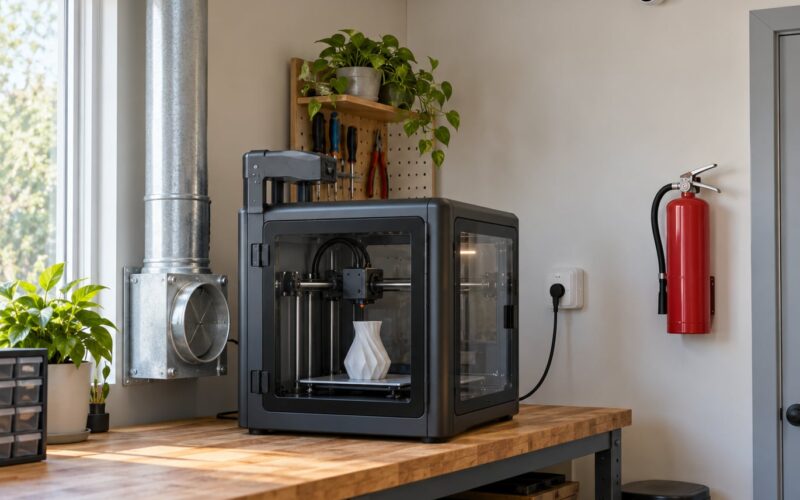
- Ventilate to the outside. For ABS, ASA, nylon, polycarbonate or resin, an extraction duct carrying chamber air outdoors is the most effective control there is.
- Use carbon plus HEPA filtration. Carbon handles gas-phase VOCs, HEPA handles particles. Both are needed; neither alone is complete.
- Drop the nozzle temperature. Print at the lowest temperature that gives you a clean layer. Every degree you remove is less thermal degradation.
- Dry your filament. Wet filament pops, spits and strands, and the community view is that it produces noticeably more particles. A filament dryer also stops the misting and streaking that make people compensate with a hotter nozzle.
- Keep the machine maintained. Blocked vents, clogged filters and a neglected hotend all increase emissions. Follow the manufacturer’s cleaning schedule rather than guessing.
- Avoid failed and overheated prints. Purge a filament change outdoors or in the garage if you can, and never leave a printer running while you troubleshoot a jam.
- Read the safety data sheet. The SDS tells you what the manufacturer says the material contains, what to do about spills and first aid. It also tells you when a spool is the thing you should be suspicious of.
Are Air Purifiers, Masks, and Resin Printer Enclosures Useful?
Useful, with clear limits. Each control handles part of the problem, and none of them replaces ventilation.
A correctly sized HEPA purifier captures a good share of airborne particles, so it helps with ultrafine particle counts in the room. It does not remove gases. That is the single most common misunderstanding in this whole topic, and several makers have bought a filter expecting the problem to disappear.
Activated carbon media targets VOCs, but it saturates. Carbon that has absorbed a room’s worth of styrene simply stops working, and it needs replacement on a schedule nobody enjoys tracking. A carbon and HEPA combination is the practical choice for an enclosure, and filter mass matters more than brand.
Enclosures are frequently treated as a safety feature. On their own they are not one. They concentrate fumes inside a chamber and, without filtration or exhaust, they do nothing for the air you breathe.
Masks and respirators deserve a caution. A dust mask or cloth mask does essentially nothing for gases. A correctly fitted P95 or P100 respirator with an organic vapour cartridge is a genuine option for people who want extra protection, particularly during resin handling or nozzle purges, but it is a supplement to ventilation and never a replacement for professional guidance when symptoms appear.
Consumer air quality monitors deserve their own note, because people buy them as reassurance and often get a coloured light. Most units in this category sense a VOC class and display a red, yellow or green indicator, not a concentration in parts per million. A purifier indicator jumping to red during resin printing tells you something real, but a green light does not certify a safe room. If you want numbers, you need calibrated instruments, which is a different purchase.
Research into schools gives a useful calibration point. A 2025 study by the Chemical Insights Research Institute and the Khaos Foundation, published in Building and Environment, measured classrooms with printers and found particle levels rising by one to four times during printing before returning to background, over 200 different VOCs, and printing accounting for up to 79% of chemicals of concern in the room. They concluded that one or two certified low-emitting printers in a classroom are unlikely to pose significant risk, and that filter replacement schedules in schools were often undocumented, which quietly undermined the air cleaners.
Frequently Asked Questions
Do all 3D printers release dangerous fumes?
No, and the differences are large. PLA and PETG at normal nozzle temperatures produce low emissions that most researchers describe as trivial at domestic scale. ABS, ASA, nylon, polycarbonate and filled filaments emit substantially more because they melt hotter. Resin printers sit in their own category, with both airborne acrylates and skin contact from uncured liquid. The printer’s design matters too: a heated sealed chamber concentrates what the filament gives off.
Is it safe to run a resin printer in a home?
It needs more care than a filament printer, not because resin is inherently more toxic but because uncured liquid acrylate contacts skin easily and can cause dermatitis and sensitisation. Print in a dedicated room or extract air outdoors, wear nitrile gloves when handling resin or washing prints, use safety glasses, and cure parts before you handle them. Wash prints in a well-ventilated area rather than a bathroom sink.
How long can you safely run a 3D printer in a room?
There is no published safe duration, so treat it as an accumulation problem rather than a clock. Short prints in a ventilated room keep concentrations low. Long unattended jobs in a closed room raise levels steadily, and that is when overnight printing in a bedroom stops being sensible. If you cannot ventilate the room, move the printer rather than shortening the print. Air that smells faintly of plastic is still air with emissions in it.
Do HEPA filters protect against 3D printer VOCs?
Partially, and the gap is important. A HEPA filter captures particles well, including a good share of ultrafine particles, but it does essentially nothing for gases. Styrene, acetaldehyde, formaldehyde and most other 3D printing VOCs pass straight through. Adding activated carbon handles the gas phase, and carbon saturates, so replacement matters. For sustained high-emission materials, exhausting air outdoors is the only option that removes the pollution from the room entirely.
Can 3D printer fumes cause headaches or nausea?
Headache and nausea are among the symptoms makers report after a long print, usually alongside burning eyes, throat irritation and sinus pressure. Odour is not a dose meter, so the absence of smell does not mean the absence of exposure. If you notice symptoms, stop printing and move to fresh air. Anything that persists after leaving the room, or any breathing difficulty, is worth raising with a healthcare professional or poison control.
What Should You Do First?
If you are asking whether the fumes in your room right now are a problem, the order is simple. Stop the print and get to fresh air if anyone feels irritation. Then work out which material was printing and where the machine sits, because that combination decides everything: PLA in a ventilated room is a different risk from ABS overnight in a closed bedroom.
Improve the ventilation before you buy anything else, and remember that 3D printer fumes in an unventilated room are usually lower than everyday exposures from cooking, cleaning products and traffic. Long-term effects of decades of hobby printing are not established either way, so keep that uncertainty in mind rather than treating vendor reassurance as proof.
For symptoms that persist after leaving the room, or any breathing difficulty, contact a healthcare professional or poison control. They handle these calls every day, and there is no reason to guess.