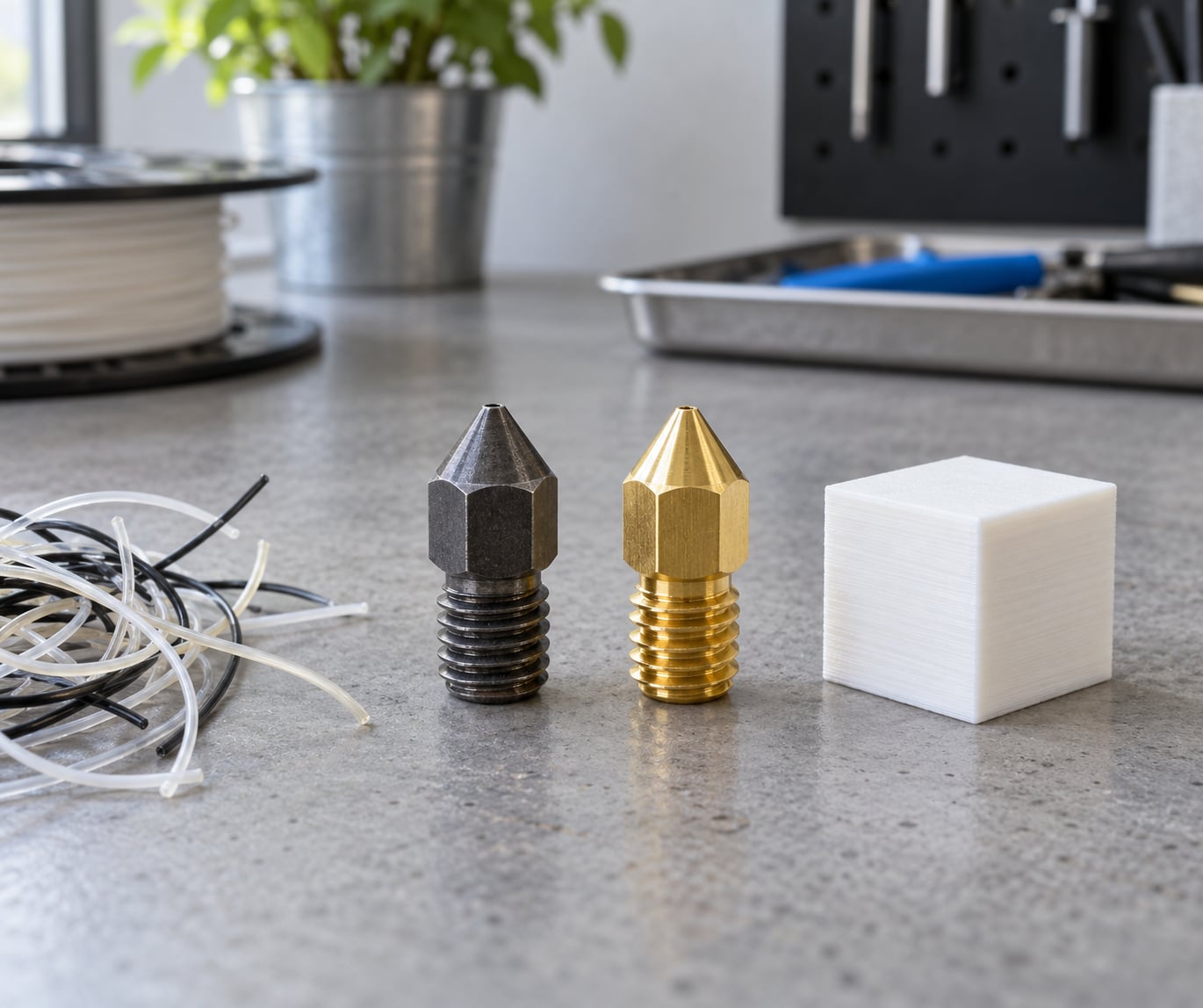
If you print only PLA, PETG, TPU or ABS, a brass nozzle is the better nozzle. Switch to hardened steel the moment you load carbon fiber, glass fiber, wood, metal-filled or glow-in-the-dark filament, or any material above 280C. Short version: brass moves heat fast and wears smooth; hardened steel shrugs off grit and heat.
That is the whole decision, and most people can stop there. The rest of this guide covers what actually changes when you swap, what it costs you in re-tuning, and how to tell whether your current brass nozzle is already worn out. I have swapped between all three materials on the same hotend more times than I care to admit, and the recurring theme across the forums is that people blame the filament for a nozzle problem long before they suspect the five-dollar part every gram of plastic has passed through.
One framing note before the specs. The nozzle is only the tip. The hotend is the assembly around it, including the heater block, thermistor, heat break and fan. You can replace one without touching the other, which matters later.
Table of Contents
- Hardened Steel vs Brass Nozzle Which to Use at a Glance
- What Temperature Can Each Nozzle Handle?
- How Do Brass and Hardened Steel Compare for Wear?
- Is your brass nozzle worn out, or is it the filament?
- Which Nozzle Gives Better Print Quality?
- What Are the Cost and Maintenance Differences?
- Which Filaments Work With Each Nozzle?
- Hardened Steel vs Brass Nozzle: Which Should You Choose?
- Frequently Asked Questions
- Can I use a hardened steel nozzle with PLA and PETG?
- Are brass nozzles suitable for carbon fiber and glass fiber filaments?
- Does a hardened steel nozzle produce better print quality than brass?
- How often should I replace a brass or hardened steel nozzle?
- Can I change the nozzle type on any 3D printer?
- Is a hardened steel nozzle worth the higher cost for home printing?
Hardened Steel vs Brass Nozzle Which to Use at a Glance
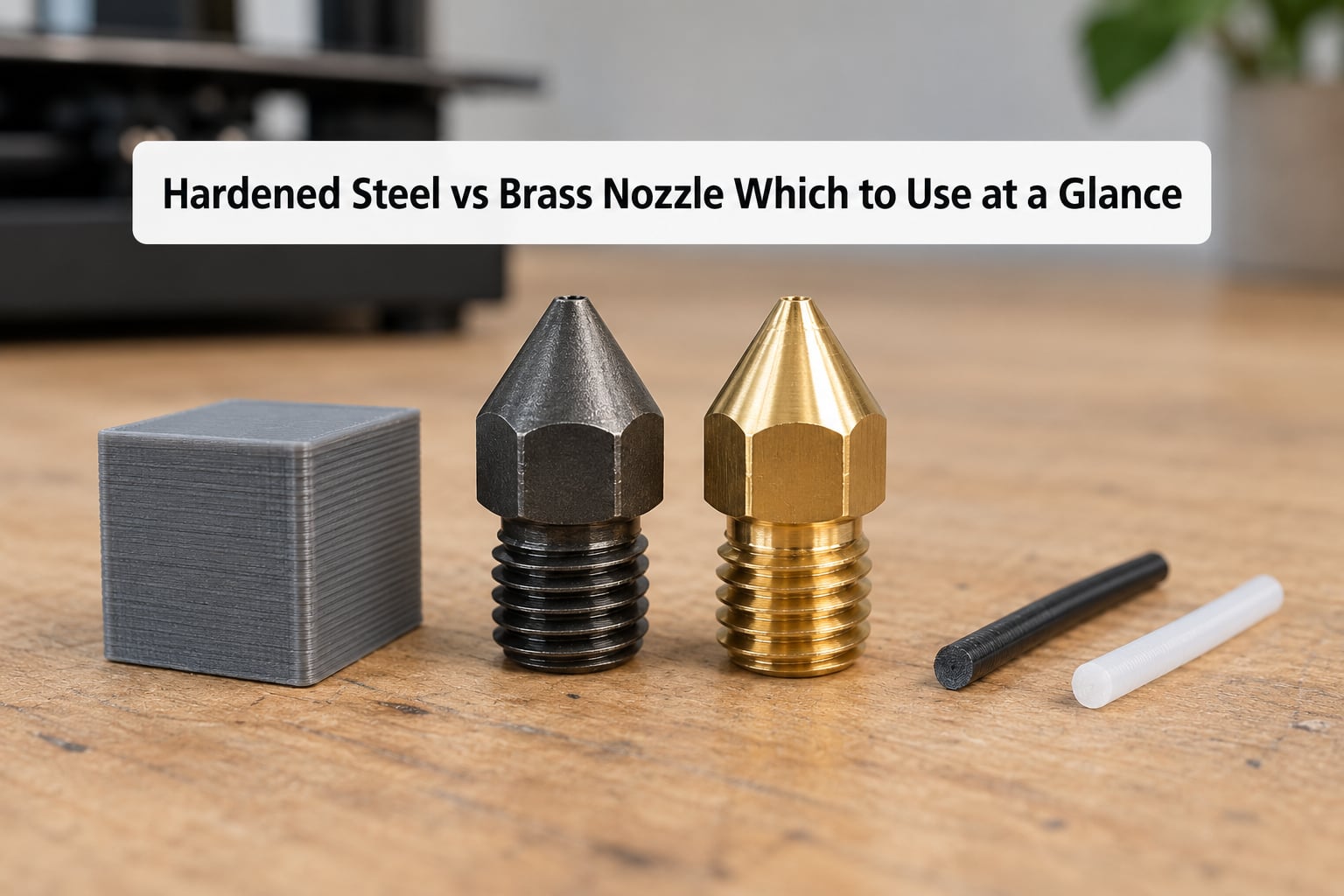
| Criterion | Brass | Hardened steel |
|---|---|---|
| Thermal conductivity | About 100-120 W/m·K | About 15-40 W/m·K |
| Hardness | Soft alloy, around 60-80 HRB | Heat treated, roughly 50-60 HRC |
| Typical max temperature | 240-280C on most nozzles | 300-350C, some rated to 400C |
| Abrasion resistance | Poor, wears fast with filled filament | Excellent, built for abrasive material |
| Filament compatibility | Standard thermoplastics, no fillers | Standard plus CF, GF, wood, metal, glow |
| Setpoint after a swap | Baseline | Raise 5-10C to match melt flow |
| Maintenance | Brass brush or needle, cheap to replace | No needles, inspect for damage |
| Best for | PLA, PETG, TPU, ABS, ASA, budget hobby work | Abrasive filaments, high-temp polymers, production runs |
Two rows in that table cause most of the confusion. Hardened steel’s low thermal conductivity is not a defect, it is the same property that makes it survive grit, and it is the reason your setpoint needs to move after a swap.
What Temperature Can Each Nozzle Handle?
Brass nozzles are commonly rated to 240C or 280C. Beyond that, the copper alloy in the melt zone starts to soften and distort, and the bore grows oval. That is plenty for PLA, PETG, TPU, ABS, ASA and most basic nylons.
Hardened steel nozzles typically carry a 300C or 350C rating, and some go to 400C. That unlocks polycarbonate, PEI, PPS and the high-temperature engineering blends, which will not flow through a brass nozzle without deforming it.
The more everyday consequence is the temperature change. Brass passes heat from the heater block into the melt far faster, so the plastic reaches full flow at a lower setpoint. Steel conducts roughly a quarter to a sixth as well. When you swap, the melt zone runs cooler at the same number, so you compensate by raising the setpoint about 5 to 10C.
That adjustment comes up constantly. A user on r/3Dprinting put it plainly: hardened steel nozzles usually need 5 to 10C more than brass, and other than that they can be used for anything. Someone in r/AnycubicKobraS1 gave the same number and the same reason, that steel’s lower conductivity is why the average increase is about 5 degrees.
If you do not adjust, the symptoms are unmistakable and get misdiagnosed. Under-extrusion, stringing, rough walls, poor layer bonding, and the persistent sense that the filament changed when you only changed metal.
How Do Brass and Hardened Steel Compare for Wear?
Abrasive filaments behave like fine sandpaper held against the inside of the bore. Carbon fiber, glass fiber, wood, metal powder and glow-in-the-dark pigment all contain hard filler particles, and every pass scours the melt zone a little wider.
Because flow scales with the square of the diameter, a bore that opens by a few hundredths of a millimetre pushes out noticeably more plastic. That is the mechanism behind the classic symptom set: sudden over-extrusion, ridges on the walls, blobbier corners, more stringing, and eventually a partial or full clog.
| Filament | Brass nozzle life | Hardened steel nozzle life |
|---|---|---|
| PLA, PETG, ABS, TPU (unfilled) | 500 hours and up | Well beyond 500 hours |
| Glow-in-the-dark PLA | Often under 100 hours | Typically several hundred hours |
| Wood-filled PLA | Roughly 50-150 hours | Several hundred hours |
| PLA-CF, PETG-CF | 10-25 hours | 150-300 hours |
| PA-CF, PAHT-CF | Often under 10 hours | Roughly 100-200 hours |
| Metal-filled filament | Very short, tens of hours | Long, but still finite |
These are community ranges, not lab constants, and wear depends heavily on how abrasive your specific spool is and how hot you run it. A printer owner on r/3Dprinting described gradual erosion of the tip, the kind of degradation you do not notice until the walls change. Another user on r/3DScanning ran CF-PC on brass for roughly 1,400 hours with no visible print impact, which shows the same filament can behave very differently depending on load.
Vendor testing points the same direction. A published test tracked bore expansion on carbon fiber PLA and reported about 15 micrometres on brass against about 2 micrometres on hardened steel after 120 hours. Treat vendor numbers as directional, but the order of magnitude is not in dispute.
Is your brass nozzle worn out, or is it the filament?
Before you buy anything, take the nozzle off and check it. Five minutes here saves three spools.
- Lines and blobs appear without any slicer change. Constant stringing that reappears after a clean is bore wear, not humidity.
- Walls look ridged or rough on one axis only. That asymmetry is a worn or partly blocked orifice.
- Your first layer got harder to set after hundreds of hours. A wider bore pushes more melt at the same Z-offset.
- The tip looks rounded, fuzzy or off-centre. Compare it against a new nozzle of the same diameter.
- Measure it. With the nozzle cool and removed, a micrometer or good calipers on the outside diameter at the tip should read about 0.40mm on a standard 0.4 nozzle. A reading at or above roughly 0.42mm means replace it.
While it is off, look up into the bore with a bright light. A visibly oval or enlarged opening is the same answer. Do not push an acupuncture needle or brass brush into hardened steel; the Prusa forum is clear that those tools can damage a hard nozzle, and brass takes them without complaint.
Which Nozzle Gives Better Print Quality?
With an undamaged nozzle of either material, print quality is essentially identical. Same layer height, same line width, same dimensional accuracy. If you are chasing a surface finish difference between brass and hardened steel, the cause is somewhere else in the machine.
What nozzle material really changes is consistency over time. Brass holds its geometry through hundreds of hours of clean filament and then degrades quickly once you load abrasive material. Hardened steel holds geometry across the whole abrasive job. Steadier geometry means steadier extrusion, which is what surface finish and dimensional accuracy actually rest on.
Three things cause more visible quality problems than nozzle material ever will: filament that has absorbed moisture, a hotend that has not finished PID tuning, and a first layer set slightly off after a swap. Work through those before blaming the metal.
What Are the Cost and Maintenance Differences?
Brass nozzles cost a few dollars each and hardened steel nozzles cost several times more per part. Per unit, brass always wins. Per printed hour, the picture changes once abrasive filament enters the schedule.
| Share of your printing that is abrasive | Cheaper over time | Why |
|---|---|---|
| Under about 10% | Brass | Rare wear events, low outlay, no re-tuning cost |
| Around 10-30% | Close call | Frequent nozzle changes plus 5-10C re-tunes start to cancel the higher upfront cost |
| Over about 30% | Hardened steel | One nozzle lasts for months of abrasive work |
Count your own time in that math. A brass swap that happens every ten hours of carbon fiber printing, each one followed by a PID re-tune and a fresh first layer, costs far more than the part.
On cleaning, brass forgives. A brass brush, an occasional needle, a heat soak and a wipe will keep it going indefinitely. Hardened steel needs gentler handling. Use heat and a brass brush, avoid needles, and never force a blockage clear. Brass also dents if you drop it or overtighten it, and that dent looks exactly like a clog, which is how people end up replacing the same nozzle twice.
Check your nozzle format before buying anything. The thread and seat differ between V6, MK8, Volcano and fully proprietary designs, and the physical diameter of the nozzle has nothing to do with compatibility. Measure yours, or look up the hotend type for your printer model, and confirm whether the silicone sock sits above or below the thread before you order.
Which Filaments Work With Each Nozzle?
- Brass is fine for PLA, PLA+ and silk, PETG, TPU and TPE, ABS, ASA, standard nylon, and PC at the lower end of its range with a hardened liner.
- Brass fails with PLA-CF, PETG-CF, PA-CF, PAHT-CF, GF and CF nylon blends, wood-filled PLA, metal-filled filament, glow-in-the-dark filament, and any sparkle or glitter filament.
- Hardened steel handles everything on the brass list plus every abrasive-filled filament above, and it is the right call for polycarbonate, PEI, PPS and other high-temperature polymers.
- Neither is the answer for continuous high-speed production runs on abrasive material. Tungsten carbide and ruby exist for that, and they cost several times more again.
Silk and sparkle PLA deserve a special note. Silk PLA is usually safe in brass. Glitter and sparkle filaments contain hard particles, so treat them like any other abrasive even if the spool does not advertise it. Users on r/BambuLab describe hardened steel as effectively mandatory for carbon fiber and sparkle filaments for exactly this reason.
Hardened Steel vs Brass Nozzle: Which Should You Choose?
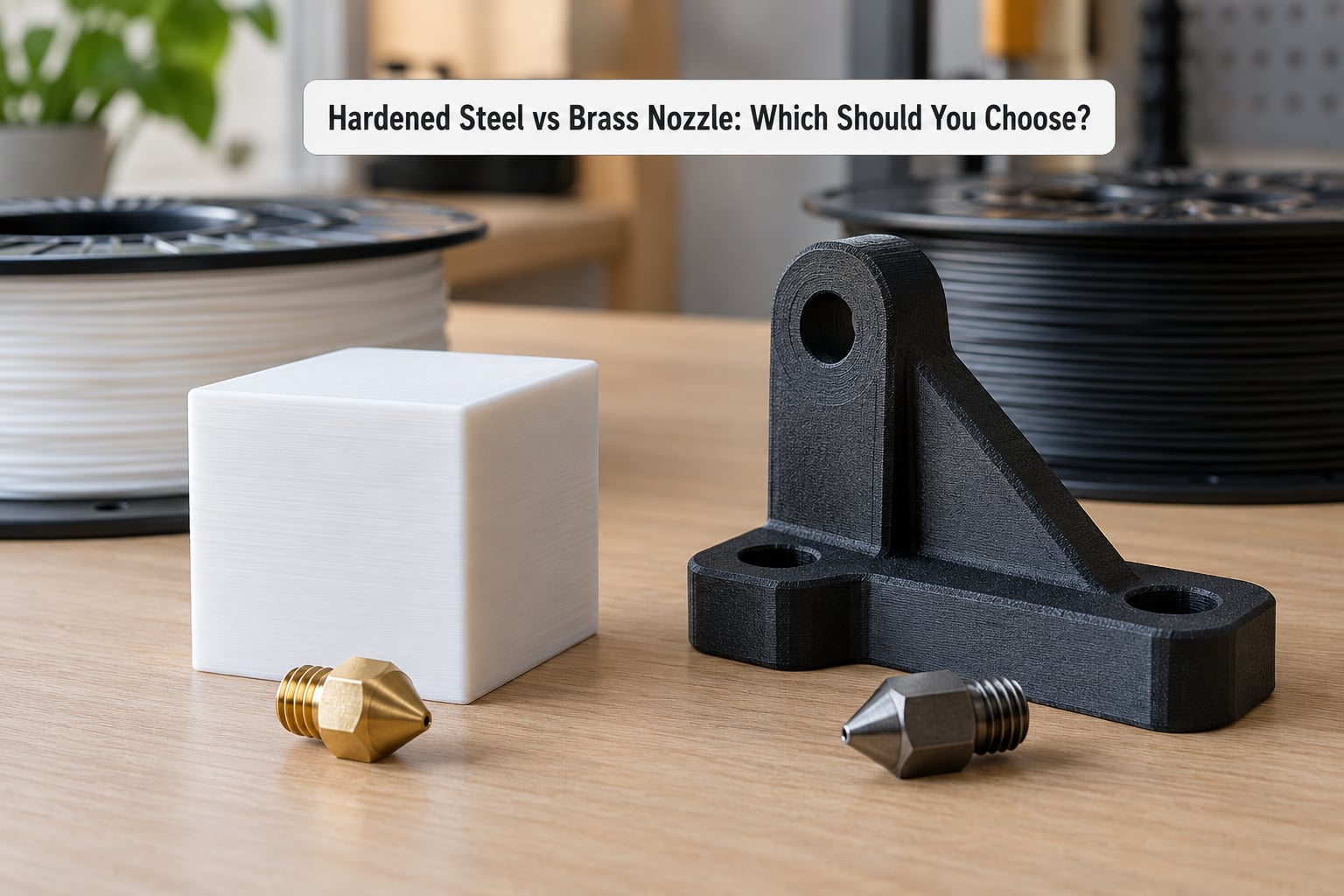
Beginners printing PLA and PETG should stay with brass. You will get the best heat transfer, the fastest response, the cheapest replacement, and the fewest calibration surprises. A hardened steel nozzle on a PLA-only printer buys you nothing you will ever notice.
Anyone printing carbon fiber, glass fiber, wood, metal-filled or glow-in-the-dark filament should fit hardened steel before the first spool, not after the third clog. Same for polycarbonate, PEI and other high-temperature polymers, and for any small-batch production work that repeats.
For everyone else, a stainless steel nozzle is the middle option worth knowing about. It is tougher than brass and softer than hardened steel, with abrasion resistance that sits between the two. It will not survive serious carbon fiber work indefinitely, and it caps out around 250C, but one on r/3Dprinting has run for years by pairing it with brass and reaching for hardened steel only when the material demands it.
If you want to run both on a single-hotend printer, keep it simple. Two nozzles, one labelled, one bagged and clean when not in use, stored on their heat break so the silicone sock does not deform. A brass heater block with a hardened steel nozzle is a very common and very cheap pairing, since the block still moves heat well and only the tip needs the hardness. You do not need to replace the whole hotend.
When you do swap, run this checklist before your real print.
- Heat the hotend to around 200C and run a PID auto-tune on the new setup.
- Raise the material setpoint by 5 to 10C over what you used with brass.
- Re-run flow or pressure advance calibration at the new temperature.
- Re-level the bed and reset your Z-offset, since the new tip sits at a slightly different height.
- Print a single wall or thin calibration part and check for gaps before committing to a long job.
Do not skip step one. A hotend swap invalidates the existing PID values, and the temperature swings that follow cause jams that look like a nozzle fault. Several owners on r/prusa3d pair a brass heater block with a hardened nozzle and treat PID re-tuning as part of the swap, not an extra.
Frequently Asked Questions
Can I use a hardened steel nozzle with PLA and PETG?
Yes, and the prints will look identical to brass as long as the nozzle is undamaged. Steel conducts heat less efficiently, so raise your PLA setpoint by about 5 to 10C and re-run PID after the swap. Many owners simply run hardened steel on everything to stop thinking about it. You are giving up the fastest heat response and the cheapest replacement for durability you may not need.
Are brass nozzles suitable for carbon fiber and glass fiber filaments?
Technically yes, briefly, but the abrasive filler erodes the bore fast. Community reports put PLA-CF and PETG-CF life on brass at roughly 10 to 25 hours before flow changes noticeably, and PA-CF is often shorter. If carbon fiber is more than an occasional experiment, fit hardened steel before loading the spool. Otherwise expect under-extrusion, stringing and clogs on a schedule.
Does a hardened steel nozzle produce better print quality than brass?
Not while both nozzles are new and undamaged. Layer height, line width and dimensional accuracy come from calibration and filament condition, not from the metal. What changes over time is consistency, because hardened steel holds its bore diameter through abrasive material while brass slowly opens up. Most apparent quality jumps after a swap are really PID and Z-offset fixes.
How often should I replace a brass or hardened steel nozzle?
With unfilled filament such as PLA, PETG or ABS, a brass nozzle can run 500 hours and up, and hardened steel far longer. With glow-in-the-dark or wood-filled filament, expect brass to last from tens to a couple hundred hours. With carbon fiber or glass fiber reinforced filament, brass often gives out in 10 to 25 hours while hardened steel runs 100 to 300. Measure the bore if prints change unexpectedly.
Can I change the nozzle type on any 3D printer?
Only within your hotend’s format. Nozzles come in V6, MK8, Volcano and fully proprietary patterns, and the seat, thread and heat break all differ between them. A nozzle that screws in badly can be unsafe, so confirm the hotend type for your printer model before ordering. You only replace the nozzle itself, not the heater block, thermistor or heat break.
Is a hardened steel nozzle worth the higher cost for home printing?
Only if you print abrasive filaments or high-temperature polymers. For a PLA and PETG household printer, a brass nozzle lasts longer than most people think and costs far less per part, so the upgrade buys nothing. If carbon fiber, glass fiber, wood or glow filament is part of your routine, hardened steel pays for itself quickly by removing repeated replacements and the re-tuning that follows each one.
Do this first: check what you actually have loaded. Unfilled PLA, PETG, TPU or ABS means brass is the right nozzle, and nothing needs to change. Any carbon fiber, glass fiber, wood, metal-filled or glow filament, or anything above 280C, means fit hardened steel before you print, then expect to add 5 to 10C and re-run PID once.