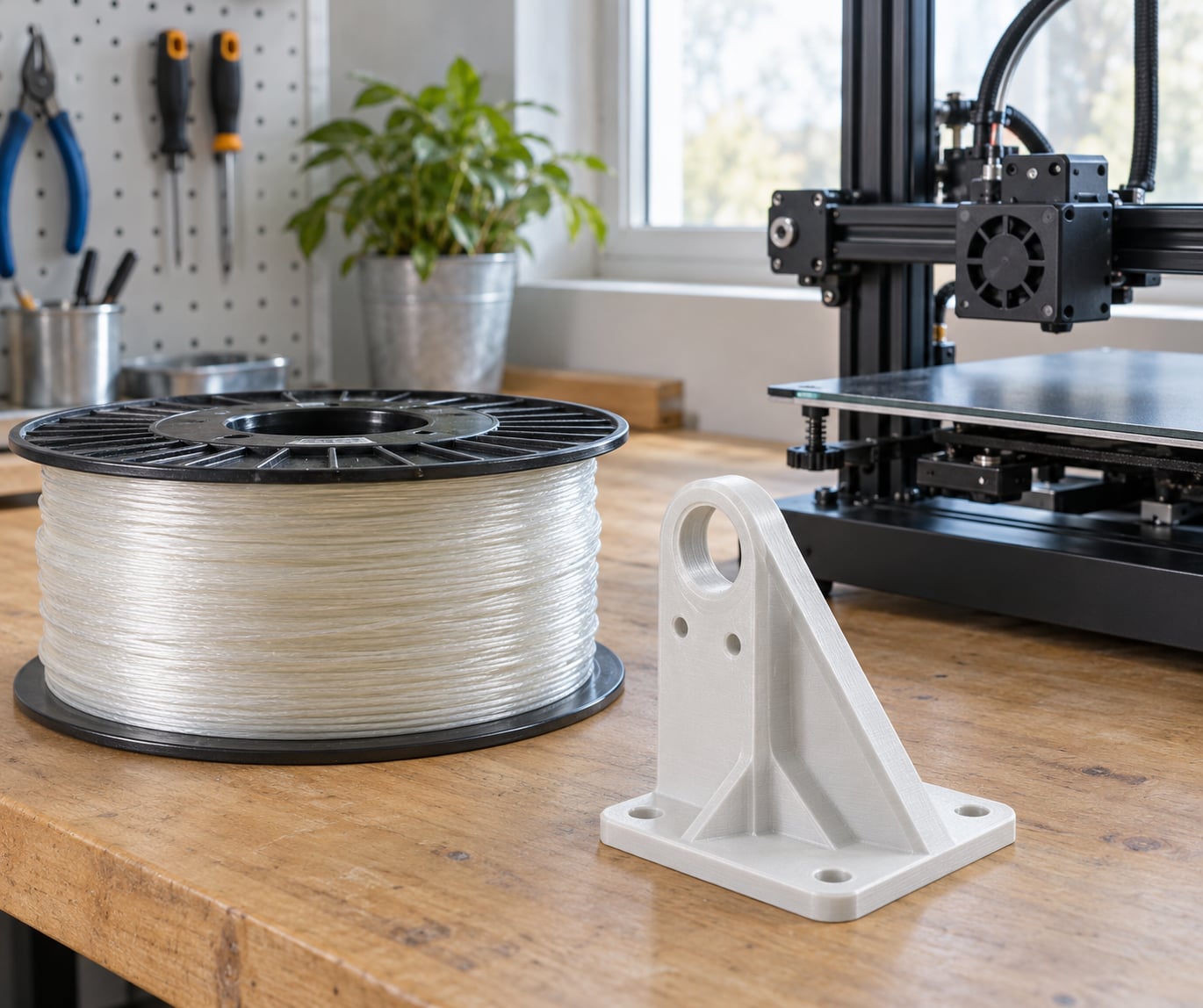
Short version: use glass fiber filament when a part has to take real load – impacts, vibration, abrasion, outdoor heat or repeated flexing – and your printer has a hardened steel or tungsten carbide nozzle fitted. Brackets, jigs, clips, RC and drone frames, bike mounts, tool holders and outdoor fixtures are the parts that gain from it.
Skip it for display models, food-contact items, living hinges and anything where a smooth surface matters more than stiffness. Plain PLA and PETG print far easier, look far better and cost less effort per part.
That decision comes down to a single question: will this part be stressed, or will it mostly be looked at?
Table of Contents
- Glass Fiber Filament: When to Use It
- Use glass fiber filament when
- Skip glass fiber filament when
- What Is Glass Fiber Filament?
- Why chopped fiber is not the same as continuous fiberglass
- How Does Glass Fiber Filament Compare With PLA, PETG and ABS?
- What Are the Main Benefits and Drawbacks?
- Can Your 3D Printer Print Glass Fiber Filament?
- When to Use Glass Fiber Filament Instead of Standard Filament
- Glass fiber filament when to use it for heat, impact and wear
- Projects worth upgrading
- Projects to leave on standard filament
- How to Print Glass Fiber Filament Successfully
- Frequently Asked Questions
- Do I need a hardened nozzle to print glass fiber filament?
- What bed temperature should I use for glass fiber PETG?
- Is glass fiber filament stronger than carbon fiber filament?
- Can you sand or machine glass fiber printed parts?
- Which 3D printers handle glass fiber filament without problems?
- Is glass fiber filament food safe or waterproof?
- Conclusion
Glass Fiber Filament: When to Use It
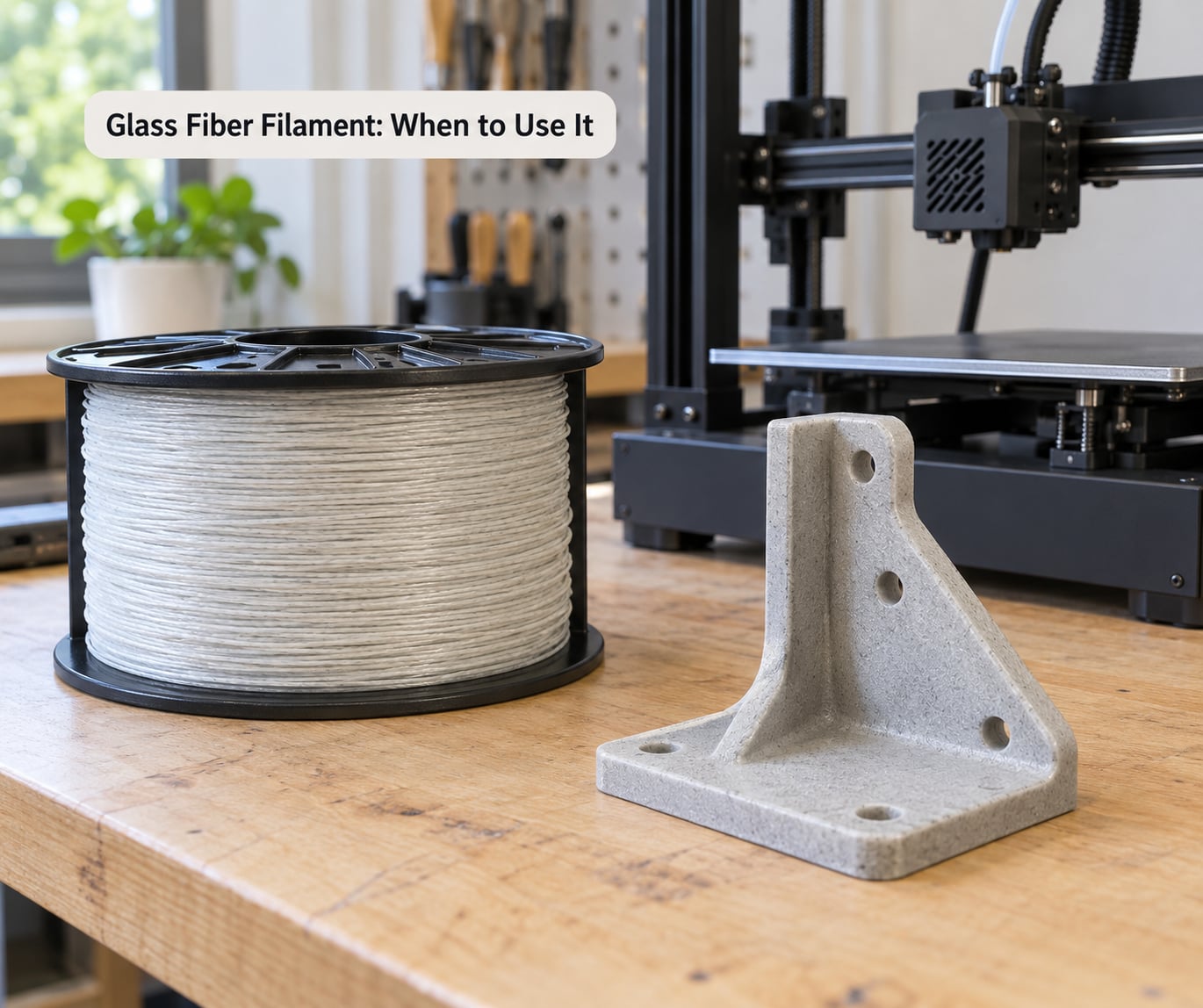
Use glass fiber filament when the part will be loaded, heated, vibrated or worn in service, and only when the printer is already set up for abrasive composite material. If the part is decorative, the nozzle is still brass, or the base polymer already handles the job, reinforcing it adds cost and headaches for nothing.
Use glass fiber filament when
- The part takes a shock, a drop or a knock where it lives.
- It sits in heat – a car interior in summer, a housing next to a motor, a box by a sunny window.
- It flexes repeatedly or vibrates constantly, like a drone arm or an RC suspension mount.
- It rubs, slides or abrades against another part.
- It lives outdoors and has to handle weather and temperature swings.
- It is a functional prototype for something you would otherwise machine or injection mold.
- Plain PLA keeps flexing in the middle of a bracket and the bolt holes deform under load.
Skip glass fiber filament when
- It is a display model, vase-mode piece or a miniature, where the matte grainy surface shows.
- It touches food or drink. Fibers reach the surface of the print and stay there.
- It needs to bend thousands of times, like a living hinge or a snap-fit clip.
- Your printer still has a brass nozzle and you do not plan to change it.
- Fine detail, tight tolerances or a smooth cosmetic surface drive the design.
- The job is light duty. Reinforcing a PLA shelf bracket nobody leans on is effort you will never get back.
Reinforced filament costs more per kilo and eats nozzles faster, so the material only pays for itself when the part is doing structural work. A display model in PETG-CF is the classic expensive mistake.
What Is Glass Fiber Filament?
Glass fiber filament is a composite thermoplastic: short, chopped strands of glass fiber mixed into a base polymer such as PLA, PETG, nylon or polycarbonate, usually at 10 to 30 percent by weight.
The glass itself never melts. It sits inside the molten plastic while the layer is extruded, and as the layer cools the strands lock into a matrix that carries load across the part. That is why a reinforced bracket feels rigid and solid where the unfilled version flexes and creaks.
The fibers change four things noticeably. Stiffness climbs, sometimes by a factor of two or more depending on the base polymer – one ABS-CF user on r/3Dprinting put the gain at roughly 2.5 times, which is in the right territory for reinforced ABS. Toughness and impact resistance rise with it. Wear and abrasion resistance improve, which matters for anything that slides or rubs. Dimensional stability under heat improves, so parts sag less in a warm car or a hot enclosure.
What does not improve is the finish or the layer bond. The surface turns matte and slightly rough, and layer adhesion usually gets worse rather than better.
Why chopped fiber is not the same as continuous fiberglass
This is the distinction that confuses most newcomers, because both get called fiberglass in print shops and forums.
Chopped fiber filament uses short strands, a few millimeters long, suspended randomly in the melt. It runs on any FDM machine with a hardened nozzle, which is what everyone on a home printer actually buys. The reinforcement is close to isotropic, so the part behaves similarly in most directions.
Continuous fiber systems, the kind Markforged popularized, lay long strands in a chosen pattern during a second pass and need a matched resin or binder. They deliver far higher stiffness for the same geometry, but they are industrial equipment, not a desktop printer upgrade.
A third category confuses the search results further: filaments with a small amount of chopped carbon fiber blended into PETG or PLA. Those are composite too, and the same nozzle rules apply. rcgroups veterans make the sharpest point about all three: if the fiber does not bond properly to the polymer, the strands act as contaminants rather than reinforcement, and bond quality matters more than the fiber type.
How Does Glass Fiber Filament Compare With PLA, PETG and ABS?
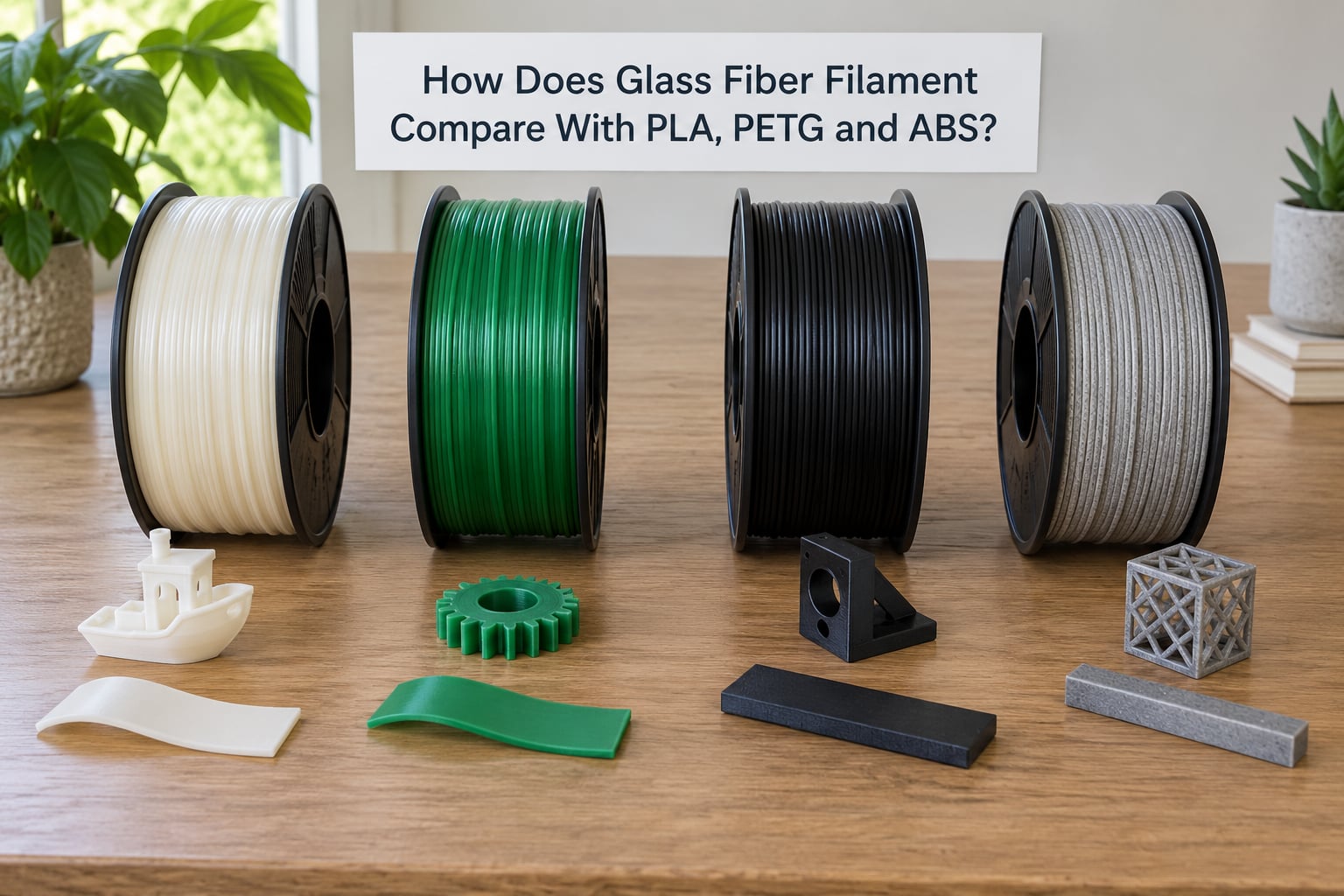
| Property | PLA | PETG | ABS or ASA | Glass fiber composite |
|---|---|---|---|---|
| Rigidity and flexural stiffness | Low, flexes in long parts | Moderate | Moderate to high | High, several times the base polymer |
| Impact and toughness | Brittle, cracks rather than bends | Tough, the practical workhorse | Impact resistant but brittle when cold | Moderate to good, more brittle with high loading |
| Heat resistance (HDT) | Low, softens in a warm room | Moderate | Higher | Moderately higher than the base polymer |
| Layer adhesion (Z strength) | Good | Very good | Good | Weaker, the most common surprise |
| Nozzle wear | Negligible | Low | Low | High, brass is not an option |
| Printing difficulty | Easy | Easy to moderate | Needs an enclosure | Moderate, slower and more finicky |
| Surface finish | Clean, glossy | Clean | Clean, matte | Matte and grainy, layer lines more visible |
| Typical use | Models, decoration, prototypes | General functional parts, containers | Enclosures, automotive interior parts | Brackets, jigs, fixtures, frames, wear parts |
The pattern is consistent: reinforcement buys stiffness, dimensional stability and wear resistance, and pays for it with toughness, layer adhesion and printability. A GF-PETG part is stiffer and handles heat better than plain PETG, but it will crack rather than flex if you drop it, and the layer lines are the first thing to let go under repeated stress.
Choose the base polymer before you choose the reinforcement. PLA-GF prints beautifully and is stiff but brittle. PETG-GF is the sensible all-rounder for workshop parts. PA6-GF (nylon) takes real impact and fatigue loads. PC-GF handles genuine heat, at the cost of demanding an all-metal hotend and very slow print speeds.
What Are the Main Benefits and Drawbacks?
The benefits are all mechanical, and they are worth chasing when the part has a job.
- Rigid parts that hold shape. Flat panels and long brackets stop flexing, so bolt holes stay round and threads stay true.
- Better heat deflection. Parts in hot environments sag less than unfilled plastic of the same base.
- Dimensional stability under load. Machined features and press fits stay where you put them.
- Abrasion and wear resistance. Good for guides, spacers and anything sliding against another part.
- Fatigue resistance. Reinforced grades hold up better under cyclic loading than brittle unfilled plastics.
- A matte, industrial-looking surface that hides scuffs better than glossy PLA.
The drawbacks are equally real, and most people meet them before they see a benefit.
- Abrasive wear on the nozzle. A Prusa forum veteran describes glass and carbon fiber as more abrasive than most filled filaments and able to ruin a brass nozzle in very short order.
- Brittleness at the layer lines. A Bambu Lab forum analysis measured PLA-CF at 144 percent of PLA Basic’s bending stiffness but only 57 percent of its impact layer adhesion. Stiff, and weak in Z.
- Worn hardware beyond the nozzle. A public service announcement circulating in 3D printing Facebook groups reported extruder wear on entry-level A1 and Mini extruders after roughly 1,200 hours of PETG-CF. Few owners know that number until the gears strip.
- Slower, fussier printing. PC glass fiber needs 280 to 330 degrees Celsius and slow speeds, per the Bambu community, which many printers cannot reach at all.
- Bed adhesion problems, especially with GF-PETG. Users land on PA glue sticks or 3DLac-type adhesion aids.
- Moisture sensitivity, particularly for nylon and PC bases, which need a dryer.
- A rough, matte surface and more visible layer lines.
Can Your 3D Printer Print Glass Fiber Filament?
Most home printers can, once two things change: the nozzle and the temperature range. Work through this list before you buy a spool.
- Fit a hardened nozzle. Hardened steel handles PLA-GF and PETG-GF well. Tungsten carbide lasts longer and copes better with the high-temperature composites, at a higher cost.
- Confirm an all-metal hotend. PTFE-lined hotends soften and creep above about 240 degrees Celsius, which rules out most ABS-GF and all PC-GF work.
- Use an enclosure for high-temperature bases. ASA, PA and PC composites warp badly in a draft. A closed chamber is the difference between a part and a failed print.
- Set up the bed. A textured PEI sheet plus an adhesion aid such as PA glue or 3DLac works far better than a smooth plate.
- Add a filament dryer. Nylon and PC composites absorb moisture quickly and print wet, stringy and weak.
- Plan ventilation and PPE for post-processing. Cutting, drilling and sanding reinforced prints makes dust. A dust mask and a vacuum beat compressed air every time.
Always follow the filament manufacturer’s temperature profile rather than a generic table. Fiber loading, polymer grade and filament diameter all shift what a given spool actually wants, and the maker’s spec sheet beats any guide, including this one.
When to Use Glass Fiber Filament Instead of Standard Filament
Glass fiber filament when to use it for heat, impact and wear
The clearest signal is a part that fails in service, not a part that looks weak. Here are projects where the upgrade earns its keep.
Projects worth upgrading
- Machine guards and mounting brackets that bolt to something and carry a load. This is where GF-PETG quietly beats everything else on a bench.
- Tool holders, organizers and shop jigs that take daily handling and would sag in PLA.
- RC chassis and drone frames where vibration is constant. A drone builder on r/3Dprinting found PLA very stiff but prone to breaking quickly, and weighed PA6-CF for a high-speed frame instead – exactly the stiffness-versus-toughness tradeoff GF lives in.
- Bike accessories, cages, fender mounts and straps carriers that live outdoors on a rough road.
- Weather-exposed fixtures, including an r/3Dprinting user’s backhoe air intake shroud built for a machine that sits outside around the clock, because the OEM part was awkward to source.
- Functional prototypes for parts headed to injection molding, where you need real mechanical behavior and real tolerances.
- Wear parts, bushings, spacers and slide blocks that rub against another surface daily.
Projects to leave on standard filament
- Display models and art. The matte grainy finish shows every layer line.
- Food-contact items, cups, bottles and cutters. Fibers surface on the print.
- Living hinges and clips that need thousands of flex cycles. Toughness beats stiffness here.
- Fine-detail miniatures, where surface quality and clean edges decide the print.
- Low-stress indoor parts where plain PLA or PETG already works and prints beautifully.
- Anything on a printer without a hardened nozzle or without an enclosure for high-temperature bases.
How to Print Glass Fiber Filament Successfully
A repeatable workflow matters more than any single setting, because reinforced filament punishes printers that were set up casually for PLA.
- Dry the filament first. Nylon and PC composites absorb water quickly. Dry according to the manufacturer’s window and print from a dry box if you can.
- Load it without forcing anything. Composite pellets bridge and jam far more easily than plain plastic. Push the extruder slowly by hand and never crank the gear against resistance.
- Install the hardened nozzle and clean it. A partially blocked nozzle is the number one cause of failed GF prints.
- Start with the maker’s profile, not a generic one. As a rough guide, PLA-GF often sits in the low 200s Celsius, PETG-GF in the mid to high 200s, PA-GF in the high 200s, and PC-GF needs 280 to 330 degrees Celsius with slow speeds.
- Lower the bed temperature slightly from your usual PLA setting if warping shows up, and add an adhesion aid rather than cranking the heat.
- Slow down. Composite prints quietly and consistently at lower speeds, and slower walls improve layer bonding.
- Orient the part so the load runs along the layers, not across them. Z strength is the weak axis, and orientation costs nothing.
- Post-process safely. Sanding and drilling work well on reinforced prints and cut with carbide bits, but do it with a mask on and a vacuum nearby.
| Symptom | Likely cause | Fix |
|---|---|---|
| Clogged nozzle | Brass or worn nozzle, damp filament | Fit a hardened or carbide nozzle, cold-pull, dry the spool |
| Part lifts or corners lift | Warping, poor first layer | Adhesion aid, textured PEI, lower bed temperature, add a brim |
| Layers split under load | Weak Z adhesion from fiber loading | More walls, slower cooling, orient the load along the layers |
| Rough or grainy extrusion | Worn nozzle opening | Replace the nozzle and check for partial clogging |
| Heavy stringing | Retraction wrong for the new melt | Re-tune retraction for the maker’s profile |
| Under-extrusion after many prints | Extruder and hotend wear | Inspect the drive gear and idler bearings early |
Frequently Asked Questions
Do I need a hardened nozzle to print glass fiber filament?
Yes. Glass fibers are abrasive and will wear through a brass nozzle in a short time, which shows up as a rough surface, a widened extrusion hole and inaccurate layers. Hardened steel is the practical minimum for PLA-GF and PETG-GF. Tungsten carbide lasts longer and is worth it for nylon and polycarbonate composites that print hot. Never force a composite through a blocked brass nozzle.
What bed temperature should I use for glass fiber PETG?
Start slightly below your usual PETG bed temperature and add an adhesion aid rather than more heat. A textured PEI sheet with PA glue or a 3DLac-type product usually beats heating the bed harder. If corners still lift, try a brim and a marginally slower first layer. Manufacturer profiles vary by fiber loading, so check the spool’s own recommendation before changing anything.
Is glass fiber filament stronger than carbon fiber filament?
It depends on which kind of strength you mean. Carbon fiber composites are stiffer and hold dimensions better. Glass fiber composites are tougher, take more abuse and repeated impact, and wear more slowly. For a part that gets hit, dropped, vibrated or scuffed, glass fiber is often the better engineering choice. For rigidity and precision, carbon fiber wins.
Can you sand or machine glass fiber printed parts?
Yes, and this is one of the material’s real advantages. Reinforced prints sand, file and drill cleanly, and carbide bits cut them far faster than they cut plain plastic. Do it with a dust mask and a vacuum, because glass dust irritates lungs and skin. Edges machined after printing often look cleaner than the layer lines underneath them.
Which 3D printers handle glass fiber filament without problems?
Any printer with a hardened steel or tungsten carbide nozzle, an all-metal hotend, a heated bed and reliable direct drive will handle PLA-GF and PETG-GF. ABS-GF and ASA-GF add a real need for an enclosure. PC-GF needs a hotend reaching 280 to 330 degrees Celsius and slow print speeds, which rules out many entry-level machines. Check your printer’s maximum nozzle temperature first.
Is glass fiber filament food safe or waterproof?
Treat it as neither. Fibers migrate to the surface of the print, so reinforced filament is not something to drink from or handle food with, and it is not a watertight material for containers. Use plain PETG for food-adjacent work and check whether even that carries a food-contact certification for your country. Composite filaments are not usually certified.
Conclusion
Glass fiber filament when to use it is a simple question once you frame it correctly: reach for it when a part works – carries load, faces heat, wears, vibrates or lives outdoors – and stay with PLA or PETG when a part mostly sits still and gets looked at.
Start by checking two things. Confirm your printer’s nozzle type and maximum temperature against the filament you have in mind, then use the manufacturer’s recommended profile rather than a generic one. If a hardened nozzle is already fitted and the part has a real job, glass fiber composite filament is one of the best upgrades a home FDM setup can make.
Last reviewed October 2026.