Updated for October 2026.
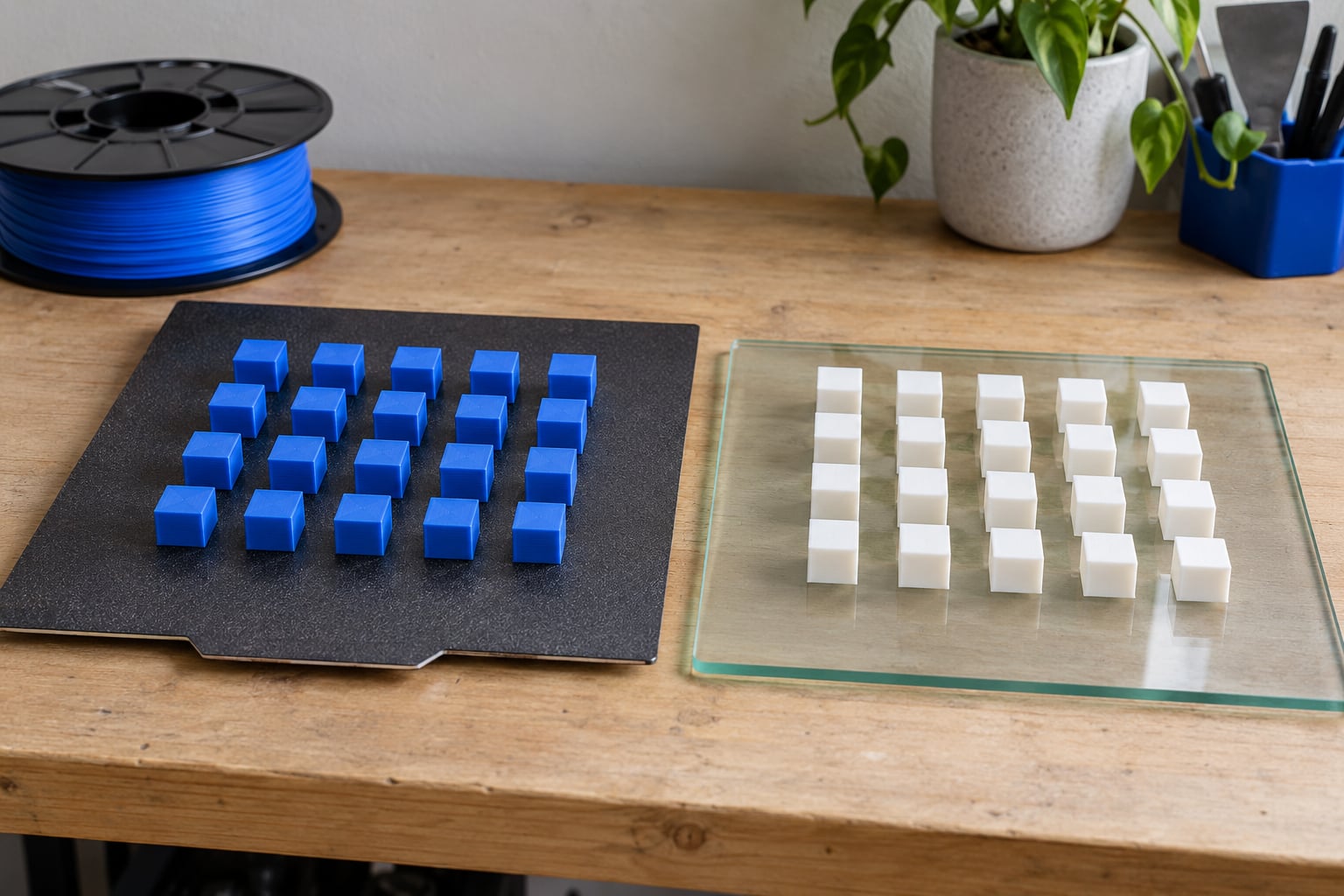
Short answer on pei vs glass build plate which is better: PEI wins for almost every FDM printer, and glass wins in a narrow set of cases. Choose textured PEI for PLA, PETG, ABS, ASA and TPU, for parts that peel off by flexing the sheet, and for a low-maintenance setup. Choose glass when flatness, dimensional stability and a mirror-smooth bottom face matter more than easy removal.
The difference is physical. A PEI sheet grips molten plastic while the nozzle is hot and releases it as the sheet cools, then bows so the finished part lifts away with two fingers. Glass does neither job. It is chemically inert, so it needs an adhesive layer such as glue stick or hairspray, and it cannot flex, so parts come off with a spatula or a painful tug on the plastic.
That single behaviour is why this question has an easy answer for most people and a real argument for a few. On r/3Dprinting and the Bambu and Prusa forums the dominant view is that PEI has been the community default since about 2015 and most owners have moved off glass. The remaining glass loyalists are usually printing display models and prototypes where the bottom surface is the presentation surface.
Table of Contents
- PEI vs Glass Build Plate at a Glance
- PEI vs Glass Build Plate: Adhesion and First-Layer Quality
- Textured PEI, smooth PEI and textured glass are three different answers
- First-layer settings matter more than the plate you own
- How Heat Resistance and Warping Affect Each Build Plate
- Which Surface Is More Durable and Easier to Maintain?
- What Materials Should You Print on PEI or Glass?
- What build plate is safest for TPU?
- Compatibility With Different 3D Printers
- PEI or Glass Build Plate Cost and Sizing
- Which Should You Choose?
- Frequently Asked Questions
- Is a PEI or glass build plate better for 3D printing?
- Can you print ABS on a PEI build plate?
- Is a textured PEI sheet harder to clean than glass?
- Should I use textured PEI or smooth PEI?
- What build plate is safest for TPU?
PEI vs Glass Build Plate at a Glance
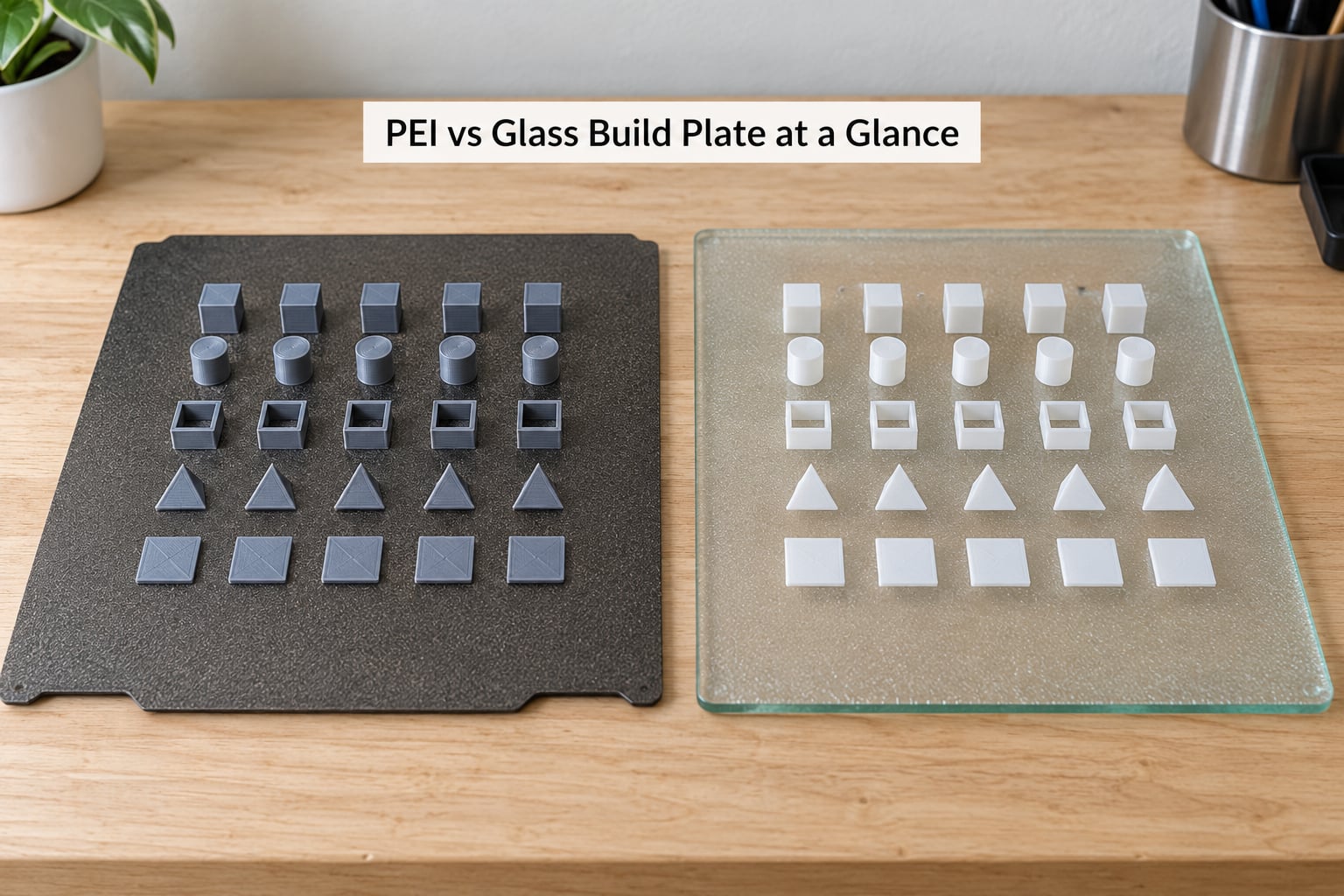
| Criterion | PEI build plate | Glass build plate |
|---|---|---|
| First-layer adhesion without adhesive | Strong on textured and smooth PEI for PLA, PETG, ABS, ASA, TPU | Weak on bare glass; needs glue stick, hairspray or an ABS slurry |
| Part removal | Flex the spring-steel sheet and the part pops off when cool | Pry or slide a spatula; no flex available |
| Bottom surface finish | Matte or satin; textured PEI leaves a visible stipple | Glossy and mirror-smooth |
| Shape retention | Spring steel flexes, which forgives small levelling errors and adds stress over a long bed | Rigid and stays flat, the better choice for large beds |
| Maximum bed temperature | Rated comfortably above what ABS and ASA need for normal printing | Handles far more heat and survives a failed heater or a thermal shock |
| PETG behaviour | Can fuse permanently and tear the coating off the spring steel; a glue layer blocks it | Can fuse and chip the surface during removal |
| ABS and ASA | Works well; a closed chamber still helps | Works, and stays rigid at temperature |
| Cleaning | IPA or warm soapy water; light 800 to 1000 grit sanding refreshes a worn coating | Easy to wipe clean, but glue and slurry residue must be removed fully |
| Wear and damage | Coating scratches, dulls and eventually peels; the sheet survives | Glass is scratch-resistant but chips or cracks from a dropped part or a hard pry |
| Best for | Most FDM work, warp-prone parts, TPU, high volumes, beginners | Display models, prototypes, large flat beds, max-temperature materials |
Read that table as a workflow decision rather than a spec sheet. The rows where PEI wins are the ones you touch every time you print. The rows where glass wins are the ones that matter on the parts you photograph.
PEI vs Glass Build Plate: Adhesion and First-Layer Quality
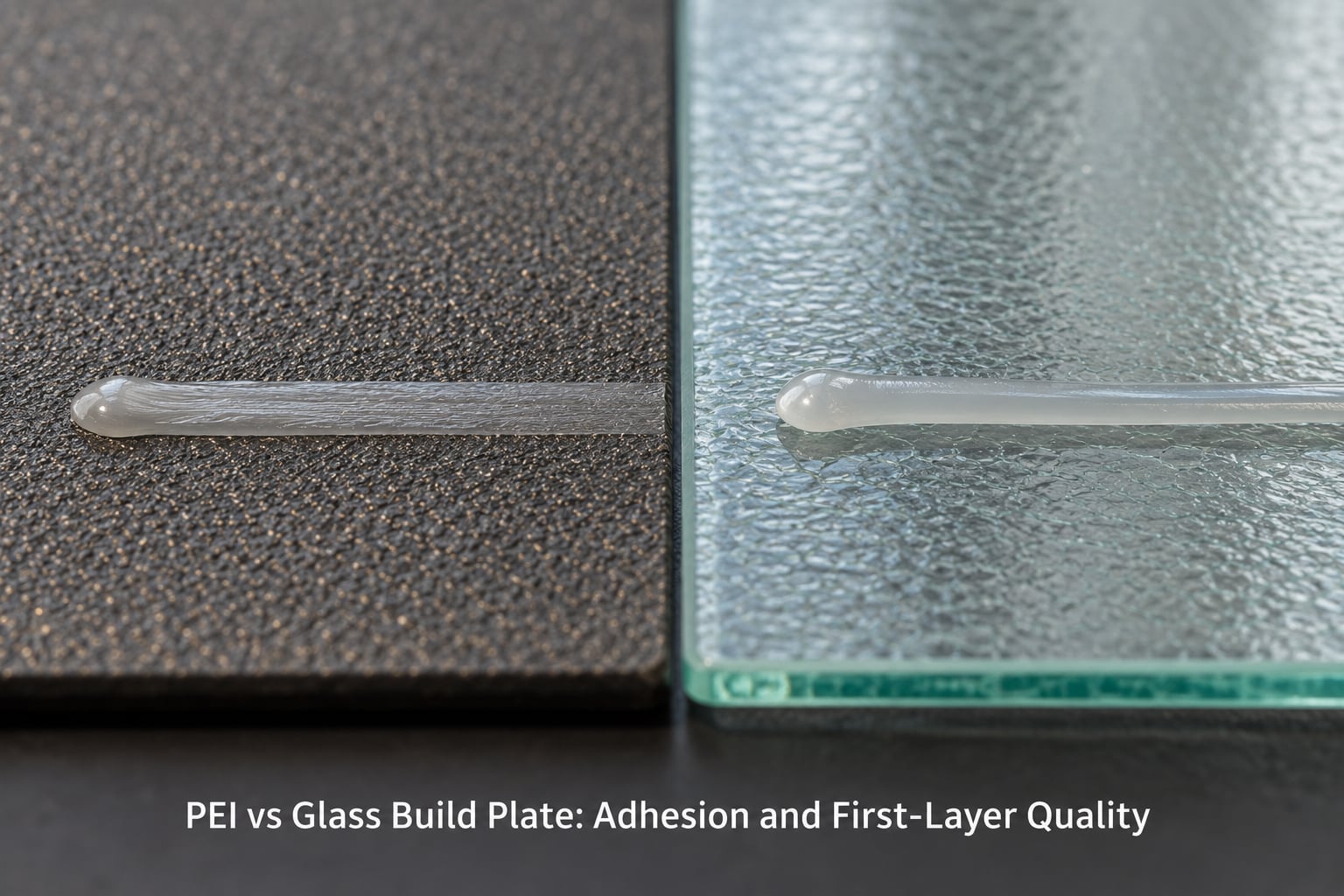
Adhesion is a tug-of-war, and that framing explains every practical difference between the two surfaces. The plate has to hold a part down hard enough to stop the corners lifting and curling as the plastic cools, then let go once the print is finished. PEI does both. It grips chemically when hot and releases as the sheet cools. Glass is nearly inert, so on its own it barely holds a first layer at any temperature.
Textured PEI, smooth PEI and textured glass are three different answers
Textured PEI has a micro-rough coating that gives molten plastic something mechanical to grab. It is the most forgiving surface made and hides first-layer imperfections that a smooth surface would print for you. Smooth PEI grips most filaments when hot and gives a glossier bottom, which is why it turns up on display work. Textured glass behaves much like textured PEI but still leans on an adhesive to do the heavy lifting at low bed temperatures.
Surface roughness cuts both ways. A coarse texture improves grip and makes a slightly squished first layer hold, but it also transfers that texture to the underside of the part. If the model is going on a shelf, that stipple is the first thing anyone sees.
There is one more counterintuitive factor: bed size changes adhesion. A larger bed means a longer lever arm and more thermal mass to heat, and a small bed reaches temperature faster and holds it more evenly. Owners swapping large glass sheets for spring steel often report that adhesion improved, not because PEI grips harder in the abstract, but because a smaller heated area cycles less thermal shock through the plate.
First-layer settings matter more than the plate you own
Whatever surface you choose, the same four settings decide most first layers: a 0.25 to 0.3 mm first layer, a first-layer speed of 20 to 30 mm/s, flow raised to 110 to 120 percent, and a first-layer fan held at 0 to 30 percent. A brim handles the rest for warp-prone geometries.
How Heat Resistance and Warping Affect Each Build Plate
Glass wins on raw heat tolerance, and that is not a close call. A thick glass sheet shrugs off a failed heater, a stuck thermostat and a thermal shock from a cold room much better than a coated steel sheet, which is why glass remains the surface of choice for maximum-temperature engineering polymers and for heated chambers running well past the 100 to 110 °C that ABS and ASA ask for.
That said, most printing happens far below either limit. Bed temperatures of 55 to 60 °C for PLA, 70 to 80 °C for PETG and 100 to 110 °C for ABS leave both surfaces comfortable, which is why heat tolerance rarely decides the comparison for a home printer.
Warping is where geometry matters more than material. Glass is rigid, so it stays put through heat cycles and keeps its flatness over a large area, which is why large-format printers value it. A spring-steel sheet can bow slightly at the centre when heated, especially on lower-cost plates, and that movement can reintroduce a levelling error mid-print. Owners on the Voron community forum have reported exactly this behaviour on some sheets.
One question that comes up constantly on r/render3v2: does the magnetic PEI plate insulate the heater and slow the bed down? A coated steel sheet is marginally slower to heat than bare glass, and it cools a touch faster once the heater stops. For a typical 20-minute PLA print the difference is noise. For an enclosed ABS print on a machine with a weak bed heater, it is one more reason glass still gets a look.
Which Surface Is More Durable and Easier to Maintain?
PEI wears; glass breaks. That is the honest comparison, and it is not as lopsided as it sounds. A textured PEI coating scuffs from spatulas, tools and a mis-calibrated nozzle, then goes dull and greasy as skin oils build up. When that happens, a light pass with 800 to 1000 grit wet-or-dry paper restores grip in a way no cleaner can. A badly scuffed sheet can also lift its coating from the steel underneath, and that is the end of it.
Glass does not scratch easily, but it has no second chance. A dropped part, a hard pry with a steel spatula, or a PETG part bonded overnight can chip the surface or crack the plate outright. Once glass chips, adhesion drops across the whole plate, not just where the chip is.
Cleaning is the easiest category. Wipe PEI with isopropyl alcohol or warm soapy water, and use acetone only on smooth PEI, never on a textured or powder-coated surface where it eats the coating. On glass, IPA and soapy water also work, but if you have been using glue stick or hairspray, remove every trace of residue or the next print will lift unevenly.
Two mistakes are worth naming. Never put glue on a textured PEI sheet: the adhesive sits in the texture, never comes out, and the grip you paid for turns into a permanent bond. And never put a metal scraper on a cold glass bed with a part stuck to it; cool the part fully, then flex what you can and slide a plastic card instead.
What Materials Should You Print on PEI or Glass?
PLA is easy on both. Textured PEI grips it at 55 to 60 °C with no help, and glass with a thin coat of glue stick gives you the cleanest, glossiest underside of any common material. If the model is a display piece, that finish is worth the glue and the scraping.
PETG is the one material that causes real damage to both surfaces. It does not just stick to smooth PEI, it can fuse to it and tear the coating off the steel when you pull the part. The same thing happens to glass, except the damage is a chip. The fix is the same release barrier: a thin, deliberately incomplete layer of PVA glue stick on the surface before printing, which lets PETG stick to the glue instead of the plate. Textured PEI handles PETG well enough that many people skip the barrier entirely.
ABS and ASA are straightforward. Both surfaces work, both benefit from an enclosure, and both are the cases where glass earns its keep, because the bed sits at 100 to 110 °C for a long print and rigidity keeps the corners down.
Filled filaments and composite prototypes are the quiet danger. Fibreglass, carbon and metal-filled filaments carry abrasive particles that cut into a textured PEI coating far faster than plain plastic does, and they will dull a glass surface too if you slide a part across it. A dedicated sacrificial sheet is the sensible habit here.
What build plate is safest for TPU?
A textured PEI spring-steel sheet is the safest surface for TPU, and a glass bed is the most dangerous one. TPU is rubbery, so it wraps around whatever it bonds to; on a spring-steel sheet you simply flex the plate and it peels away intact, while on glass the only ways out are a hard pry that chips the surface or a knife that can take a chunk of the part with it. Smooth PEI also works, but a narrow-footprint TPU part on a smooth sheet can bond too well, which is why some owners keep a textured sheet aside for flexibles. Whatever you use, let the bed cool completely before you touch the print.
Compatibility With Different 3D Printers
Resin printers do not use either surface. A build plate is an FDM component, and if your machine is a resin printer this whole comparison is settled before it starts.
On FDM machines the useful question is what your printer shipped with and what it will accept as a replacement. Bambu Lab P1S, X1C and H2D, Prusa MK4S and MINI, Voron, Ender and Creality models all use different bed dimensions, and a plate has to match the physical bed opening, not just the advertised size. Check three things: the bed dimensions, whether the mount is magnetic or a spring-loaded clamp, and whether the replacement plate is a supported accessory with its own Z-offset profile.
That last point causes more confusion than anything else on this topic. A thicker glass sheet sits higher than a thin spring-steel sheet, so if you swap plates you must re-level and re-calibrate Z-offset, and on an auto-levelling printer the Z-probe may also need re-seating. Questions about fitting a glass plate to a PEI printer appear constantly on the Bambu and Prusa forums, and the short answer is usually yes, with a mandatory re-calibration afterwards.
PEI or Glass Build Plate Cost and Sizing
Glass is the cheaper plate to buy and the more expensive one to break. A plain glass sheet costs a fraction of a spring-steel PEI plate, and a replacement is easy to find at any size. Textured, satin and carbon-fibre PEI sheets sit at the other end of the range, and large-format plates cost more simply because there is more steel in them.
Sizing follows the printer. The common bed shapes are the compact 235 x 235 mm and 250 x 250 mm plates, the 300 x 300 mm plates used on larger beds, and custom sizes for Voron and other enclosed builds. Thicker glass is more rigid and more dangerous; a spring-steel plate needs a magnetic base and, on printers that use one, a different heater mount than a glass setup.
Over a year of ownership the maths usually favours PEI. A scratched PEI sheet is a fifteen-minute sanding job or a low-cost replacement. A chipped glass plate is a replacement plus the risk of a ruined part, and a steel spatula pry is how most of those chips happen.
Which Should You Choose?
Choose textured PEI if you print PETG, TPU, filled filaments or anything warp-prone, if you want to lift parts off with your fingers, or if you would rather never think about glue again. Choose smooth PEI if you like the easier cleanup and want a cleaner bottom without the stipple. Choose glass if the part is a display model or a prototype, if you run a large bed where rigidity keeps the flatness honest, or if you print at temperatures where thermal stability matters more than removal.
A short checklist: if you print mostly PLA and PETG and you pop parts off with a spatula, you will like glass. If you print any combination of PETG, TPU, ABS or ASA, textured PEI is the safer plate. If you mostly make display pieces, glass is worth the extra handling. If you have both on hand, keep both, and switch rather than fight a surface that is wrong for the filament in the spool.
Frequently Asked Questions
Is a PEI or glass build plate better for 3D printing?
A PEI build plate is better for nearly all modern FDM printing because it grips plastic when hot, releases it when cool and flexes so parts peel off by hand. A glass build plate is better for two specific cases: display models and prototypes where a mirror-smooth bottom is the finish you want, and large or high-temperature work where rigidity and heat tolerance matter more than easy removal.
Can you print ABS on a PEI build plate?
Yes. A textured PEI sheet holds ABS and ASA reliably at the 100 to 110 °C bed temperatures those materials need, and the spring-steel sheet handles the heat without deforming. You will still want a closed chamber, since the warping problem with ABS comes from the air layer around the part, not from the plate.
Is a textured PEI sheet harder to clean than glass?
A textured PEI sheet is slightly harder to clean because the micro-texture traps fibres and residue, but warm soapy water or isopropyl alcohol handles it in seconds. Skip acetone on textured or powder-coated surfaces, since it strips the coating. Glass wipes clean easily, but glue stick and hairspray have to be removed completely or the next print will lift unevenly.
Should I use textured PEI or smooth PEI?
Textured PEI is the safer default: it grips hardest, hides first-layer imperfections and handles PETG, TPU and filled filaments well. Smooth PEI gives a glossier bottom, cleans up more easily and suits display work, but a narrow-footprint PETG part can bond to it too strongly. Start textured unless your prints are going on a shelf.
What build plate is safest for TPU?
A textured PEI spring-steel sheet is the safest surface for TPU, because you can flex the plate and the rubbery part peels away intact. Glass is the most dangerous option, since TPU wraps around the bond and the only way off is a hard pry that chips the surface. Let the bed cool completely before you touch a TPU print, and keep a dedicated sheet if you print flexibles often.
So the short version: start with a textured PEI sheet, because it grips and releases, and that combination is what makes printing predictable. Move to glass when the bottom surface of the part is part of the deliverable, and re-level and re-calibrate your Z-offset whenever you change plates. If you keep both, you will never argue with a surface again.