Selling 3D printed products is legal in most places, and the process is not complicated once you separate two questions that beginners tend to merge. The first is whether the license attached to the design lets you sell physical copies. The second is whether your business, tax, safety and labeling duties are in order. Miss the first and you are infringing. Miss the second and the sale can still be legal, just undeclared and uninsured. This guide walks through how to sell 3D printed products legally, in eight steps, with a check after each one so you know it worked. It is general information, not legal or tax advice, and rules differ by country, state and product type.
Expect about two to three hours of setup before your first order and a few hours a month keeping records once you are running. The hard part is not the printing. It is keeping design rights and paperwork straight.
Table of Contents
- What You Need
- Step-by-Step
- How to Sell 3D Printed Products Legally: Define What You Are Selling
- Check Licenses and Business Registration
- Clear Designs and Intellectual Property Rights
- Assess Product Safety and Labeling
- Document Production, Suppliers, and Material Claims
- Set Up Pricing, Taxes, and Invoicing
- Create Accurate Listings and Sales Terms
- Keep Records and Recheck Before Scaling
- Common Mistakes
- Frequently Asked Questions
- Do I need a license to sell 3D printed products?
- Can I sell a 3D model I downloaded or purchased?
- Are 3D printed products subject to product-safety laws?
- Do I need to collect sales tax when selling printed products online?
- Can I advertise 3D printed items as food-safe, medical-grade, or child-safe?
- Should I register my 3D printing business before making my first sale?
- Conclusion
What You Need
Before you list anything, gather seven things. A written product record for each item. The design and sourcing files, including the license page or purchase receipt for every model you did not create. Printer and material specifications, so you can state what a customer actually receives. Research on the jurisdiction you operate in. Cost records for materials, machine time, packaging and platform fees. Packaging materials. And one place to keep compliance and tax documents, which can be a single folder with subfolders.
Requirements vary by country, state, product type and where you ship from. A decorative vase and a child’s toy are not the same regulatory object, and a seller in one country exporting to another can pick up obligations at both ends. Assume nothing carries over from someone else’s setup, including advice from a forum thread about a product they sold two years ago.
Step-by-Step
How to sell 3D printed products legally comes down to eight actions, in this order. Do them in order because each one can invalidate the last.
How to Sell 3D Printed Products Legally: Define What You Are Selling
Write down each product’s purpose, materials, intended users, production method and country of sale. Then sort it into a category, because categories trigger different rules.
Personal-use models and files you never sell are the simplest case. Decorative goods and functional parts you modeled yourself sit next. Toys, children’s items, medical devices, safety-related products and food-contact items are the ones that pull in extra obligations. Personalized goods sit in between, since the base design still needs rights even when the name changes.
The check: a written classification for every product, supported by its actual features rather than by how you hope to market it.
Check Licenses and Business Registration
Many sellers assume opening an online shop is all the permission they need. It usually is not. Depending on where you live and what you sell, you may need sole proprietor or other business registration, a resale certificate, a general business license, home-business approval from your landlord or local authority, or a sales-tax or VAT registration.
Check with the official local agencies rather than a blog, including the city or county clerk, the state revenue department and the tax authority where your customers are. Sellers in the United States, Canada, the UK and the EU each have a different starting point, and a few require registration before the first sale rather than after a threshold.
The check: written confirmation that the sales activity is permitted where you operate and where you deliver, from the agency that governs it.
Clear Designs and Intellectual Property Rights
You own the CAD files you make yourself. For anything else, the license attached to the file decides what you can do with a physical copy. Downloading a free model is not permission to sell it. Many creators publish files for personal use only, and selling prints from those files without a commercial license is the single most common way new sellers get into trouble.
Here is how the common Creative Commons licenses map to printing for money.
| License | Sell physical prints | Modify the design | What you must do |
|---|---|---|---|
| CC0 public domain | Yes | Yes | Nothing, though crediting the designer is good manners |
| CC BY | Yes | Yes | Credit the designer, link the license, note changes |
| CC BY-SA | Yes | Yes | Credit and release modified files under the same license |
| CC BY-ND | Yes | No | Credit; print the design unaltered |
| CC BY-NC | No | Yes, non-commercially | Credit; personal and research use only |
| CC BY-NC-SA | No | Yes, non-commercially | Credit and share alike; no selling |
| CC BY-NC-ND | No | No | Credit; no selling, no changes |
| Personal use or store terms | No | Usually no | Nothing; check the listing page before you buy |
Copyright, patent and trademark are three separate risks. Copyright protects the expression in the file. A patent, where one exists, can cover how a functional part works. A trademark protects names, logos and brand identifiers, and it is the one that most often bites print sellers: a fan-made figure carrying a character name, logo or distinctive design can infringe even when the model file itself was published freely. Franchise and likeness rights are separate again.
Buying a file also does not buy a trademark. It does not let you imply the original brand made the item, and it does not license the name printed on the listing.
On marketplaces, assume enforcement is automated. A single IP complaint can remove a listing and suspend a shop without a human reviewing your side, so the design clearance happens before the listing, not after. The consensus in the r/3Dprinting community is blunt on this point: legality is entirely a function of the license attached to the file, and a free download is a file rather than permission.
The check: a retained license record or purchase receipt for every design, plus written permission for each element you use, kept in one folder you can produce on request.
Assess Product Safety and Labeling
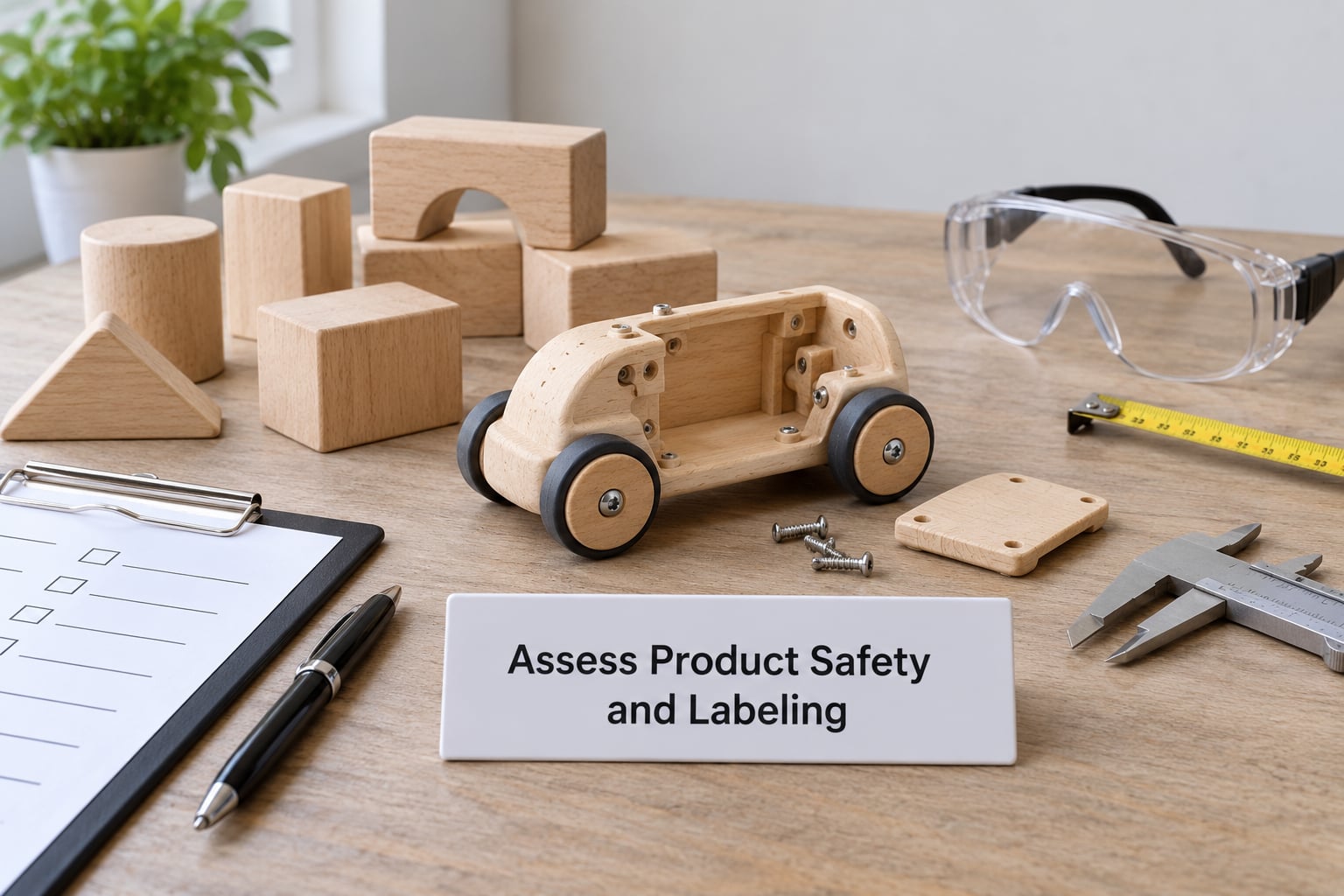
Some categories pull in testing, certification, warnings, instructions or standards before a single unit ships. Children’s products, electrical accessories, food-contact items, medical items, protective equipment and cosmetics are the usual triggers. Marketing something to children is what activates many of these rules, and the thresholds differ by country and by age band.
A clean print and correct dimensions tell you nothing about regulatory compliance. Dimensional accuracy and a successful print do not establish that a product is safe, and a resin print handled in an unventilated room raises its own handling questions for you and anyone who works with you.
Labeling is part of this, not an afterthought. Depending on where you sell, you may need country-of-origin marking, material identification, warnings, age guidance and instructions in the local language. A seller in Quebec, for example, has to contend with French-language labeling rules that most competitors ignore.
The check: a documented risk review for each product, with every required test, certification, label and market restriction completed before you list it.
Document Production, Suppliers, and Material Claims
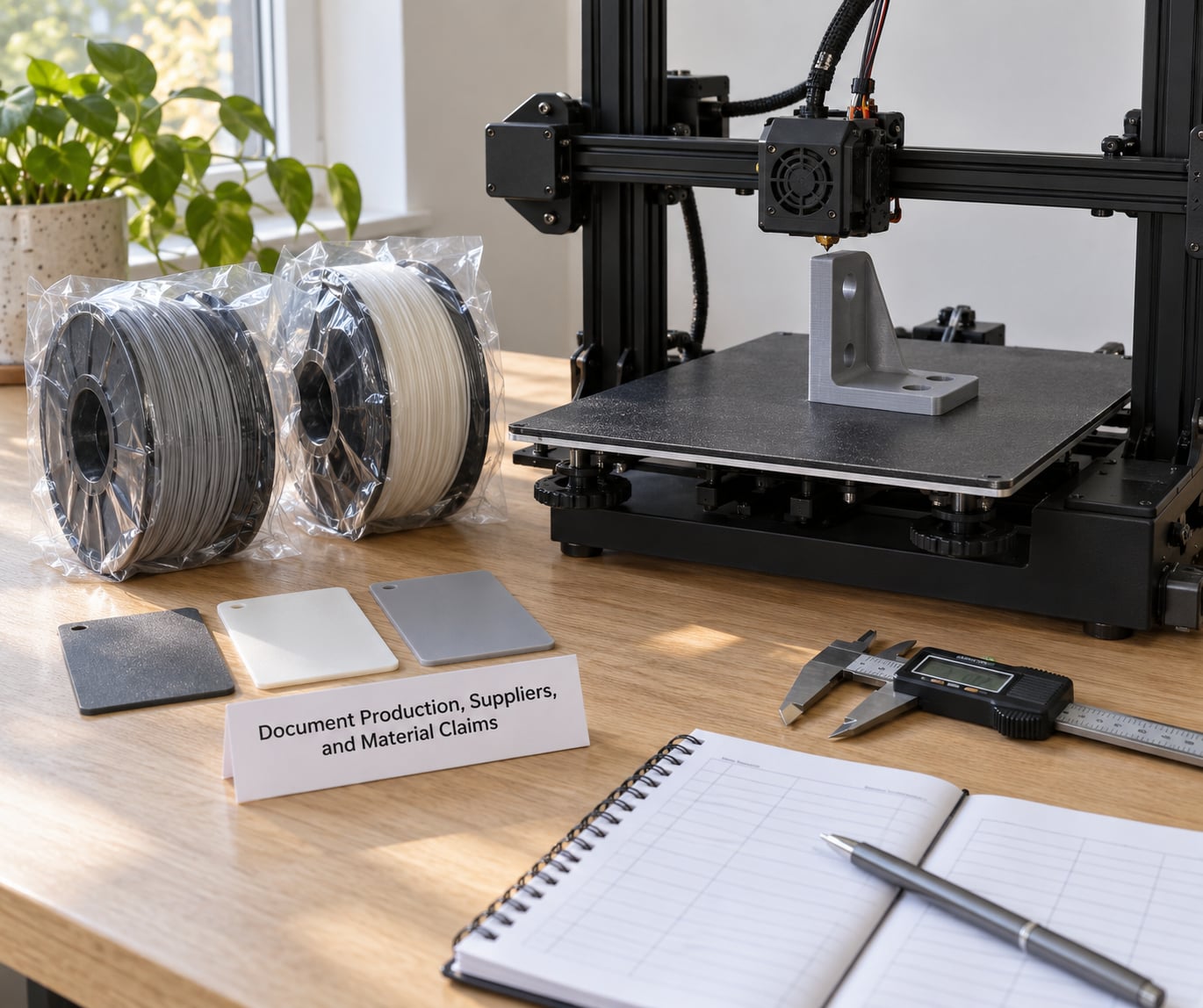
Keep a production record for each item: which printer made it, which resin or filament, which supplier and batch, and which safety data sheet came with the material. If you use a print farm or contract manufacturer, describe it accurately in the listing instead of implying you printed it in your spare room. Buyers who care about provenance will find out, and the ones who do not are not the customers you want.
Most of all, keep claims inside what you can support. Do not advertise prints as food-safe, medical-grade, biocompatible, sterilizable or load-bearing unless a documented standard backs the claim for that specific material and process. The same goes for strength: a printed part that held on your bench is not a rated structural component.
The check: a record that identifies what was made, with what, by whom and from which materials, and a claims list where every adjective traces back to a document.
Set Up Pricing, Taxes, and Invoicing
Build your price from separated lines: material, machine time, labor, packaging, platform fees, shipping subsidy, returns allowance and tax. Mixing them together is how sellers end up either undercharging or accidentally promising a margin they do not have.
On tax, understand that remote sales can create obligations without any physical presence in the customer’s country. Economic nexus rules, VAT, GST, customs and import duties each apply differently, and marketplace facilitators handle some of this while leaving the rest with you. A printed item crossing a border may attract duty the buyer did not expect, so decide early whether your prices include it.
Issue real invoices. Name your entity, your registered address, the customer, the description, the date, the tax treatment and the payment terms. That single document answers most questions an accountant, a marketplace or a business buyer will ask you later.
The check: a sample invoice in front of you, and a written tax position you have checked against official guidance for where you sell and where your customers are.
Create Accurate Listings and Sales Terms
List specifications a buyer can act on: dimensions, tolerances, material, weight, colors available, what is included, what is excluded, machine finish, and realistic lead times. State the limits of the process rather than hoping nobody asks, because resin prints and filament prints behave differently under heat, impact and UV, and a customer who learns that on day one usually stays.
Be explicit about what they are buying: a finished stock item, a print made to order, or a digital file. Those are three different products with three different delivery models, and mixing them up causes refunds and complaints.
Publish your terms somewhere visible: shipping restrictions, return window, warranty position, what you will and will not reprint, and how to reach you. If you sell to companies rather than individuals, expect them to ask who holds the design rights and whether you will indemnify them. Some will walk away from a seller who cannot answer, and that is a fair question.
The check: place a test order yourself, or have someone read the listing end to end, and confirm every material claim and every commitment matches what you would actually ship.
Keep Records and Recheck Before Scaling
Build a system you can actually maintain: order log, expense receipts, supplier invoices, design licenses and receipts, safety decisions, customer messages, tax calculations and returns. Keep them by date rather than by memory. A spreadsheet with one row per order and linked receipts handles a small operation fine.
Separately, think about what you can claim as a business expense. Printers, filament and resin, failed prints, electricity for the machine, software, workshop space, and platform fees are the usual candidates, and the rules on which apply depend on your country and how you use the equipment. Ask a qualified local tax professional rather than trusting a forum answer about write-offs.
Recheck on a schedule. Laws, marketplace policies and platform fee structures all change, and a policy change can matter more than anything you did at launch. Twice a year is enough for most small operations.
The check: a file that lets an accountant or adviser trace a single sale from listing, through production, to delivery and after-sale support.
Common Mistakes
Printing files without commercial rights. The fix is to check the license on the download page before you print the first unit, not after the orders arrive. Save a screenshot of the license with the file.
Assuming business registration covers product regulation. Registering to sell does not make a toy compliant. These are separate systems with separate agencies, and one does not substitute for the other.
Making unsupported safety claims. Food-safe, medical-grade and child-safe are regulated claims. If you cannot point to a document, remove the word.
Mixing personal and business expenses. One bank account, one card and a clean split from day one. Untangling mixed records later is far more work than keeping them apart.
Hiding the production method or personalization. Say plainly whether you print in-house, use a print farm, or print to order. Buyers tolerate slow custom work far better than a surprise.
Vague product descriptions. A photo and a title will not protect you when a customer expected a different size or finish. Write the specification.
Shipping into restricted markets. Check destination rules before you accept the order, not at the point of shipping.
Failing to retain records. The license screenshot, the receipt and the order row take seconds to save and are what you rely on if anyone questions a sale.
Before you launch, run this ten-item check: license confirmed for every design; business or tax registration verified for your location; resale or sales-tax position documented; product category classified; safety and labeling review done; production record started; terms and returns published; test order placed; record-keeping folder created; and a named adviser identified for questions you cannot answer yourself.
Frequently Asked Questions
Do I need a license to sell 3D printed products?
It depends on two separate things. You need commercial rights to the design, which comes from the file’s license, the designer’s terms, or your own CAD work. You also need whatever business and tax registration your local authority requires where you operate and where you deliver. A general online business registration does not grant rights to someone else’s model, and design rights do not satisfy tax or safety rules. Confirm both separately before your first listing.
Can I sell a 3D model I downloaded or purchased?
Only if the license allows commercial use. CC0, CC BY, CC BY-SA and CC BY-ND permit selling physical prints, with attribution for the CC BY variants. Any non-commercial license, including CC BY-NC, CC BY-NC-SA and CC BY-NC-ND, does not. Store purchase terms often allow personal printing only. A free download is a file, not a permission slip. Keep the license text or receipt with each design you sell.
Are 3D printed products subject to product-safety laws?
Yes, and the category decides which rules apply. Toys and anything marketed to children, electrical accessories, food-contact items, medical items and protective equipment can require testing, certification, warnings and instructions before sale. Decorative goods usually trigger far less. A successful print and accurate dimensions do not establish compliance. Review the category rules for each market you ship to, and treat safety data sheets for resins and filaments as part of your production records.
Do I need to collect sales tax when selling printed products online?
Often yes, and where you owe it is not always where you live. Sales tax, VAT, GST, customs duty and import charges can all apply based on your customer’s location, with economic nexus rules creating obligations in places where you have no physical presence. Marketplaces collect and remit in some cases and not others. Check the revenue authority for your seller location and your customer locations, and decide whether your listed prices include duty before you start shipping internationally.
Can I advertise 3D printed items as food-safe, medical-grade, or child-safe?
Only with documentation for the specific material and process you used. These are regulated claims rather than marketing preferences, and a claim that fails can pull the listing, trigger a report or expose you to liability. If you cannot name the standard, the test report and the material grade that supports the claim, leave the words out. Describe what the item is and what it does, and let the buyer judge fit for purpose.
Should I register my 3D printing business before making my first sale?
In many places, yes, and the answer depends on your jurisdiction rather than on your sales volume. Some sellers on r/EtsySellers advise waiting until revenue justifies the paperwork, while others say registration from day one is simpler. Both are defensible where the law is loose. The safe route is to ask your local business registry and tax authority what a home-based seller of physical goods must do, and to follow that answer rather than a stranger’s forum post.
Conclusion
Start with classification, not with a listing. Write down what each product is, which jurisdiction it ships into, which rules apply to that category there, and where the design rights come from. Once those four answers exist, business registration, taxes, safety and records follow in a predictable order, and a small home print operation can be run properly without a lawyer on retainer.
Use the official agencies for the specifics, and bring in a qualified local legal or tax professional for product-specific decisions such as certification, entity structure or cross-border sales. Two hours of setup is a fair price for knowing exactly how to sell 3D printed products legally in your market.