Downloading a free STL file does not give you the right to sell what you print, and it does not transfer the designer’s copyright. What you may do comes entirely from the license attached to the model page. Below is how STL file licenses explained for makers work in practice, where to find those terms on each platform, and why silence on a listing is not permission.
Updated for October 2026. This is general information about how model licenses work, not legal advice. If you have money or a business on the line, talk to a lawyer in your jurisdiction.
Table of Contents
- STL File Licenses Explained for Makers
- What Is an STL File License?
- Which STL File License Terms Should You Look For?
- Common 3D Model License Types and What They Allow
- CC0 and public domain dedications
- The six Creative Commons licences
- Open-source style licences: GPL and MIT
- Paid commercial tiers
- Platform terms that sit outside Creative Commons
- How to Choose a License for Your Own STL File
- Can You Print, Modify, Share, or Sell an STL File?
- Printing for yourself or as a gift
- Selling printed objects
- Running a print service or pay-per-print
- Modifying and reposting
- Client commissions
- Using STL File Licenses Explained for Makers: a 60-second check
- How to Check a License Before Using an STL File
- What to Do When the License Is Missing or Unclear
- STL File License and Attribution Checklist
- Frequently Asked Questions
- Does downloading an STL file give me permission to print it?
- Can I modify an STL file if the license does not say I can?
- Does printing an STL model commercially automatically make the file commercial?
- What is the difference between attribution and a non-commercial license?
- Can I share an STL file that I downloaded from a marketplace?
- Conclusion: Start With the Exact License
STL File Licenses Explained for Makers
A mesh file is geometry. An STL stores nothing but triangle coordinates describing an outer surface. It carries no usage terms, no author name and no warranty, which is exactly why two files with identical geometry can carry completely different rules.
The design itself is a creative work, and it is protected by copyright from the moment it is fixed in a tangible form, according to the US Copyright Office. The designer holds that copyright by default. A license is the permission they choose to grant you, usually as a condition of the download. No license stated means no permission beyond the narrow default, which is why a free download and a free-for-anything license are not the same thing.
This distinction matters most in the three situations that cause the most regret later: selling printed objects, running a print service, and reposting a modified file. Personal printing for yourself is nearly always fine. Almost everything else depends on which of the four Creative Commons conditions apply, or on a platform’s own terms layered on top.
What Is an STL File License?
An STL file license is the set of usage terms attached to a 3D model by the person who designed it, telling you what you may do with it: print it, modify it, redistribute it, or sell prints of it.
Think of it as a permission slip, not a purchase. When you download a model under Creative Commons terms or a platform standard license, the designer keeps ownership. You get a licence to use the work, on stated conditions. Creative Commons licences are irrevocable in practice, which means a designer who has once granted CC BY 4.0 cannot retroactively withdraw that permission from files already released, even if they later change the listing.
These are the terms that decide your day:
- Permitted uses — the actions spelled out as allowed, such as personal printing or commercial printing.
- Prohibited uses — the actions specifically ruled out, usually reselling the file itself or using the design in a way that competes with the designer.
- Attribution — whether and how you must credit the creator, and where the credit has to appear.
- Modification and derivatives — whether a remixed version is permitted, and whether you may post it.
- Redistribution — whether you may re-upload the file, unchanged or modified.
- Commercial use — the clause most people actually need, and the one most often buried.
- Source responsibility — most platforms require that you download from the original listing rather than a mirror, so the designer keeps accurate statistics.
One more technical wrinkle worth knowing: the licence deed that appears as a badge on a model page is a human-readable summary, while the legal code behind it is the enforceable text. If the two seem to disagree, the legal code wins.
Which STL File License Terms Should You Look For?
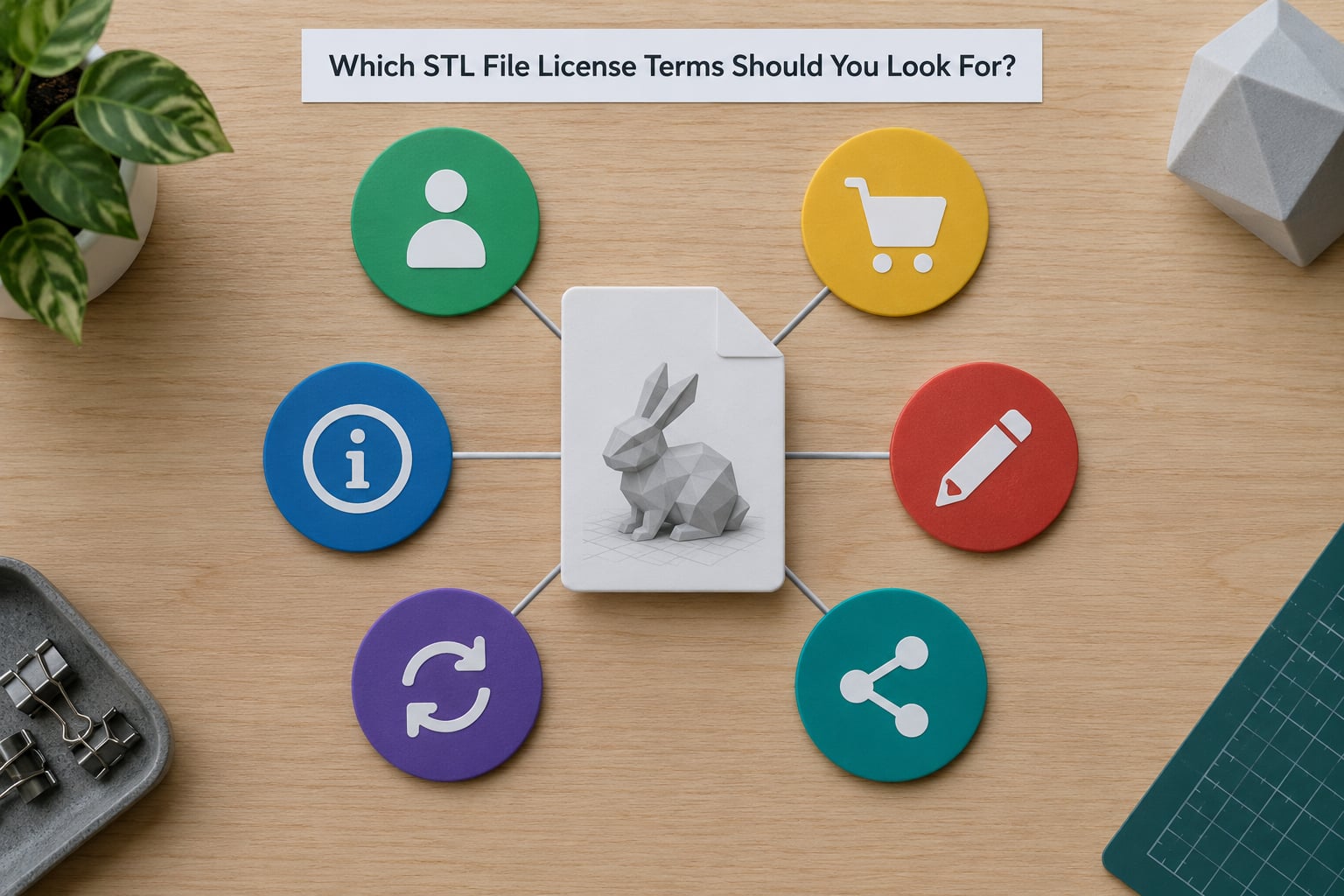
Scan the listing for these seven terms. They tell you more in ten seconds than the model description ever will.
| Term | What it usually allows | A decision it changes |
|---|---|---|
| Personal use only | Printing for yourself, gifts, school projects and cosplay | Whether you can list anything at a maker market |
| Commercial use | Selling printed objects, client work, print service | Whether you can put the model on an Etsy listing |
| Attribution (BY) | Reuse with credit, almost always commercially | Whether your listing needs a credit line in the description |
| No derivatives (ND) | Use the file as shipped, no remixing | Whether you may rescale or fix a broken support before printing |
| Share alike (SA) | Remix freely if your remix carries the same licence | Whether you can publish your fixed version to a marketplace |
| Public domain (CC0) | No conditions at all, including no credit | Whether you need to keep the designer listed anywhere |
| Custom or paid tier | Whatever the seller’s written terms say | Whether a quantity cap or revenue ceiling applies to your shop |
Read the term in full rather than inferring it. “Free for personal use” and “non-commercial” are not identical: the first is about who the print is for, the second is about whether money changes hands anywhere in the chain.
Common 3D Model License Types and What They Allow
Most 3D model licensing comes down to one of five families. The names repeat across families, so the exact wording matters more than the label.
CC0 and public domain dedications
CC0 is a public dedication tool, and Creative Commons describes it as a way for creators to give up their copyright and put a work into the public domain as far as the law allows. Practically, that means no conditions: print it, sell it, modify it, re-upload it, no credit required. It is the cleanest licence for a maker and the rarest on model platforms, so treat a CC0 claim with the same scepticism you would any other badge and confirm it on the page.
The six Creative Commons licences
CC licences are built from four conditions: BY (credit the creator), NC (non-commercial), SA (share-alike) and ND (no derivatives). Combined, they give six standard licences plus the most restrictive option.
- CC BY — credit required, commercial use and modification allowed, redistribution allowed.
- CC BY-SA — same, plus any remix you publish must carry the same licence.
- CC BY-ND — credit required, commercial use allowed, no modified versions at all.
- CC BY-NC — credit required, personal use only, modification allowed but only for non-commercial purposes.
- CC BY-NC-SA — personal use only, and remixes must stay non-commercial and open.
- CC BY-NC-ND — personal use only and no modifications. Printing the file exactly as published is the entire grant.
The version number matters too. CC BY-SA 4.0 and CC BY-SA 3.0 are different licences, and mixing them across a remix chain is the sort of detail that breaks share-alike compatibility later.
Open-source style licences: GPL and MIT
Some modelers, especially those who also publish their parametric source files, release under software licences. GPL carries a strong share-alike obligation intended for software, and applying its wording to geometry gets murky fast. MIT is permissive with attribution. Both are unusual on download sites and worth asking the designer about directly rather than interpreting yourself.
Paid commercial tiers
Seller-specific terms are the norm on commercial marketplaces: All Rights Reserved for a free file that is not licensed for redistribution, Personal Use Only as a default, then Limited Commercial and Full or Extended Commercial as upgrades. The gaps that trip people up are quantity caps, revenue thresholds, and whether the licence covers the physical product, the digital file, or both. Buying a paid model grants you a licence, not a transfer of copyright. You still cannot resell the file itself or train a competing library on it.
Platform terms that sit outside Creative Commons
Platforms add their own layer. Printables offers a Personal Use Only selector that does not map onto any CC licence, so it cannot be reasoned about with CC logic. Site-wide terms also usually govern anything a user uploads, which is why a CC BY upload may still be bound by rules about commercial activity on the platform itself.
How to Choose a License for Your Own STL File
Publishing under a clear licence is the single most generous thing a modeler can do for the community, and it costs nothing to decide early. Six questions cover it.
- Do you want personal printing only, or commercial printing too? CC BY gets you reach and commercial permission with only a credit obligation. Personal Use Only protects you but pushes good makers to commercial alternatives.
- Do you allow modifications? If yes, decide whether remixes must carry the same licence. Share-alike keeps improvements flowing back to the community; without it, a small fix may quietly become someone else’s product.
- Do you want attribution enforced? BY requires it. Dropping BY means nobody has to name you, which some designers prefer.
- How do you treat physical products? Say it explicitly. Most CC licences already permit selling printed objects, and writing it out in your own words removes the argument.
- Do you want a paid tier? Dual licensing is the workable pattern: a CC base for reach, plus a separate paid commercial licence for sellers. Sellers usually want exactly this, and saying so up front ends the awkward email exchange.
- Written terms or a badge? A licence badge on the model page is fine. A short README in the download, plus the same terms on your site, survives a platform change or a takedown.
Once released under an open licence, that grant is generally irrevocable. You can stop updating and add new restrictions to future releases, but you cannot claw back permissions already granted on files in the wild.
Can You Print, Modify, Share, or Sell an STL File?
These are four different questions, and most of the confusion I see comes from treating them as one. Here is how each breaks down.
Printing for yourself or as a gift
Almost always permitted, on virtually every licence including CC BY-NC-ND, because nothing is sold and nothing is redistributed. Giving a physical object away is not redistribution of the file. School projects, cosplay props and repairing your own broken part all sit comfortably here.
Selling printed objects
This is the question that keeps the forums busy. The answer depends on the licence, and the honest version is a two-bucket test.
You can usually sell prints when the licence is CC0, CC BY, CC BY-SA or CC BY-ND; the platform’s default terms allow commercial use; or you bought a licence that grants commercial use. Selling prints is not the same as selling the file, and none of these licences stops you from selling the object in your hands.
You cannot sell prints when the licence says personal use only, non-commercial, or Creative Commons NC in any combination; the listing is All Rights Reserved with no commercial grant; or you never checked and silence is the only information you have. Printing for a customer is still selling, whether the money goes to you or to a platform fee.
Running a print service or pay-per-print
A print service is a different activity from selling your own printed objects, and it is the hardest question in this whole area. The consensus on r/3Dprinting is that running a service is materially different from stocking and reselling specific finished objects from a repository, because you are supplying labour and materials rather than distributing designs. The licence still governs it though: an NC model stays off-limits when money is involved, and NC has no exception for someone else paying.
Two habits cut the risk. Take STL files supplied by the client rather than repository links, so the client owns the commercial decision. Then put a written commercial-use clause in your client agreement stating who is responsible for having the right to print the supplied file.
Modifying and reposting
Allowed under CC BY, CC BY-SA and CC0, with different obligations. Under SA, your remix must carry the same licence. Under ND, no modification at all, which is stricter than it sounds: a file that will not slice until you fix it is a real situation, and the safe answer is to fix your own copy and not publish it. Rescaling a model is a modification in the plain reading of these terms, not a technicality.
Client commissions
If a client sends you a model link for a paid commission, the risk sits with whoever chose the model. Get the licence checked before you quote, and ask in writing whether the client holds commercial rights. If they do not, the job is off, or it moves to a CC0 or CC BY model.
Using STL File Licenses Explained for Makers: a 60-second check
Before you download, spend a minute on this sequence. It catches nearly every mistake I have seen people make.
- Find the licence badge or terms text on the model page, not on a repost or a download mirror.
- Read the exact words and note the version number.
- Decide which of your four actions it covers: personal print, sell prints, modify, redistribute.
- Check whether you are using the original file or someone else’s re-upload.
- Screenshot the terms and the page date and save them with the file.
How to Check a License Before Using an STL File
Licence information lives in a different place on every platform, and missing it is what causes the “no licence listed” panic. Here is where each one keeps it.
| Platform | What to look for | Where the terms sit |
|---|---|---|
| Printables | Licence dropdown, including Personal Use Only | On the model page, before you download |
| Thingiverse | Standard Creative Commons licences, chosen at upload | Model page licence field, plus any author note |
| Cults3D | Free files may carry a licence; paid tiers are sold separately | File description and the shop terms |
| MakerWorld | Licence selector plus platform-wide terms | Model page, with site terms linked nearby |
| MyMiniFactory | Standard Creative Commons choices on free models | Model page licence line |
Platform terms can also override or supplement the per-model licence, so read both. Then save your evidence: a screenshot of the licence badge, the page date and the download date, stored next to the file. This is the single habit that pays off later, because the terms a designer argues from are the ones that were visible at the time you downloaded.
Finally, check whether anything is embedded in the mesh itself. Most slicers will not show it, but the licence text is sometimes written into the model description or carried in an accompanying text file in the download. Anything you find in the file itself is worth reading as carefully as the badge.
What to Do When the License Is Missing or Unclear
Silence does not mean permission. In the absence of a licence, copyright law leaves the creator with all rights, so the working default is personal use only, and that default is the safe one to rely on.
You have four options when a model has no usable terms.
- Ask the creator in writing. A short message naming the model and the exact use you have in mind gets a clear answer surprisingly often, and the written reply is itself permission.
- Find a replacement. Search the same platform for a CC BY or CC0 version, or a remix from someone who relicensed it properly.
- Commission an independent model. Paying a designer for a model built to your dimensions clears the question entirely.
- Limit yourself to a clearly licensed use. A private experimental print is far removed from redistribution, commercial use or public posting.
Two situations need extra care. The first is third-party intellectual property: a designer cannot licence what they do not own, so a CC BY badge on a recognisable film, game or brand character does not clear someone else’s copyright or trademark. Printing one for your own use is a different risk level from selling them. The second is enforcement. In practice, creators who post NC and ND designs tend to discover violations only when they stumble across a marketplace listing, and the usual result is a takedown request rather than a court case. If that happens to you, stop selling the item, keep the licence evidence you saved, and either write to the designer for a retrospective licence or leave the project alone.
STL File License and Attribution Checklist
Run this list before you print something you did not design, whether the plan is a weekend print or a shop full of inventory.
- Source: I downloaded from the original model page, not a mirror or a re-upload.
- Licence: I have read the exact licence text and noted the version number.
- Personal use: my intended use sits inside what the licence permits.
- Commercial rights: if money changes hands anywhere, the licence or a purchase covers it.
- Modification: I have checked whether a remix is permitted before changing anything.
- Redistribution: I am not re-uploading the file unless the licence allows it, and share-alike terms travel with any remix.
- Attribution: I know the creator name, the model title and the source URL.
- Third-party IP: the design does not reproduce a protected character, logo or brand without permission.
- Evidence: a dated screenshot of the licence and the page is saved with the file.
- Scope: my use of the physical print is separate from any right to redistribute the digital file.
When attribution is required, keep it specific and visible. Copy-ready lines:
3D model by [Creator Name], from [Platform] at [URL]. Licensed under CC BY 4.0. Modified for print fit.
Based on “[Model Title]” by [Creator Name], licensed under CC BY-NC 4.0. Printed by [Your Shop], [Year].
On a marketplace listing, put the credit in the description where buyers and reviewers can see it. On a physical product, a small printed card or an engraved line on the base does the job.
Frequently Asked Questions
Does downloading an STL file give me permission to print it?
Not by itself. Downloading a file transfers the mesh, not the rights. Every design is copyrighted when created, and the licence attached to the listing tells you which uses are permitted. Printing for yourself is almost always fine, including under the strictest Creative Commons terms, because nothing is sold or redistributed. Selling prints, remixing and re-uploading all require specific permission that you only get from the licence text or a written answer from the designer.
Can I modify an STL file if the license does not say I can?
Assume no. Any No Derivatives term rules out modified versions entirely, including a scaled copy or a support fix, and many Personal Use Only licences are equally restrictive. Where the terms are silent or missing, treat modification as not permitted until the designer confirms otherwise in writing. If you do need an adapted model, commission it or work from a CC BY or CC0 design where the terms clearly allow remixing and redistribution.
Does printing an STL model commercially automatically make the file commercial?
Selling a printed object is the commercial act, and the file itself does not change status because you charged for it. Most open licences such as CC BY permit selling the physical print indefinitely while still forbidding you from reselling the digital file. Non-commercial and Personal Use Only terms take the opposite position: the moment a print is sold, used in a paid product or printed for a paying customer, you are outside the licence, even if the designer never sees a cent of it.
What is the difference between attribution and a non-commercial license?
They answer different questions. Attribution is a credit obligation: you must name the creator, link to the source and note any changes. Non-commercial is a permission limit: it rules out any use where money is involved. They combine freely, which is why CC BY-NC exists. Attribution on its own says nothing about selling, and a non-commercial term does not remove the need for credit, so a model can be both heavily credited and firmly non-commercial.
Can I share an STL file that I downloaded from a marketplace?
Only if the licence permits redistribution. CC BY, CC BY-SA and CC0 all allow re-uploading, with share-alike requiring your re-upload to carry the same licence. CC BY-NC allows sharing only if the sharing itself is non-commercial, which is rarely practical on a marketplace. Any ND or Personal Use Only term means the file stays where it is. Platform terms often add their own restrictions on re-uploading content you did not create, so check those too.
Conclusion: Start With the Exact License
One habit covers almost everything: find the licence on the model page and read the exact wording before you download. Personal printing is nearly always fine. Selling prints, running a paid service and posting remixes are not, unless the terms say so. Save a dated copy of what you read, credit the designer when credit is required, and if the terms are missing or ambiguous, ask the creator in writing before the file ends up in a slicer.
For high-value commercial work or a genuine dispute, get specific legal advice. Rules differ by country, and a marketplace takedown is a practical problem with real deadlines, not something to work out alone.