No standard 3D print is dishwasher safe out of the box. Dishwashers run roughly 60-75 °C with heated drying, high-pressure jets and alkaline detergent, and that combination softens most filaments, drives water into the layer lines and breaks down whatever sealant you coated the part with. To learn how to make 3D prints dishwasher safe you have to change all three: the filament, the surface, and the cycle.
This guide covers the four routes that actually work, ranked by how much washing each one survives, plus the print settings and design changes that give you the best shot. Budget an hour of active time per part plus a full cure, and expect to inspect the part after every few washes.
Table of Contents
- What You Need
- Step-by-Step: How to Make 3D Prints Dishwasher Safe
- Can PLA 3D Prints Go in the Dishwasher?
- Choose a Heat-Resistant Filament
- Use a Compatible Dishwasher-Safe Coating
- Run a Gentle Dishwasher Cycle
- Dry and Inspect the Print
- Common Mistakes
- Frequently Asked Questions
- Is PETG 3D printing filament dishwasher safe?
- Can I put standard PLA 3D prints in the dishwasher?
- What coating makes a 3D print dishwasher safe?
- Should I use the dishwasher’s heated drying cycle for 3D prints?
- How do I know if a 3D print is safe for food contact?
- Can I repeatedly wash the same 3D-printed kitchen tool?
- Conclusion
What You Need
You do not need a second printer or a fancy machine. The list is short:
- Filament you can actually heat. Polypropylene and PETG are the two families most makers land on. PLA is the wrong starting point, and I explain why below.
- A food-contact-compatible coating if you are printing in PLA or PETG. That means a two-part epoxy, a polyurethane varnish, or a food-contact silicone — not a generic clear spray from the hardware aisle.
- Surface prep kit: 180 to 400 grit sandpaper or 220 to 600 grit wet sanding, isopropyl alcohol, clean nitrile gloves, and a tack-free brush for dust.
- A curing space. A shelf with air movement and no dust. Full cure times run 24 to 72 hours depending on the coating.
- A drying spot. A rack where the part can drain and air-dry completely, not a closed cabinet or a towel pile.
- A washing-up brush and unscented dish soap for hand washing, plus a thermometer if you want to test your dishwasher’s real temperature.
Step-by-Step: How to Make 3D Prints Dishwasher Safe
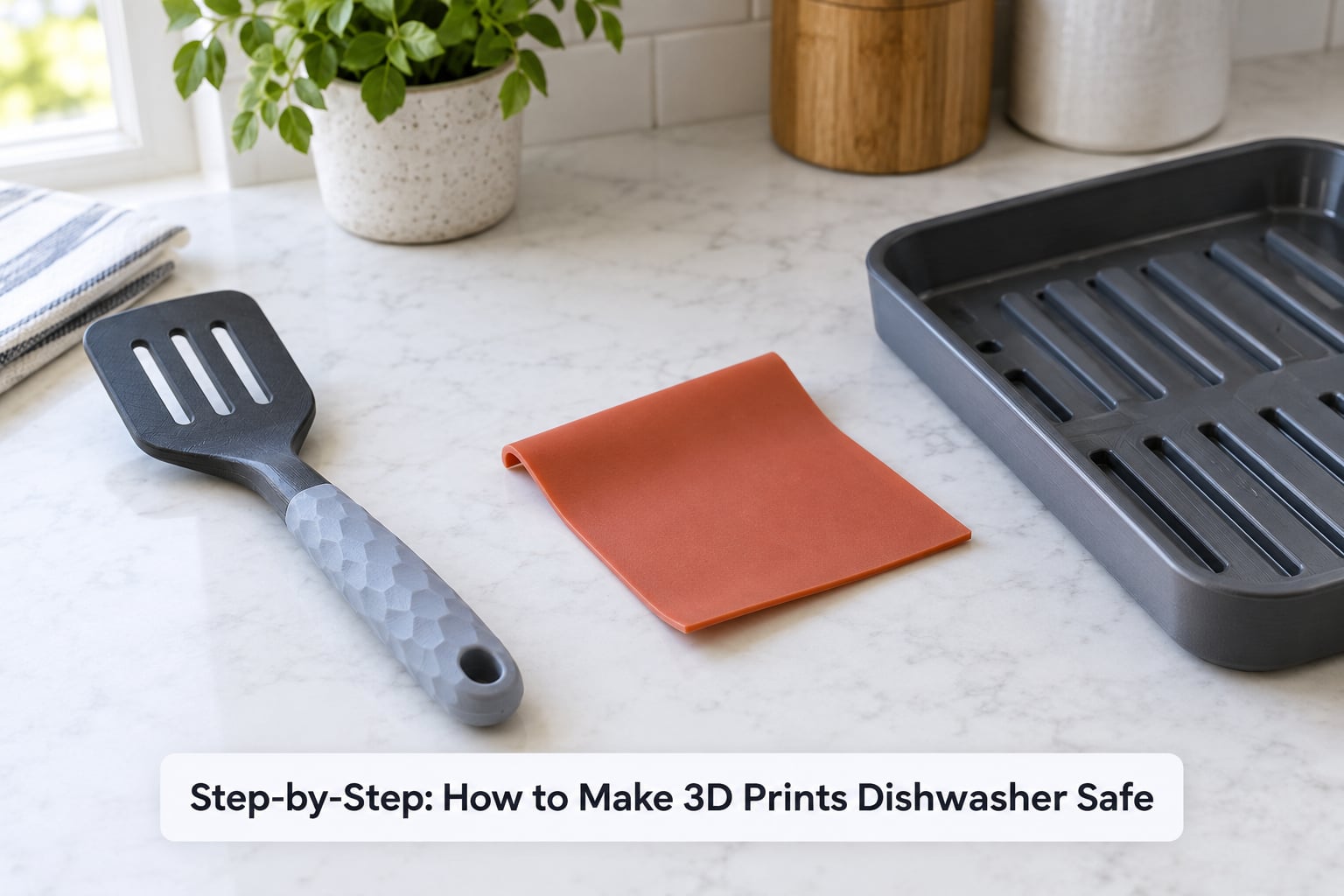
Can PLA 3D Prints Go in the Dishwasher?
No. PLA softens somewhere around 55-60 °C and its heat distortion temperature under load sits lower still, so a normal dishwasher cycle bends flat parts before the coating question even comes up. Repeated thermal cycling also embrittles PLA, which is why people report prints turning brittle after a few washes rather than melting outright.
A member on the Lulzbot forum put it more bluntly: no 3D printed plastic is dishwasher safe or food safe for reuse by extension, because extrusion leaves microscopic voids throughout the part. That is the root problem for every material, and PLA is simply the version that also deforms.
If you already own a PLA part you want to save, coating it well can buy you many cycles. Just set your expectations at hand washing rather than machine washing.
Choose a Heat-Resistant Filament
PP and PETG are the two realistic candidates, and each trades a different weakness. Anything below is a guide; your filament supplier’s own temperature data and chemical safety sheet always take priority, since additives change the picture.
| Material | Heat behaviour | Dishwasher verdict | Notes |
|---|---|---|---|
| Polypropylene (PP) | Softens near 140-165 °C | Best candidate | Hard to print, warps badly, sticks to nothing. UltiMaker’s community recommends it anyway: food safe and dishwasher safe, printed with thin layers at high temperature. |
| PETG | Tg around 80 °C, HDT roughly 70-80 °C | Conditional | Survives eco and normal cycles. Softens in sanitize and heated-dry runs. |
| ASA | HDT roughly 95-105 °C | Conditional to good | Heat is not the limit; layer adhesion over time is. |
| ABS | HDT roughly 100-110 °C | Conditional | Needs an enclosure. Styrene vapour is a separate concern during printing. |
| Nylon | HDT roughly 75-90 °C | Poor | Absorbs water aggressively and swells, which opens the layer lines. |
| PC | Very high heat tolerance | Good on heat | Demanding to print, hygroscopic like nylon. |
| TPU | Flexible, moderate heat | Poor | Rubbery and soft; rarely survives rigid part loading. |
| PLA | HDT roughly 55-60 °C | No | Coat it and hand wash only. |
| Resin (SLA) | Varies by formulation | Rinse and cure first | Uncured resin is a skin irritant and nothing else should happen to it. |
Print it as dense as you can stand to. For a food or washing contact surface I run 60% infill or higher, 6 to 8 top and bottom layers, three or four perimeters, and a layer height of 0.12-0.15 mm. Lower layer height means smaller gaps between roads and less capillary action wicking water into the part.
Use a Compatible Dishwasher-Safe Coating
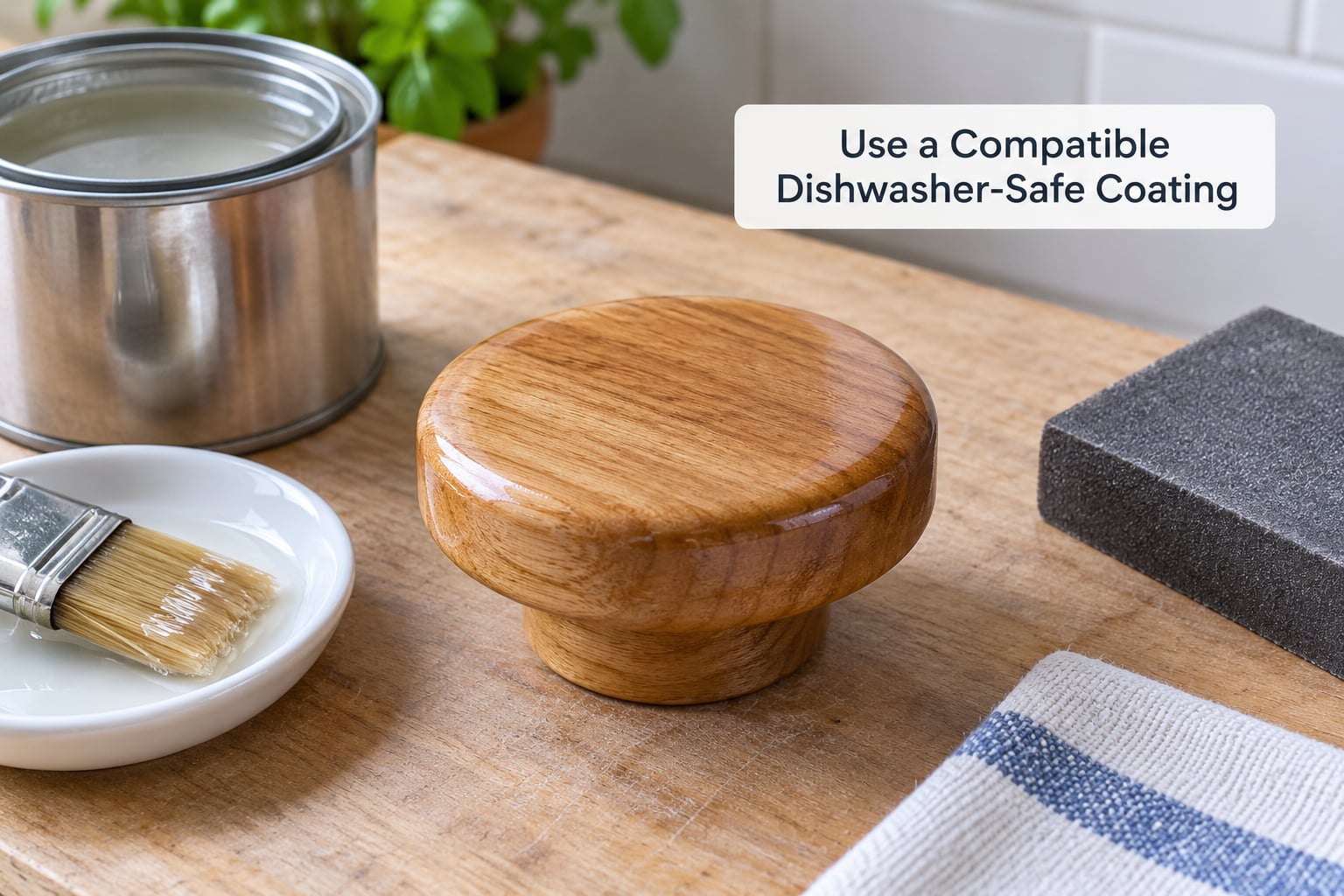
A coating does one job well: it stops water and detergent from reaching the layer lines. It does not raise the polymer’s heat resistance, so a coated PLA part still needs a gentle cycle.
| Coating | Coats | Full cure | Dishwasher survival | Best use |
|---|---|---|---|---|
| Two-part food-grade epoxy | 2 thin coats | 24-72 hours | Best of the bunch, still finite | Cutlery, utensil rests, organizers |
| Polyurethane varnish | 3-4 thin coats | 24-48 hours | Moderate, yellows over time | Low-wear items, drawer organizers |
| Shellac (food-contact flake sealer) | 4-6 thin coats | 1-2 hours between coats | Poor, not for dishwashers | Dry-contact items and display pieces |
| Spray sealant | 2-3 passes | 24 hours | Weakest option | Water resistance only, not washing |
| Food-contact silicone | Brush or dip | 24 hours | Good, flexible | Gaskets, grips, moulded parts |
| Vapor smoothing then coat | 1 epoxy coat | 72 hours | Best surface, most effort | Show-face parts and anything wet |
The procedure is the same shape for every one of them. Wash the part with soap and water and let it dry fully. Sand wet from 180 grit up to 400-600 grit to give the coating something to grip, and rinse off the sanding grit. Degrease with isopropyl alcohol and handle with clean gloves so you do not leave fingerprints in the wet coat. Apply thin coats, never one thick one, because thick coatings bubble and peel at the edges. Between coats, sand lightly with 400 grit to knock back the tooth. Let it cure fully before the first wash, and resist the urge to accelerate it with a heat gun — under-cured coating is the single most common reason these parts fail early.
Run a Gentle Dishwasher Cycle
Not every program is the same exposure, and this is where most advice gets vague.
| Cycle | Typical wash temperature | Drying | Exposure risk |
|---|---|---|---|
| Eco | About 50-55 °C, longer soak | No heated dry | Lowest — safest for printed parts |
| Normal / Auto | About 60-65 °C | Condensation or short heated dry | Moderate |
| Intensive / Sanitize | 65-75 °C | Heated dry often on | Highest — PETG and coated PLA will deform |
| Heated dry added to any cycle | Adds sustained heat after the wash | Extended | High — this is what cracks coatings |
That sanitize temperature is where the confusion online comes from: a 65 °C cycle is enough to warp plenty of prints, so people who never run sanitize think their parts are more dishwasher-proof than they are.
Place the part on the top rack, separated from pots and glasses so the jets do not bang it around, and never wedge it between two hard items. Turn off heated drying and let the part air-dry on the rack. If it must go back before it is cool, you are handling something still at its softest point in the cycle.
Dry and Inspect the Print
Water trapped in a layer line stays there. Stand the part upright on a rack with air on all sides and give it at least several hours, longer if the part has cavities. Do not put it in a closed cupboard or wrap it in a towel, which just holds the moisture against the surface.
After every few washes look for the failure signs: a soft or tacky surface, whitening or hazing on the coating, cracking that starts at a sharp edge or around a hole, a faint sweet or chemical smell once the part is still warm, delamination where the coating has lifted from the layer lines, or a fit that has gone slack because the part warped. Any of those means stop washing it. Sand back to clean plastic, recoat, cure, and run another first-wash test — or retire the part if the substrate itself is deforming.
For anything that touches food, treat the part as a second surface after coating. Regulators call that a functional barrier, and as one filament supplier puts it, once a part is coated the system is food-meets-coating, not food-meets-filament. So the documentation that matters is the coating’s food-contact statement, not the spool label.
Common Mistakes
- Assuming any filament is dishwasher safe. Spool labels describe the polymer grade, not the printed part or a cycle. Only PP and some PETG formulations hold their shape on a hot wash, and even those need the right cycle.
- Boiling water and heated drying. Boiling tests and sanitize cycles push past the heat distortion temperature of everything short of PP and PC. Use the eco program instead.
- Applying an incompatible coating. Shellac and generic spray sealers harden fine and then peel in the first few washes. A thread on r/3Dprinting put it that none of the sealers are marked safe for hard-wearing parts, and none react well to dishwashers.
- Crowding the rack. A thin printed part next to a cast-iron pan gets chipped or bent by the spray arm long before the material fails.
- Testing on a kitchen item you care about. Run the first cycle on the sacrificial part. If it yellows or warps you have lost a spoon rest, not a dinner plate.
- Ignoring damage between washes. A cracked coating lets detergent into the layer lines, and the part looks fine until it suddenly delaminates. Thirty seconds of inspection beats re-printing.
- Expecting forever. Nobody on the forums has posted a clean cycle-count test, which tells you something. Think in tens of washes and check along the way, not hundreds.
Frequently Asked Questions
Is PETG 3D printing filament dishwasher safe?
PETG is the most practical mainstream choice for occasional dishwasher use, because its heat distortion temperature sits around 70-80 °C. That clears an eco cycle and most normal cycles, but a sanitize or intensive run can soften it, especially on flat parts where bending stress adds to the heat. Print it dense and use the top rack without heated drying. If you need a part to survive routine sanitizing, polypropylene is the better choice.
Can I put standard PLA 3D prints in the dishwasher?
No. PLA softens around 55-60 °C and a normal dishwasher cycle reaches that range, so parts bend before the coating question even arises. Repeated thermal cycling also embrittles the plastic. A fully cured food-grade epoxy coating will protect the surface from water and detergent, but the underlying material still deforms. Hand wash a coated PLA part instead.
What coating makes a 3D print dishwasher safe?
A fully cured food-contact two-part epoxy is the most durable option, usually two thin coats with 24 to 72 hours of cure time. Food-contact silicone comes next for flexible parts. Polyurethane varnish survives moderate cycles and yellows over time. Shellac flakes and general spray sealers harden well but peel or wash off in a dishwasher, so treat them as water resistance only. No coating raises the filament’s heat resistance.
Should I use the dishwasher’s heated drying cycle for 3D prints?
No. Heated drying adds sustained heat after the wash finishes, and it is the step most often blamed for cracked coatings and warped flat parts. Let the part air-dry on the rack instead, standing upright with air moving around it. A cooled part that has dried properly is far more likely to keep its shape and its coating than one that spent another twenty minutes in a hot cabinet.
How do I know if a 3D print is safe for food contact?
Check documentation, not marketing. Look for a food-contact or food-contact-substance compliance statement from the filament supplier, covering the specific formulation and additives, and the same from the coating manufacturer. US filament often cites 21 CFR 177 listings, and EU materials reference Regulation 10/2011 or framework regulation 1935/2004. A compliant material still does not make the printed part safe, because layer lines trap residue and biofilm.
Can I repeatedly wash the same 3D-printed kitchen tool?
You can, but you have to inspect it. Coated parts typically manage tens of gentle cycles before the coating needs sanding back and reapplying, and nobody has published a reliable cycle-count test, so treat any number as a guess. Stop washing at the first sign of tackiness, hazing, cracking at an edge, a warm chemical smell, or a loosening fit. For low-wear items like utensil rests, hand washing with soap and a brush often extends part life further.
Conclusion
Start with the material, because it is the decision you cannot undo later. If the part needs to handle hot washes, print it in polypropylene or dense PETG and design it with drain holes and no trapped cavities. If you are working in PLA or PETG, seal it with a food-contact epoxy, cure it fully, and keep to eco or normal cycles with heated drying switched off. Then inspect after every few washes. That habit is what keeps a printed part useful instead of cracked.