The honest answer to how to protect your 3D model designs is three things working together: dated proof that you made it, tight control over the files, and a written statement of what other people may do with them. Nobody can lock a file away completely, but you can make copying inconvenient, provable and enforceable. The whole workflow takes an afternoon to set up, then about ten minutes a month to maintain.
I have watched the same pattern repeat across print marketplaces for years. Someone posts a free file to build an audience, a seller lifts it a month later and lists it as their own, and the original maker spends a year arguing on forums with no record of who created what. The fix is boring and unglamorous: an asset list, an evidence trail, and a licence that says what happens if someone ignores it.
The steps below are general information about how protection works in many countries, not legal advice. Rights, registration routes and enforcement procedures differ by country and always depend on the facts of a case.
Table of Contents
- What You Need to Protect Your 3D Model Designs
- Step-by-Step: How to Protect Your 3D Model Designs
- 1. Identify and Inventory Every Protected Asset
- 2. Preserve Dated Evidence of Creation and Ownership
- 3. Secure Accounts, Devices, and Design Files
- 4. Understand Copyright and Other Protection Options
- 5. Control Sharing With Clear Agreements
- 6. Publish Carefully and Use Watermarks Selectively
- 7. Monitor Copies of Your 3D Model Designs and Respond to Misuse
- Common Mistakes That Cost Makers Their Designs
- Frequently Asked Questions
- Who owns a 3D model I paid a freelancer or employee to create?
- Are watermarks and disabled meshes enough to protect a 3D design?
- Does publishing a free or paid 3D model online prevent me from copyrighting it?
- How can I share a 3D model with a manufacturer without losing control of it?
- When should I hire a lawyer or IP specialist to review my 3D designs?
- Conclusion
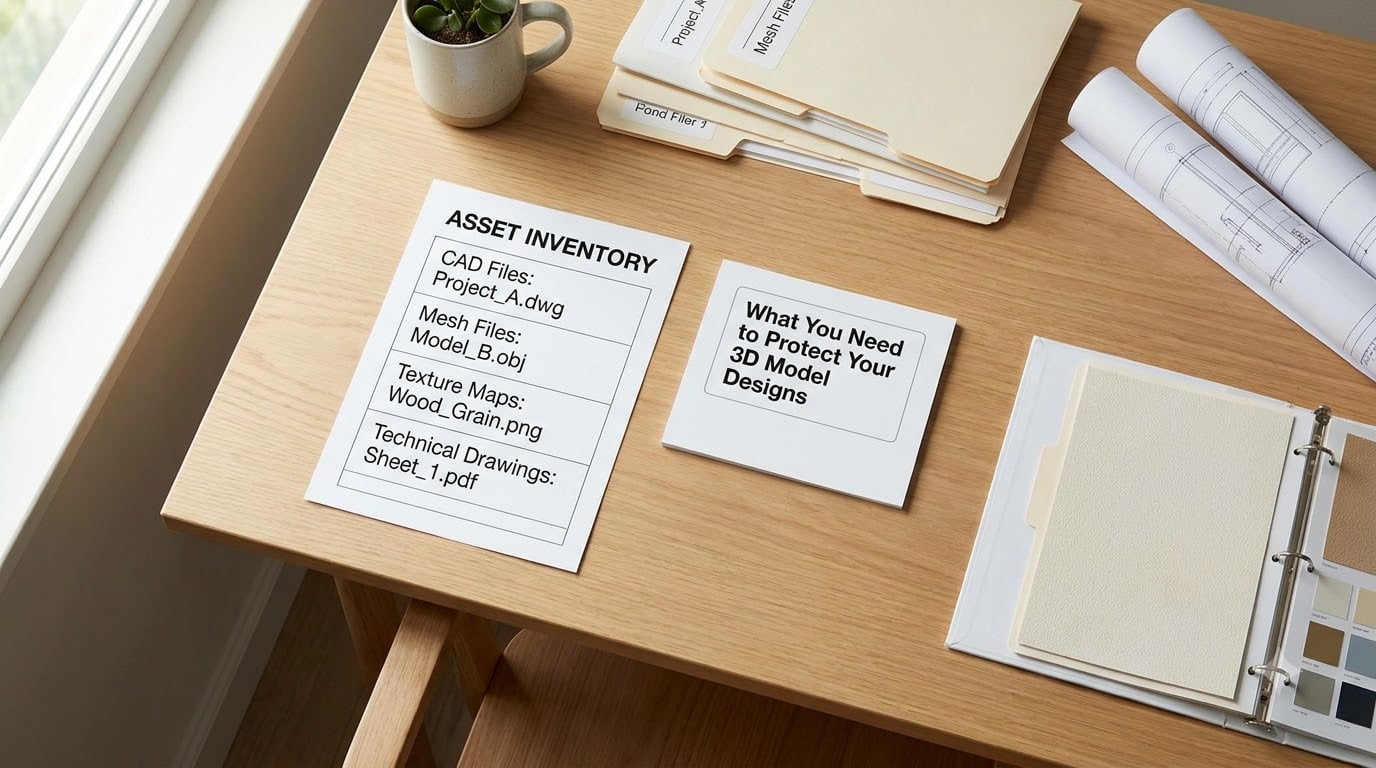
What You Need to Protect Your 3D Model Designs
Before you change anything about how you work, gather the material you will wish you had on the day a copy shows up.
- Source files. The native CAD or modelling file, the version your slicer reads, and anything you exported along the way.
- Derived assets. Meshes, textures, decals, technical drawings, scanned reference files, simulation results and renders.
- Version history. Every dated save, every published revision, every named design version.
- Identification details. File names, format versions, creation timestamps, distinctive geometry features, embedded author fields.
- Secure storage. Two backup locations plus an access-controlled folder for collaborators.
- Access controls. Account logins with two-factor authentication and a password manager holding the credentials.
- Agreements. NDAs, freelance contracts, collaboration agreements or licence templates for any work involving other people.
- Monitoring tools. Saved searches and marketplace alerts for your name, your model names and your usernames.
The same workflow applies whether you print replacement parts for your own equipment, scan and sell physical objects, or publish visualization assets for other artists. A scan of a real object carries its own extra question about rights in the underlying subject, so scan-based work deserves a closer read on ownership before you sell it.
Step-by-Step: How to Protect Your 3D Model Designs
1. Identify and Inventory Every Protected Asset
Start by writing down what exists, because most theft disputes come down to two people claiming the same file and nobody can say which one came first.
A simple spreadsheet is enough. One row per asset, with the file name, format, creation date, latest version number, who created it, who worked on it, and anything unusual that identifies it, such as a distinctive panel line or an unusual modifier count baked into the geometry.
Include the things that are easy to forget: the 2D technical drawing, the texture atlas, the scan file, the original concept sketches, the renders used in your listing, and any derivative files other people made under licence.
Keep the descriptive detail in the inventory private. An asset list is a roadmap to everything you own, and publishing your own inventory is an invitation.
Success check: every design you have ever posted or sold appears exactly once in the register, with a name and a date.
2. Preserve Dated Evidence of Creation and Ownership
Evidence is what turns an argument into a claim. The cheapest method is simply never deleting anything.
Keep dated backups in at least two places, with version history turned on rather than overwritten files named final_v2. Save design journals or project notes covering the problem you were solving and your iterations. Retain project briefs, client emails, file transfer records, and photographs of test prints with their dates attached.
Version control systems with automatic commit timestamps are useful here, as are cloud storage services with their own version history. Where you need a fixed, third-party record of when something existed, a timestamping or certificate service can add one.
Be realistic about what this buys you. Timestamps, photographs and development records are strong corroboration, but in many jurisdictions they are not by themselves decisive proof of ownership, and a court may still ask who created the work. Evidence is much stronger when the chain of collaborators is documented from the start.
Success check: pick any design at random and produce its earliest dated record in under two minutes.
3. Secure Accounts, Devices, and Design Files
Most losses are not breakouts. They are a reused password on a shared account or a contractor who still has access months after the project ended.
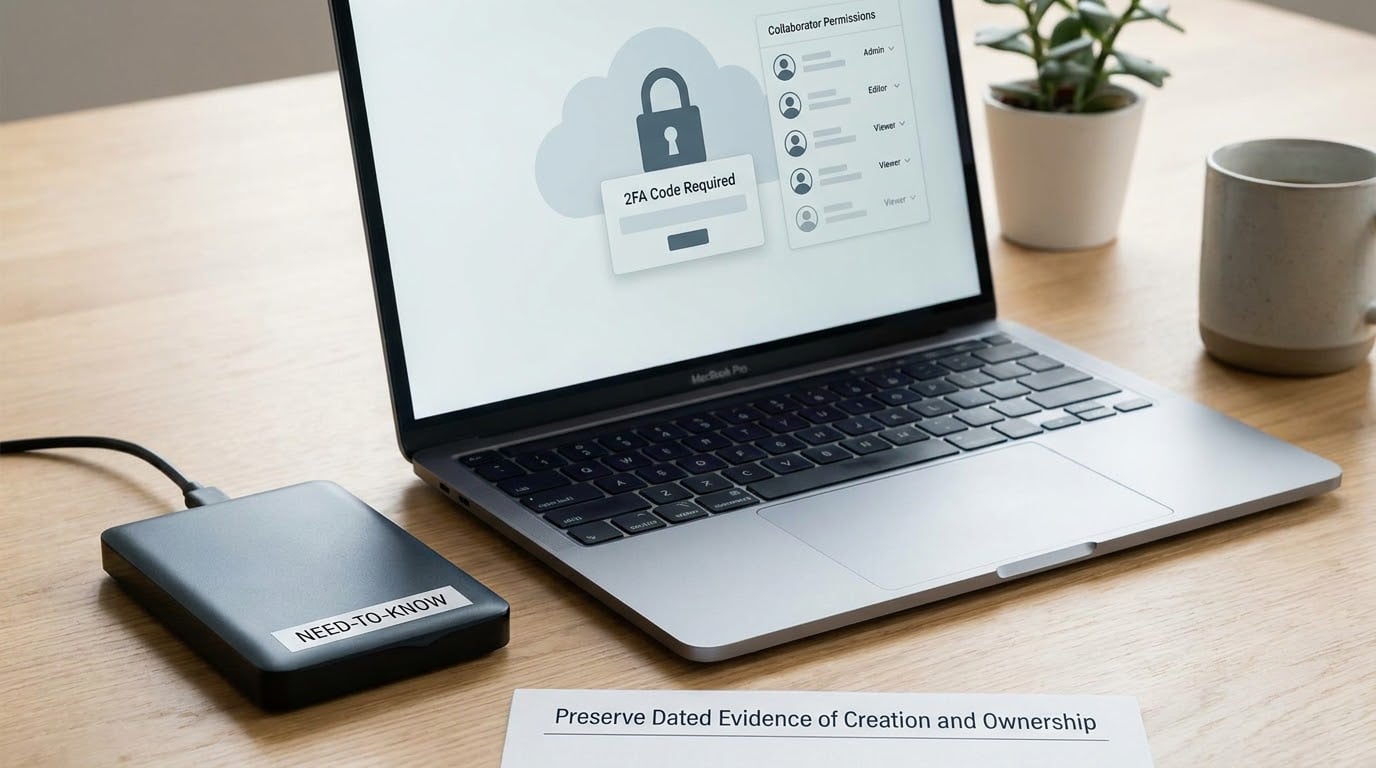
Use a unique password per service, stored in a password manager, with multifactor authentication switched on for your email first, since that is the account that resets everything else. Enable full-disk encryption on your work machine and encrypted storage for your backups.
Then apply least privilege. Share need-to-know: a contractor working on textures does not need your whole library. Use role-based folders, give each collaborator their own login rather than sharing one, and turn on activity logs so you can see what was downloaded and when. Keep one off-site backup that no collaborator can delete.
Offboarding matters more than onboarding. When someone leaves or a contract ends, remove their access the same day and rotate any shared credentials.
Success check: review your collaborator list and confirm every entry is someone you would happily hand the full library to today.
4. Understand Copyright and Other Protection Options
Yes, 3D models can be copyrighted. In most countries copyright attaches automatically once an original work is saved in a fixed form, with no registration required to own it. Registration or recordation usually adds a public record, evidence value and, in some places, a prerequisite for suing.
What copyright protects is the original expression: the particular surface detail, the sculptural choices, technical drawings, written description, and visual assets such as textures and renders. What it does not protect is the idea, the function, the manufacturing method, or geometry that exists only to make the part work.
That distinction decides most real disputes. A decorative figurine can carry strong copyright in its sculpting. A replacement bracket that holds a shaft straight has functional features that copyright may not reach at all, which is why purely functional geometry sometimes leaves you with patents or contract law instead.
Other routes cover different ground. Utility patents cover how a thing works, design patents cover ornamental appearance in some countries, and registered industrial design rights do similar work elsewhere. Trademarks protect names, logos and brand identifiers rather than the model itself. Trade secret protection depends on the design staying confidential. Requirements, costs and available routes vary by country, so registration offices such as the WIPO and national intellectual property agencies are the right place to check yours.
Success check: for one design, you can state in one sentence which features you rely on and which features you deliberately do not.
5. Control Sharing With Clear Agreements
A short written agreement settles more disputes than any amount of goodwill, because the copy you are worried about usually starts as an informal favour.
Define the purpose of the work, the permitted uses, which files and versions are covered, the term, the territory, confidentiality rules, attribution requirements, whether modification is allowed, payment terms, who owns the result, how the agreement ends, and how disagreements get handled.
Different relationships need different documents. A non-disclosure agreement covers confidentiality for a print bureau or manufacturer. A freelance agreement should also cover ownership and licence terms. A collaboration agreement needs rules for shared work and for what each of you may do with it afterwards. A licence sets what a buyer may do with the file they purchased.
Two things people get wrong. An NDA does not transfer ownership; it only restricts what the other party may do or reveal. And a vague clause is close to useless, so if a deal involves real money or your production files, pay a qualified professional to review it.
Success check: a stranger could read your agreement and tell, without asking you, exactly what the recipient may and may not do.
6. Publish Carefully and Use Watermarks Selectively
The file you publish is the file you have partly given away, so decide per asset what leaves your hands.
Share renders and low-resolution previews publicly. Hold back the native CAD file, fully usable high-resolution meshes, separate printable shells and complete texture libraries unless releasing them is genuinely the point. Strip or review embedded metadata before publishing, since exported files often carry your name, your company and your local folder paths.
Watermarks have a narrow job. A visible mark on renders and preview meshes helps you identify which copy came from you, and a small marker embedded in a mesh can sometimes survive scaling or remeshing. Both are routinely stripped, and neither creates ownership on its own. Use them as a fingerprint, never as a lock.
Success check: download your own public listing as a stranger would and ask whether what you see is enough to print and sell from.
7. Monitor Copies of Your 3D Model Designs and Respond to Misuse
Protection you never check is just documentation.
Once a month, search your name, your model names, distinctive product combinations and your usernames across the marketplaces and file-sharing sites you use. Save the searches so they run automatically, and set alerts on your brand and product names.
When something looks wrong, capture it before anything changes: full-page screenshots with the URL and date visible, the listing URL, the seller name, listing identifiers, purchase receipts, and a downloaded copy of the file for comparison. Compare it against your dated records and note which features match, which are original to your work, and which differ.
Then respond in order. Report the listing through the platform’s own process, and where a copyright registration or account supports it, use the formal notice route. Follow up with a short factual message to the seller stating what you own and what you want. Where a contract applies, use its remedy clause. If the copy is commercial and cross-border, treat it as a matter for an IP professional rather than something to resolve alone.
Keep it factual. Public accusations rarely help, and a documented, calm trail is far stronger than a thread full of heat.
Success check: your monitoring routine produced a dated record you could hand to someone else, not just a screenshot you glanced at.
Common Mistakes That Cost Makers Their Designs
Handing over native CAD too early. Send a watertight mesh for quoting and printing, and keep the source file until a contract is signed.
Trusting passwords alone. Access control needs multifactor authentication, per-person logins and activity logs, not one shared login.
Assuming a watermark creates ownership. It identifies copies; it does not prove you made them or stop anyone removing it.
Deleting old versions. The earliest dated file is often the most useful thing you own. Archive instead of overwriting.
Failing to record collaborators. If three people touched a model, write down who did what and when. Undocumented shared authorship is the weakest link in a claim.
Relying on vague terms. A listing’s terms of use rarely bind anyone who downloads a file, and they never substitute for a real agreement.
Publishing identifiable metadata by accident. Check exported files for your name and folder paths before you upload anything.
Confronting someone with no evidence. Collect and preserve first. An accusation without a dated record is hard to act on.
If you do only one thing today, build the asset inventory and set up your second backup. Everything else in this guide depends on those two records existing.
Frequently Asked Questions
Who owns a 3D model I paid a freelancer or employee to create?
Usually the person or company named in the written agreement, and usually that is not automatically the designer. Employment and commission terms differ by country, and a signed contract assigning rights is the cleanest answer. If no agreement exists, ownership can genuinely be unclear, especially where several people contributed. Get the terms in writing before work starts rather than trying to resolve it afterwards.
Are watermarks and disabled meshes enough to protect a 3D design?
No. A watermark helps you recognise a copy, and a disabled or low-resolution mesh makes casual reuse harder, but both are removed easily and neither proves who created the work. They sit alongside dated records, access control and clear licence terms rather than replacing them. Treat them as fingerprints on your files, useful for attribution after the fact.
Does publishing a free or paid 3D model online prevent me from copyrighting it?
No. Publishing generally does not remove copyright, though an explicit public domain dedication or a licence such as Creative Commons changes what others may do with it. Free and paid releases are both publishing. Keep dated records of your creation regardless, and attach a clear licence statement so buyers know whether remixing and resale are permitted.
How can I share a 3D model with a manufacturer without losing control of it?
Share on a need-to-know basis, send the least sensitive file that lets them quote or print, and put a written agreement in place covering permitted use, confidentiality, whether files may be retained or reused, ownership of any modifications, and what happens when the work ends. Revoke access when the project finishes, and keep delivery records. A signed agreement matters more than the transfer method.
When should I hire a lawyer or IP specialist to review my 3D designs?
Before any deal involving your production files, exclusive rights, significant money or cross-border enforcement, and before you rely on registration as a basis for a claim. For a single print bureau quote or a hobbyist release, a written checklist usually covers it. Professionals cost real money, so the trigger is usually the size of what you would lose, not the number of designs you have.
Conclusion
Five things carry most of the weight: inventory your assets, preserve dated evidence, restrict who can reach the files, state in writing what sharing permits, and monitor what has been published.
Start with the first two. Build the register and the second backup before you post another preview, because the versions and dates you are about to create today are the ones you will wish you had when a copy appears.
This is general information, and how to protect your 3D model designs legally depends on your country and the facts. For work with real commercial value, have a qualified IP professional review your agreements and your filing options.