What skills additive manufacturing jobs need comes down to a mix of design software ability, materials and process knowledge, hands-on machine and post-processing experience, quality control reading, and the communication to tie a build together. Most postings ask for a blend of about six of these on any given day rather than all twelve at once.
The tricky part for job seekers is that the skill set changes with the role. An operator and a process engineer both work with the same machines, but only one of them is expected to redesign the part. Knowing the full picture helps you pick a specialty that fits your background instead of chasing a generic “3D printing” label.
Here is the framework we use when we look at what employers actually ask for, drawn from job postings across aerospace, medical devices, automotive and tooling work. The twelve skills below each include what the skill looks like on the job and a concrete example, so you can test whether you already have some of them.
Table of Contents
- What Skills Additive Manufacturing Jobs Need at a Glance
- 1. CAD and Digital Design Skills
- What skills additive manufacturing jobs need for design work?
- 2. 3D Printing Setup and Build Knowledge
- 3. Additive Manufacturing Process Selection
- 4. Materials and Material Science Knowledge
- 5. Additive Manufacturing and Computer-Aided Manufacturing
- 6. Post-Processing and Finishing Skills
- 7. Quality Control and Inspection Skills
- 8. Problem-Solving and Troubleshooting
- 9. Production Planning and Workflow Skills
- 10. Data and Digital Workflow Skills
- Is AI taking over additive manufacturing jobs?
- 11. Safety and Regulatory Skills
- Which certifications actually help?
- 12. Communication and Cross-Disciplinary Collaboration
- Frequently Asked Questions
- What skills are most important for additive manufacturing jobs?
- Do I need a degree to work in 3D printing?
- Which software should I learn for additive manufacturing?
- Can I get an additive manufacturing job without experience?
- What certifications or credentials help with 3D printing careers?
- How can I build a portfolio for an additive manufacturing role?
- Conclusion
What Skills Additive Manufacturing Jobs Need at a Glance
This table is the fastest way to see the whole set. Read down the role column to find the job family closest to your background, then work across.
| Skill | What it looks like on the job | Where it is used | Example in practice |
|---|---|---|---|
| CAD and digital design | Modeling a part in parametric software and checking it against a drawing | AM designer, design engineer | Modeling a custom machine bracket with fillets in the right places |
| Build setup and slicing | Orienting parts, adding supports, setting layer and temperature profiles | Print technician, operator | Rotating a part 45 degrees to cut support material and build time |
| Process selection | Choosing FDM, SLA, SLS, SLM, DMLS or jetting for a given part | Process engineer, applications engineer | Ruling out SLS because the part needs a fully solid cross-section |
| Materials knowledge | Understanding how polymer, resin, metal or composite behaves under load | Materials engineer, process engineer | Switching from ABS to a fiber-reinforced filament to stop warping |
| CAM and subtractive fluency | Setting up mills, lathes and finishing operations around printed parts | Manufacturing technician, tooling engineer | Reaming a printed bore to final tolerance instead of redesigning the part |
| Post-processing | Support removal, curing, stress relief, blasting, polishing, HIP | Post-processing technician, technician | Stress relieving a metal part before removing it from the plate |
| Quality control and inspection | Reading drawings, tolerances and inspection plans, using gauges and CMMs | Quality assurance specialist, inspector | Checking a hole position against a datum scheme with a coordinate measuring machine |
| Troubleshooting | Diagnosing warping, cracking, porosity, delamination and dimensional drift | Technician, process engineer, R&D | Tracing layer separation to a build plate that was not properly cleaned |
| Production planning | Nesting, build layout, scheduling, changeovers, inventory and reporting | Production manager, lead technician | Filling a plate with mixed parts without starving the nesting software |
| Digital workflow and data | Mesh repair, 3MF and STL prep, build history review, machine monitoring | Digital manufacturing engineer, technician | Fixing a non-manifold mesh before a build is ever queued |
| Safety and regulatory | Resin, powder, gas and high-temperature handling, PPE, ventilation, standards | Operator, safety lead, quality manager | Running powder handling with proper extraction and a documented material classification |
| Communication and collaboration | Writing build sheets, explaining limits to designers, closing the loop with quality | Every role, weighted more at senior level | Sending back a design with an unsupported 12 degree overhang and a suggested fix |
1. CAD and Digital Design Skills
Every AM workflow starts with a solid model, so CAD ability is the most commonly listed requirement in the field. What employers want is not drafting speed; it is the ability to model a part that will actually build well.
Parametric modeling matters more than free-form sculpting. Designs have to stay editable when a customer changes a dimension, and a model full of baked-in references is painful to revise on a production run.
What skills additive manufacturing jobs need for design work?
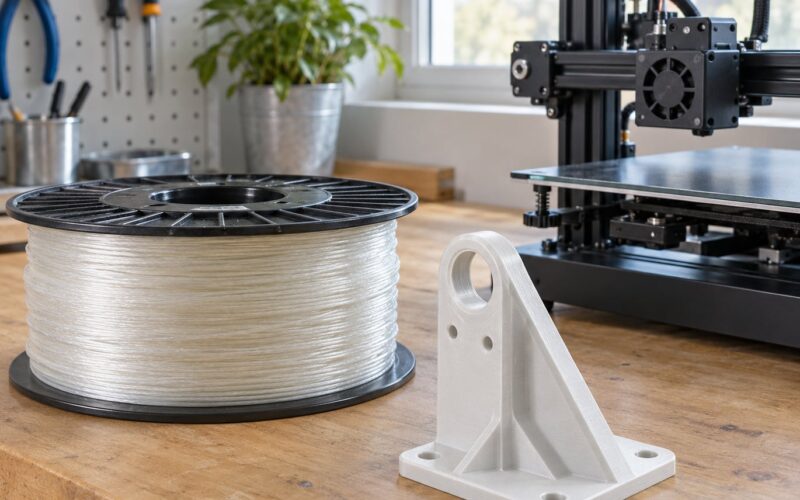
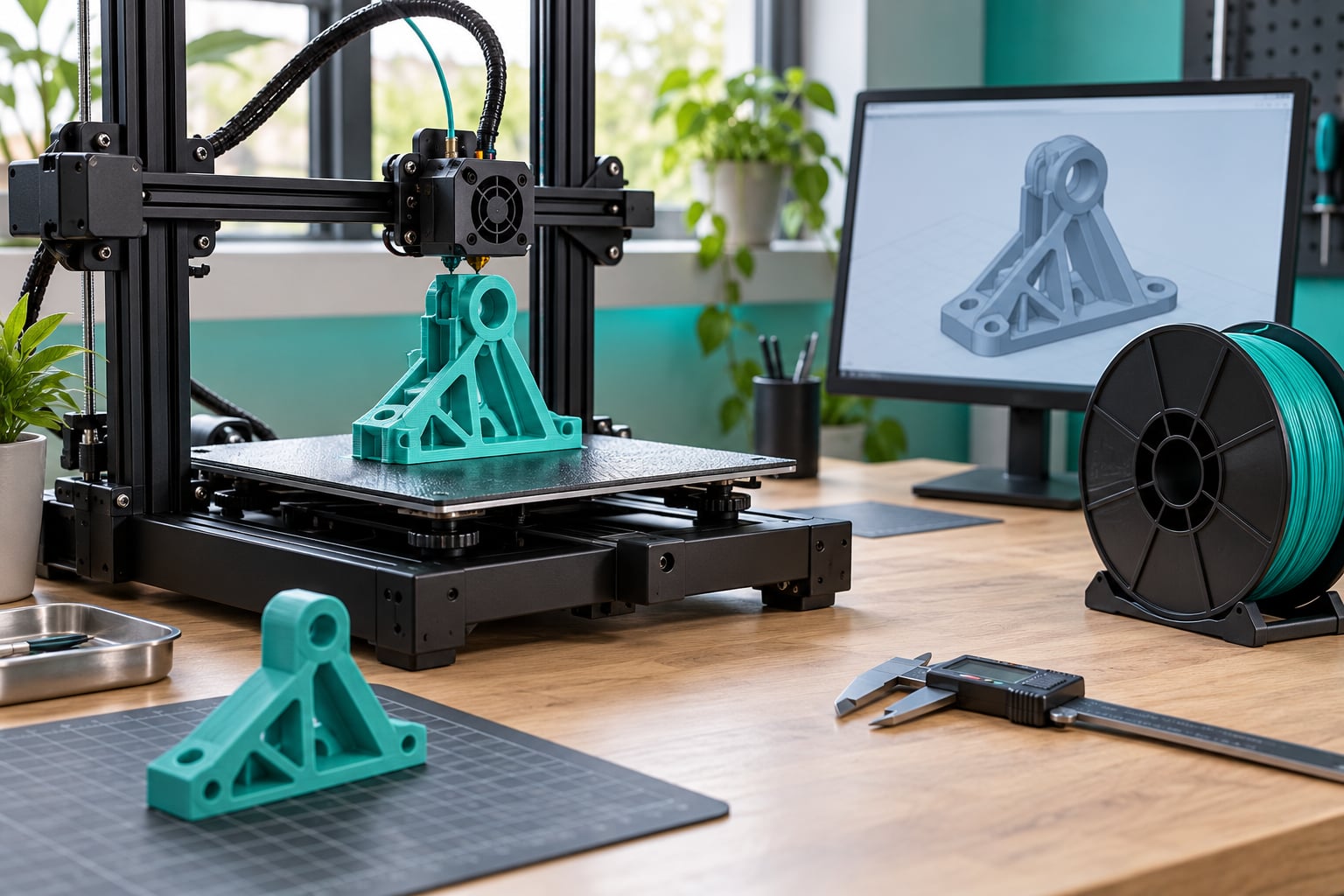
For design work, the four things employers look for are parametric CAD, design for additive manufacturing, model preparation, and the ability to read tolerances. A practical example: a company needed a custom machine bracket to hold a sensor at an angle. The designer modeled it in a few hours, added fillets at the internal corners that would otherwise need support, and printed it in prototype material the same afternoon instead of waiting a week for a machined fixture.
If you want a foothold without a full design background, learn one CAD package deeply and practice DfAM on parts you can hold in your hand. That combination reads better on a resume than three software names.
2. 3D Printing Setup and Build Knowledge
Setup is where a technician adds real value and where a lot of new hires are weak. It covers build preparation, orientation, support strategy, slicing profiles, machine calibration and safe operation.
Orientation alone can change build time and surface quality dramatically. A technician who learns to rotate a part away from an overhang, or to place it so supports fall off cleanly, saves material and reduces post-processing hours.
Employers also ask about maintenance basics: nozzle condition, belt tension, first layer adhesion, and how to tell a hardware fault from a file fault. A job description that lists “basic machine maintenance” usually means keeping a log, not rebuilding a motion system.
3. Additive Manufacturing Process Selection
Process selection is the skill that separates a technician from an engineer, and it is highly in demand. You are matching material, geometry, tolerances, batch size and lead time to one of several families: FDM and material extrusion, SLA and other photopolymer processes, SLS and other powder-bed approaches, SLM and DMLS for metals, and binder jetting for larger metal parts.
A decision-oriented example: a company wants 40 low-volume brackets with an internal channel that cannot be machined. SLS would fuse the channel walls and trap powder inside, so the right answer is a metal process or a design change. Being able to reason through that trade-off in a meeting is the job.
Cost-per-part reasoning comes with it. More capable machines cost more per hour and more per kilogram of material, so the right process is the cheapest one that meets the requirement, not the most advanced one available.
4. Materials and Material Science Knowledge
Material knowledge connects the properties on a datasheet to what you actually see on the build plate. Technicians and process engineers need working familiarity with thermoplastics, thermosets, resins, metals, composites, and the binders and supports used with them.
Knowing the mechanism behind a defect makes troubleshooting much faster. ABS and unfilled PETG shrink differently as they cool, which is why they warp on a large flat part. A fiber-reinforced filament prints flatter but is harder to machine. A brittle photopolymer prints beautifully and then snaps at a threaded hole.
Post-processing chemistry belongs here too, because it changes material properties. Annealing a metal part relieves residual stress; it does not change the design.
5. Additive Manufacturing and Computer-Aided Manufacturing
Additive is rarely the only process in a shop. Parts get printed, then faced, reamed, tapped or turned. CAM fluency and a working understanding of subtractive and forming processes help you design around what the mill can finish rather than trying to make the printer hit a tolerance it was never built for.
This is also the shortest route in for experienced machinists. Tooling, fixture and workpiece experience translates directly, because the mental model of material, tolerance and finish is already there. Several people in machining forums describe entering industrial 3D printing by pairing a trade background with AM-specific training rather than starting from zero.
A hybrid shop benefits from people who can quote a printed part against a machined part honestly, including post-processing time, not just machine time.
6. Post-Processing and Finishing Skills
Printed geometry is rarely the final geometry. Post-processing covers support removal, heat treatment, machining, blasting, polishing, curing, HIP and inspection handoff, and it takes real time in any production schedule.
A concrete metal example: a bracket printed in an aluminum alloy comes off the plate with support marks and residual stress. The technician stress-relieves it first, so the part does not move during the finishing operation, then removes supports, then finishes the mating faces. Skipping the stress relief is the shortcut that produces parts that pass inspection and fail in service.
Surface finishing also determines whether a part is fit for appearance or fit for function. For medical and consumer applications, bead blasting, vibratory finishing and hand polishing are separate learned skills, and they are frequently listed on their own job postings.
7. Quality Control and Inspection Skills
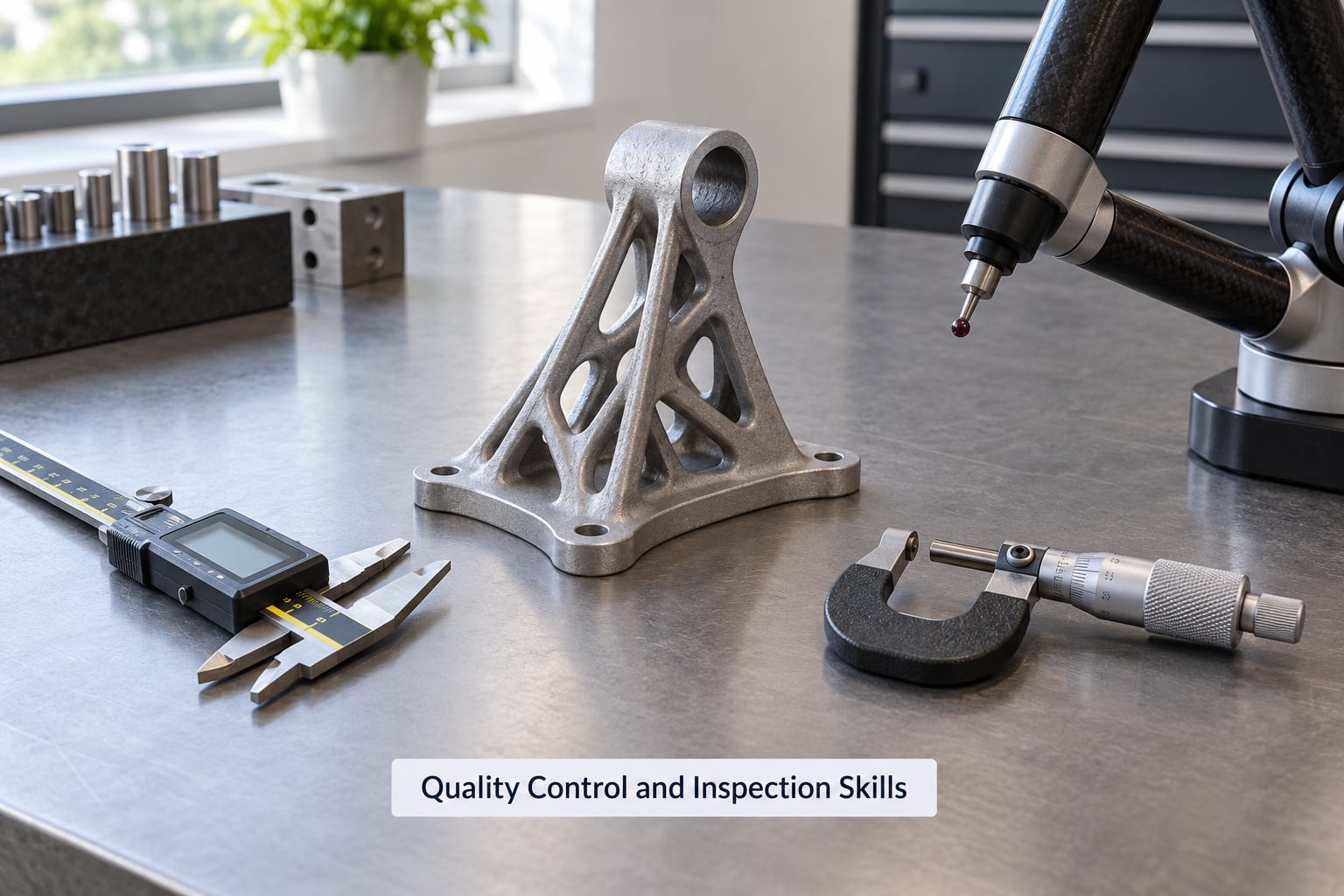
Quality control in AM means reading drawings, understanding toleranced dimensions and datums, and knowing what a printed part can realistically hold. Ask an experienced AM inspector what a nominal-plus process means and they will explain the whole inspection philosophy in one sentence.
Tool skills matter here: calipers, micrometers, thread gauges and depth gauges for shop-floor checks, and coordinate measuring machines, optical scanners or CT scanning for anything with internal channels or tight tolerances.
Digital manufacturing records are part of the job too. Traceability is not optional in aerospace or medical work, so familiarity with inspection plans, material certificates and non-conformance reporting is a genuine differentiator for a new technician.
8. Problem-Solving and Troubleshooting
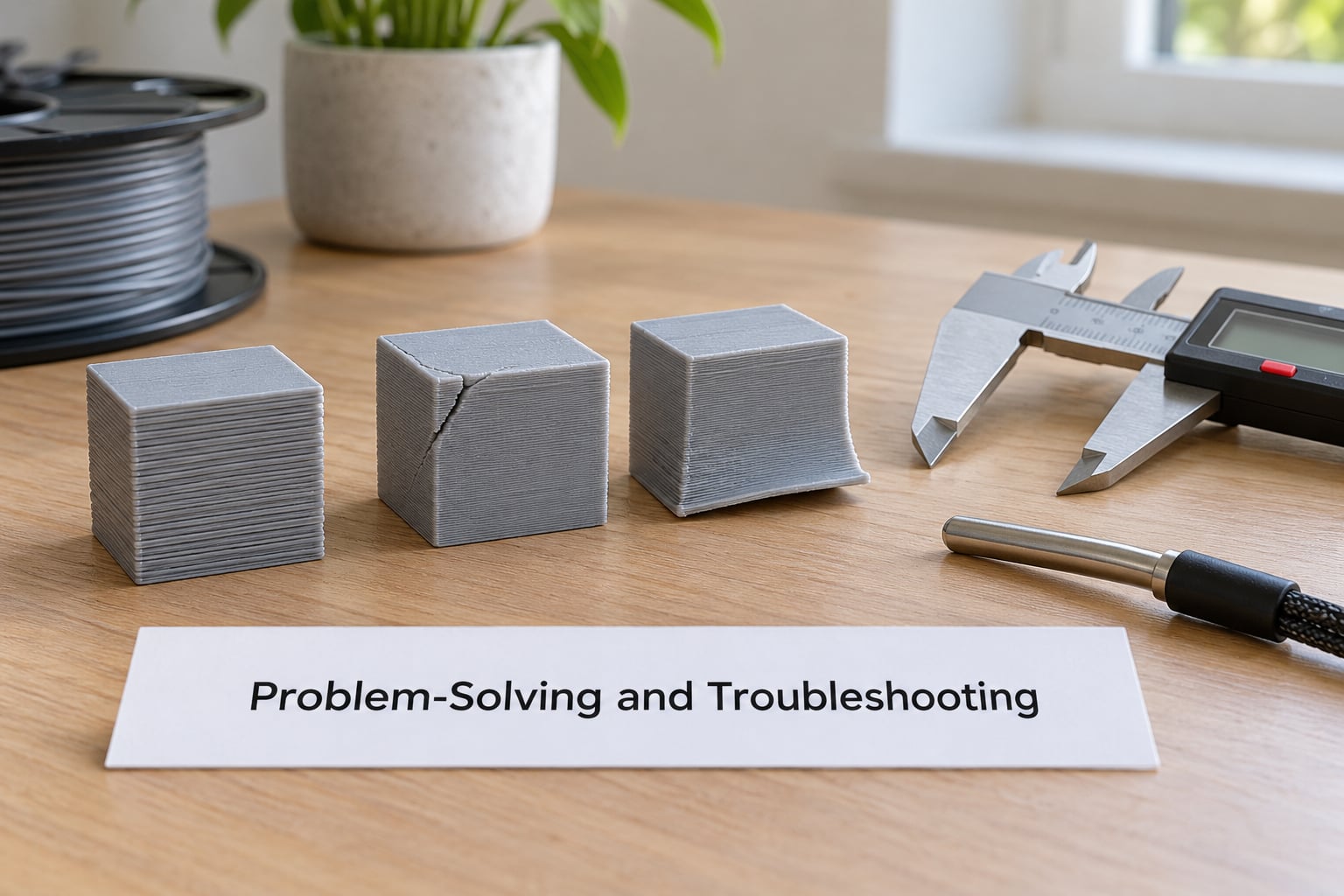
Troubleshooting is the skill interviewers probe hardest for, because defect names are easy to fake and diagnosis is not. Common problems include delamination between layers, warping from thermal contraction, cracking in clear materials, incomplete fusion or poor bonding in powder processes, porosity, and dimensions that drift across the build.
A disciplined approach beats guesswork: reproduce the issue on a small coupon, change one variable at a time, and record the result. Delamination on a plastic print usually traces to interlayer temperature, contaminated filament, or a dirty build plate, in that order of likelihood. Porosity in a metal part usually traces to powder handling, gas flow, or an uncalibrated energy density.
Written troubleshooting notes impress hiring managers more than a list of machines you have touched. It shows you think in causes, not symptoms.
9. Production Planning and Workflow Skills
Once a company moves from prototypes to repeatable output, the work changes. Production planning skills cover nesting, build layout, scheduling, changeovers, documentation, inventory coordination and production reporting.
Nesting is the practical skill people underestimate. Placing parts so they share a plate without creating a support conflict or a thermal island takes experience, and it directly sets cost-per-part. A production manager who can fill a plate with mixed geometry changes the numbers on a quote.
Documentation is the other half. Build sheets, parameter sets, maintenance logs and deviation records are what let a company print the same part a year from now. If you have never written one, that is a gap you can close this week on any machine.
10. Data and Digital Workflow Skills
Digital workflow skills sit between CAD and the machine: mesh repair, STL and 3MF preparation, slicer and build software, build history review, and machine monitoring. You do not need to be a programmer. You need to be the person who catches the bad file before it becomes a failed build and a missed delivery date.
Is AI taking over additive manufacturing jobs?
Automation is taking over repetitive monitoring and parameter optimization, not the judgment calls. Software already flags anomalies in a build and suggests parameter changes. What it does not do is decide whether a customer should be told the part is delayed, or whether a design change is worth the risk on a qualified aerospace program. Those remain human work, and the roles that grow are the ones where monitoring data meets that judgment.
Basic data literacy is the practical target: read a build log, compare two runs, and explain what changed. Most AM software tools also want a working spreadsheet habit, and for machine monitoring data, that is usually enough.
11. Safety and Regulatory Skills
Safety skills are concrete and non-negotiable. Resins and solvents, metal powders, shielding gases, high-temperature chambers, moving machine axes and abrasive cleaning all carry real hazards. Operators need to know filtration and ventilation requirements, powder handling procedures, PPE selection and what an emergency spill or exposure response looks like.
Which certifications actually help?
The credential that helps most depends on the level you are targeting. For technician and operator roles, vendor training on the specific machine family you will run, plus a safety or material-handling certificate, is usually more persuasive than a general credential. For design and process roles, an additive manufacturing fundamentals certificate from a recognized industry body carries weight because it signals you know the process chain, not one machine. For R&D and qualification work, employers usually check relevant degrees, publications and prior certification testing experience directly. No single certificate replaces shop time, but the right one shortens the interview.
Regulatory awareness is part of this too. Depending on the sector, quality management systems, material classifications and workplace standards apply, and roles that touch qualification or production records are expected to document their work.
12. Communication and Cross-Disciplinary Collaboration
Additive manufacturing is an interdisciplinary field, so the ability to work across disciplines is not a bonus skill. Operators and technicians translate feedback between designers, engineers, quality teams, customers and supervisors, often in both directions.
A realistic example: a customer sends a housing that has a 12 degree overhang over a critical sealing face. The technician flags that it will need supports that mark the sealing surface, and suggests splitting the part or reorienting it. The designer updates the model, the customer approves the change, and nobody discovers the problem during final inspection.
In job postings this shows up as teamwork, written communication, adaptability and self-directed learning. The people moving into senior AM positions are rarely the ones who only know how to run a machine. They are the ones who can explain why the machine is doing what it is doing to someone who was not in the room.
Frequently Asked Questions
What skills are most important for additive manufacturing jobs?
The most important skills are CAD and design-for-additive-manufacturing ability, knowledge of materials and print parameters, hands-on build setup and troubleshooting, post-processing and quality control, and clear communication. Entry-level postings usually weight machine setup and safe operation most heavily, while engineer roles weight design, process selection and data skills. Soft skills such as written problem-solving and cross-team communication separate candidates at the interview stage.
Do I need a degree to work in 3D printing?
Not for most technician and operator roles, which often ask for an associate degree, a certificate or equivalent shop experience. Design engineer, process engineer and Ru0026amp;D postings are more likely to ask for a bachelor’s, and some research-heavy roles prefer a master’s or PhD. Job seekers in AM forums report that advanced degrees are common in listings aimed at engineers but not required for the technician path, so target the role you want rather than the industry name.
Which software should I learn for additive manufacturing?
Start with one parametric CAD package, such as SolidWorks, Fusion 360 or Inventor, and learn it well enough to model print-friendly geometry. Next learn mesh handling and file formats like STL and 3MF, then the slicer or build software for the process you will actually use. Build history review and basic machine monitoring tools come next. Employers care more about depth in one stack than a long list of software names.
Can I get an additive manufacturing job without experience?
Yes, most often at the technician or operator level, and it is the clearest transition path into the field. A background in machining, welding, tooling, CAD drafting, quality or materials transfers better than most people expect. Build a small portfolio, learn one machine properly, document two or three prints you debugged yourself, and target companies that run training for new hires. Engineer and Ru0026amp;D roles are much harder to enter without a degree and project history.
What certifications or credentials help with 3D printing careers?
For technician roles, vendor training on the machine family you will operate plus a safety or material handling certificate is the most direct route. For design and process roles, an additive manufacturing fundamentals certificate from an industry body shows you understand the full process chain. Vendor academies and industry association programs both carry weight, and neither replaces shop time. Pick the credential that matches the job level you are applying for rather than collecting certificates.
How can I build a portfolio for an additive manufacturing role?
Pick one project and follow it end to end: design a part for printability, print it, measure it against your drawing, hit one defect, fix it and write up what changed. Post the CAD file, the final part, a few photos and a short troubleshooting note. A hiring manager reads a clear process write-up faster than a long gallery, and the write-up is what proves you can diagnose problems rather than just operate a machine.
Conclusion
Pick a job family first, because the twelve skills above are weighted very differently depending on whether you want to operate machines, design parts, own the process or run production. Then identify the two you are weakest at and work on those directly, rather than collecting credentials.
One small finished project does more for your application than a list of software names. Design something, print it, measure it, break it once, fix it and write down what you changed. That single write-up demonstrates design, setup, inspection and troubleshooting at once, which is exactly the combination these postings are looking for.